2.7 - Binomial expansion with Pascal's triangle
Use Pascal's triangle to expand a positive integer power of a two-term expression. You will also work out a single coefficient without expanding everything, then use coefficients to form equations involving an unknown constant.
Where Pascal's triangle comes from
Can you work out the coefficient of in without writing the whole expansion? Five brackets would create a lot of working. By the end, you will pick out just the one term you need.
You already know
Expanding means multiplying every term in one bracket by every term in the other and collecting like terms. A power counts repeated factors: means .
Start with . The coefficient appears because you can choose the from the first bracket or from the second. For , there are three ways to choose exactly one , three ways to choose exactly two, and one way to choose all three. This gives .
Binomial and coefficient
A binomial is an expression with two terms, such as . A coefficient is the multiplier of a specified power: in , the coefficient of is , not . The coefficient can be negative, zero or contain another letter.
The coefficients of , written from the constant term upwards, form Pascal's triangle. Start with , put at both ends of each new row, and add the two entries immediately above to get an interior entry.
[DIAGRAM: asset_name: Pascal's triangle through power five; asset_slug: l2fm-pascal-triangle; caption: Each interior entry is the sum of the two above it; the row for power five has six entries; description: Pascal's triangle with rows labelled power 0 through power 5. The rows are 1; 1 1; 1 2 1; 1 3 3 1; 1 4 6 4 1; and 1 5 10 10 5 1. The two middle 3 entries in the power 3 row have arrows to the 6 below them in the power 4 row, showing 3 plus 3 equals 6. The power 5 row is lightly highlighted]
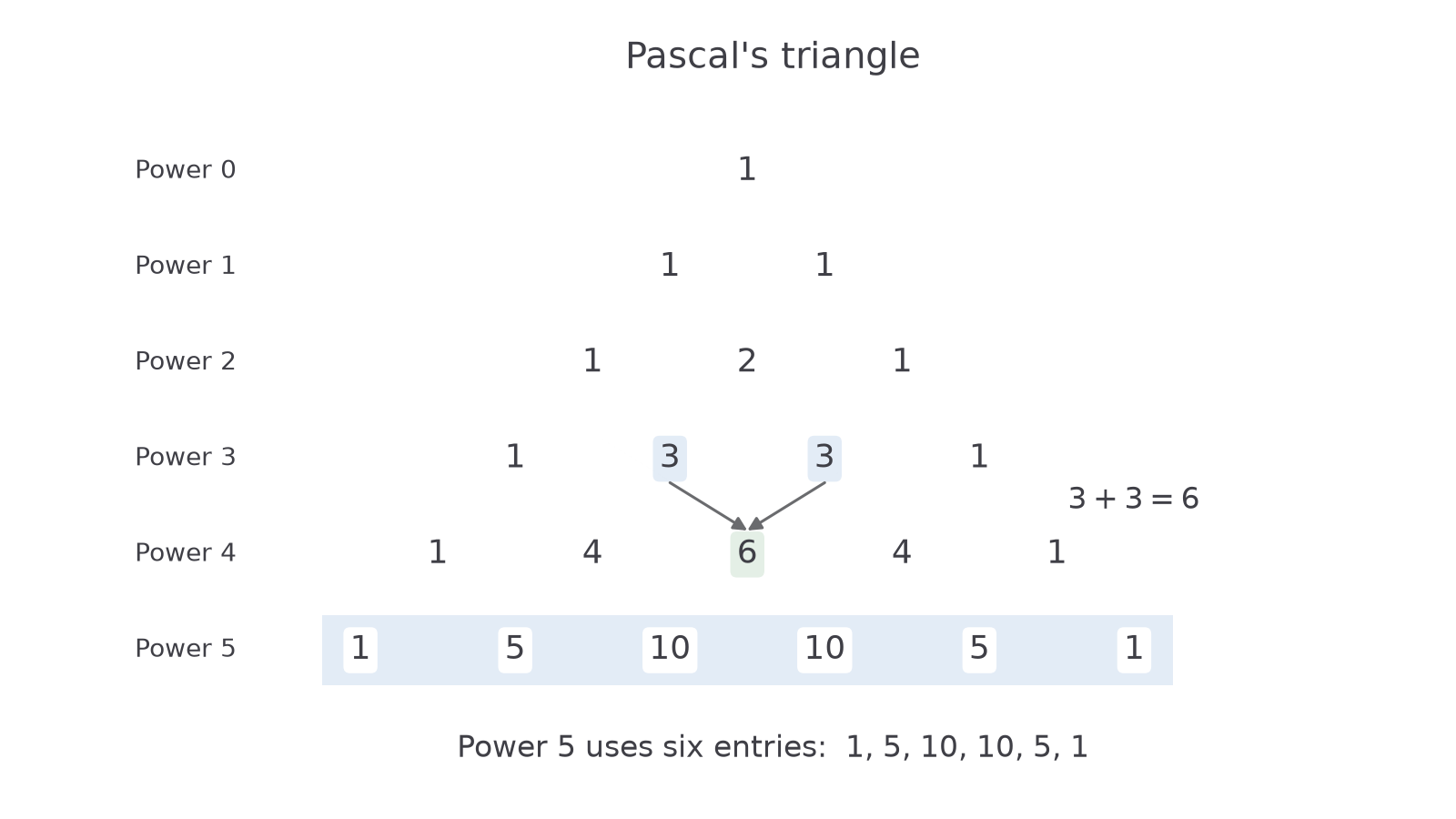
Why does adding work? On multiplying an expansion by one more , a new term comes either from the old term times , or from the old term times . Those are two separate contributions, so their coefficients add.
Reading Pascal's triangle
For a positive integer power , use the row with entries, starting with the single as row . Its entries are the coefficients in
Every interior entry is the sum of the two entries immediately above it. Pascal's triangle is not supplied in the exam.
Not on the formulae sheet: learn it.
There is a useful surprise hiding in each row: its entries add to . For row , . Setting in explains it, or you can count the two choices from each of the brackets.
Key idea
Pascal's numbers count how many ways a term can be formed. The power uses coefficients, including both end entries.
Use that meaning to distinguish a coefficient from the number of all possible choices.
Expanding a complete binomial power
Pascal's numbers supply the counts, but you must also include the powers of the two actual terms in your bracket.
For a cube, the powers of the first term go down from to , while those of the second go up from to . Each product therefore uses exactly three factors. This prevents the common mistake of using Pascal's numbers without the powers they multiply.
Binomial expansion for positive integer powers
For real numbers , and a positive integer power, combine the appropriate Pascal row with descending powers of and ascending powers of . For example,
For a subtraction, include the negative sign as part of the second term. This finite expansion is for positive integer powers; it is not a rule for expanding a square root or a negative power.
Not on the formulae sheet: learn it.
Write a line with all the powers first. Evaluating the numerical coefficients is a separate, shorter job.
Worked example 1: a scaled constant
Question. Expand and simplify .
Plan. Use , pairing descending powers of with ascending powers of .
Why this step? The term uses two factors and one , so its coefficient is , not .
Answer. .
Check. At , both forms give : .
Worked example 2 changes only the plus sign to a minus sign. Even powers of are positive; odd powers are negative.
Worked example 2: alternating signs
Question. Expand and simplify .
Plan. Use the same row, treating the second term as throughout.
Why this step? The sign belongs inside the power: , whereas .
Answer. .
Check. At , the original is , and .
With , the signs alternate, but the magnitude is raised to a power too. Keep every copy of the multiplier when its square or fourth power is needed.
Watch out
Wrong: . All three factors are , so . Likewise, .
The next cube keeps a negative second term and introduces a multiplier on . Include that multiplier in every relevant power.
Selecting one coefficient
If the question asks for just one coefficient, select the one Pascal entry and the powers that can produce the requested term.
For an term, choose the -containing part from exactly two brackets. From the other brackets, choose the constant. In a fifth power, that leaves three constant factors. Count positions from zero: the first Pascal entry belongs to , the second to , and so on.
A single term in a binomial expansion
For nonzero real and , positive integer , and integer with , the term containing in is
Here is entry of Pascal row . The coefficient is . If or is zero, simplify the bracket as a single term instead.
Not on the formulae sheet: learn it.
The formula organises the choices; there is no need to memorise a separate expansion for each power.
Worked example 3: one term from a fifth power
Question. Work out the coefficient of in .
Plan. Use the third entry of row , then take two factors and three factors.
Why this step? Choosing two factors uses two of the five brackets, so exactly three contribute a .
Answer. The coefficient is .
Check. Choosing the two positions gives choices. Each contributes , so the total coefficient is .
Change only to . The requested power remains even, so the coefficient stays positive.
Worked example 4: a negative term raised to an even power
Question. Work out the coefficient of in .
Plan. Select the same Pascal entry, retaining the sign inside .
Why this step? There are two negative factors, so their signs cancel. A negative sign in the bracket does not make every coefficient negative.
Answer. The coefficient is .
Check. Replacing by in Worked example 3 changes only the odd-powered terms. Its coefficient therefore remains .
We can now answer the opening question by changing the requested power from to . The fourth entry is , two constants remain, and the cube of is negative:
Thus the required coefficient is . You have avoided calculating five other terms.
Exam tip
Write the selected term, including all multipliers and powers, before evaluating it. If the question asks for the coefficient of , give the multiplier alone; do not leave in the final answer.
Change the constant and the multiplier of , keeping an odd requested power. Check the sign before doing the arithmetic.
Forming equations from coefficients
A coefficient may contain an unknown constant, so equating coefficients gives an equation to solve.
Use only the requested terms. The two expansions need not be equal: a question may state that just one pair of their coefficients matches. For example, equal coefficients do not imply equal constant terms.
Worked example 5: a linear equation in the constant
Question. The expansions of and have the same coefficient of . Work out .
Plan. Select the term in each expansion and equate their coefficients.
Why this step? A coefficient is the multiplier of . The equation is , so there is no left to solve for.
Answer. .
Check. The first coefficient becomes , matching the second.
Worked example 6 changes only the power being compared, from to . The first coefficient now contains , so both signs of may work.
Worked example 6: two possible constants
Question. The expansions of and have the same coefficient of . Work out the possible values of .
Plan. Select the terms, equate coefficients and solve the resulting square equation.
Why this step? Squaring erases the sign: both and have square . The word “possible” asks you to retain both.
Answer. .
Check. For either value, , as required.
The same approach works when a question relates two coefficients within one expansion: work out each coefficient first, then translate the stated relationship. Respect any condition on the constant. For example, if , then gives , so . Dividing by is justified by the nonzero condition. Without that condition, would also satisfy the original equation.
Watch out
Wrong: equate to . Either equate the complete terms, and , or, more simply, equate their coefficients: . Do not put on just one side.
Keep the same requested power with new numerical multipliers. There are again two possible values, so check both signs.
Quick Recap
- Power uses Pascal row , with entries. The entries add to .
- Combine the row with descending powers of the first term and ascending powers of the second.
- Keep a negative sign and any numerical multiplier inside the power.
- For one coefficient, calculate just its term. For an unknown constant, equate coefficients and retain every allowed solution.
The opening coefficient is , without expanding in full.