2.2, 2.3 - Functions, domain and range
Use function notation to connect an input to its output, then describe exactly which inputs and outputs are possible. In 2.2 you will interpret and use a function rule; in 2.3 you will work out domains and ranges, including quadratics whose smallest output occurs inside an interval.
Function rules, inputs and outputs
A function gives an output of at the left end of an interval and at the right end. Could its output still be somewhere between them? Keep that question in mind: the answer will explain why checking just two inputs can be misleading.
Start with a familiar rule: square a number, double it, then subtract . Input gives ; input also gives . Each input still gives one definite output. Sharing an output is allowed.
Function
A function assigns exactly one output to each input in its domain. The notation , read “f of x”, means the output of the function when the input is . For example, is a function. A rule saying “choose either square root of the input” is not a function on positive inputs: input would have two outputs, and .
The brackets tell you what to put into the rule. Thus asks for an output, while gives an output and asks which input produced it. Neither notation means multiplication by a letter called .
You already know
Substitute into every occurrence of a variable, using brackets around negative values. Solving an equation reverses that task: work out the unknown value that makes the equation true. In particular, has both solutions and .
Here is the distinction in a pair of questions about the same rule. The rule itself is supplied in the question; function notation is not supplied on the formulae sheet.
Worked example 1: an input is given
Question. The function is given by . Work out .
Plan. Replace by the complete input , then follow the order of operations.
Why this step? The square applies to the whole input. Without brackets, means , which is a different calculation.
Answer. .
Check. Input has the same square as , so it must give the same output, .
Worked example 2 changes only the direction of the question: the output is given and the input is unknown. This time there may be more than one answer.
Worked example 2: an output is given
Question. The function is given by . Work out the values of when .
Plan. Equate the rule to the supplied output, then solve the resulting equation.
Why this step? The is an output, so set the whole rule equal to . Substituting would answer a different question.
Answer. or .
Check. and , so both inputs work.
Two inputs giving the same output do not break the definition of a function. Two outputs for one input would. That distinction will matter when you reverse a function in the next lesson.
Watch out
Wrong: “, so calculate .” Right: solve the equation . The given output is ; the input is what you need to find.
Try the reverse direction again, with the coefficients changed.
The domain and forbidden inputs
The domain tells you which inputs a function is allowed to use, so it belongs to the function alongside its rule.
Domain
The domain of a function is the set of allowed input values. For example, allows every real input greater than , including and , but excludes . “For all , except ” allows every real input apart from zero.
A question may choose a domain, such as , even when the rule could accept more inputs. Use that stated domain. If you are asked for all real inputs for which a rule is defined, look for operations that fail.
Division by zero is undefined. A real square root cannot have a negative number inside it, and means the non-negative square root of . If the square root is also a denominator, zero must be excluded too.
Restrictions on real inputs
For real-valued functions,
Any domain stated in the question must also be respected.
Not on the formulae sheet: learn it.
The last condition combines the first two: the quantity under the root may be neither negative nor zero.
Worked example 3: a zero denominator
Question. The function is given by . Write down its domain for real inputs.
Plan. Work out which input makes the denominator zero, then exclude it.
Why this step? Negative denominators are allowed; only a zero denominator prevents this calculation.
Answer. The domain is all real , except .
Check. and both exist, while would require division by zero.
Worked example 4 changes only the denominator: it is now the square root of the previous denominator. This excludes a whole side of the number line, not just one point.
Worked example 4: a root in the denominator
Question. The function is given by . Write down its domain for real inputs.
Plan. Require the quantity inside the root to be positive, because its root is a denominator.
Why this step? The boundary input gives . The square root exists there, but dividing by it does not.
Answer. The domain is .
Check. Input gives ; input would require ; input would give a zero denominator. Only the first is allowed for this real-valued rule.
Keep restrictions from the original rule when simplifying. For instance, only for : cancelling a factor does not make the original missing input reappear.
Watch out
Wrong: the domain of is . Right: , because equality makes the denominator zero. For the rule on its own, equality would be allowed.
Move the boundary and apply the same two restrictions yourself.
The range and interval endpoints
The range records every output the function actually reaches from its allowed inputs.
Range
The range of a function is the set of possible output values from its domain. For example, on all real inputs has range : zero is reached, but negative outputs are not. This is different from the statistical range, which is one number obtained by subtracting the smallest value from the largest.
Write a domain using , and a range using , or the relevant output name. Think of a graph: the domain runs along the horizontal axis, while the range runs up the vertical axis.
If a rule increases throughout an interval, the smallest input gives the smallest output. If it decreases throughout, the smallest input gives the largest output. Endpoint calculations work in these cases because the rule keeps moving in the same direction and takes every value between the endpoint outputs.
Worked example 5: an increasing rule
Question. The function is given by , with domain . Work out the range, giving your answer as an inequality.
Plan. Evaluate the endpoint outputs and keep track of which endpoints are included.
Why this step? A positive coefficient of makes outputs increase with inputs, so the endpoint order stays the same.
Answer. .
Check. Input is allowed and gives , inside the proposed range. Output would need the excluded input , while output comes from the included input .
Worked example 6 changes only the sign of the coefficient of . The rule now decreases, so the endpoints exchange their roles.
Worked example 6: a decreasing rule
Question. The function is given by , with domain . Work out the range, giving your answer as an inequality.
Plan. Evaluate both endpoint outputs, then write them in increasing order with their correct inclusion signs.
Why this step? The excluded input now gives the upper boundary. Inclusion belongs to the endpoint that produced an output, not automatically to the left or right of the final inequality.
Answer. .
Check. Input gives , which lies in this interval. Output occurs at ; output would require the excluded input .
The same endpoint reasoning works for a cubic such as , which increases throughout: domain gives range . But it does not work automatically for a quadratic that turns inside the domain. We will check that next.
Watch out
Wrong: write as the range of . Those are output values, so write . A list of integers also misses the real values between them.
Try the decreasing rule with a new interval, including its left endpoint instead of its right endpoint.
Quadratic ranges and the turning point
A quadratic can turn between its endpoint inputs, so check its turning point as well as the interval boundaries.
You already know
Completing the square writes a quadratic as . Since a square is non-negative, its turning point is . If , this is a minimum; if , it is a maximum.
For , the smallest possible output is , reached at . That input only matters if the domain allows it. The same rule can therefore have different ranges when the domain changes.
[DIAGRAM: asset_name: A quadratic with and without its turning point; asset_slug: l2fm-quadratic-domain-range; caption: The domain determines whether the minimum output is reached; description: Two coordinate graphs of f(x) equals (x minus 2) squared minus 3. The left graph highlights domain minus 1 to 4 inclusive, with endpoint points (minus 1, 6) and (4, 1) and the minimum (2, minus 3). Its range is minus 3 to 6 inclusive. The right graph highlights only domain 3 to 4 inclusive, from (3, minus 2) to (4, 1); the turning point is shown faintly outside the chosen domain. Its range is minus 2 to 1 inclusive. Blue marks allowed parts of the curve and sage marks the output intervals.]
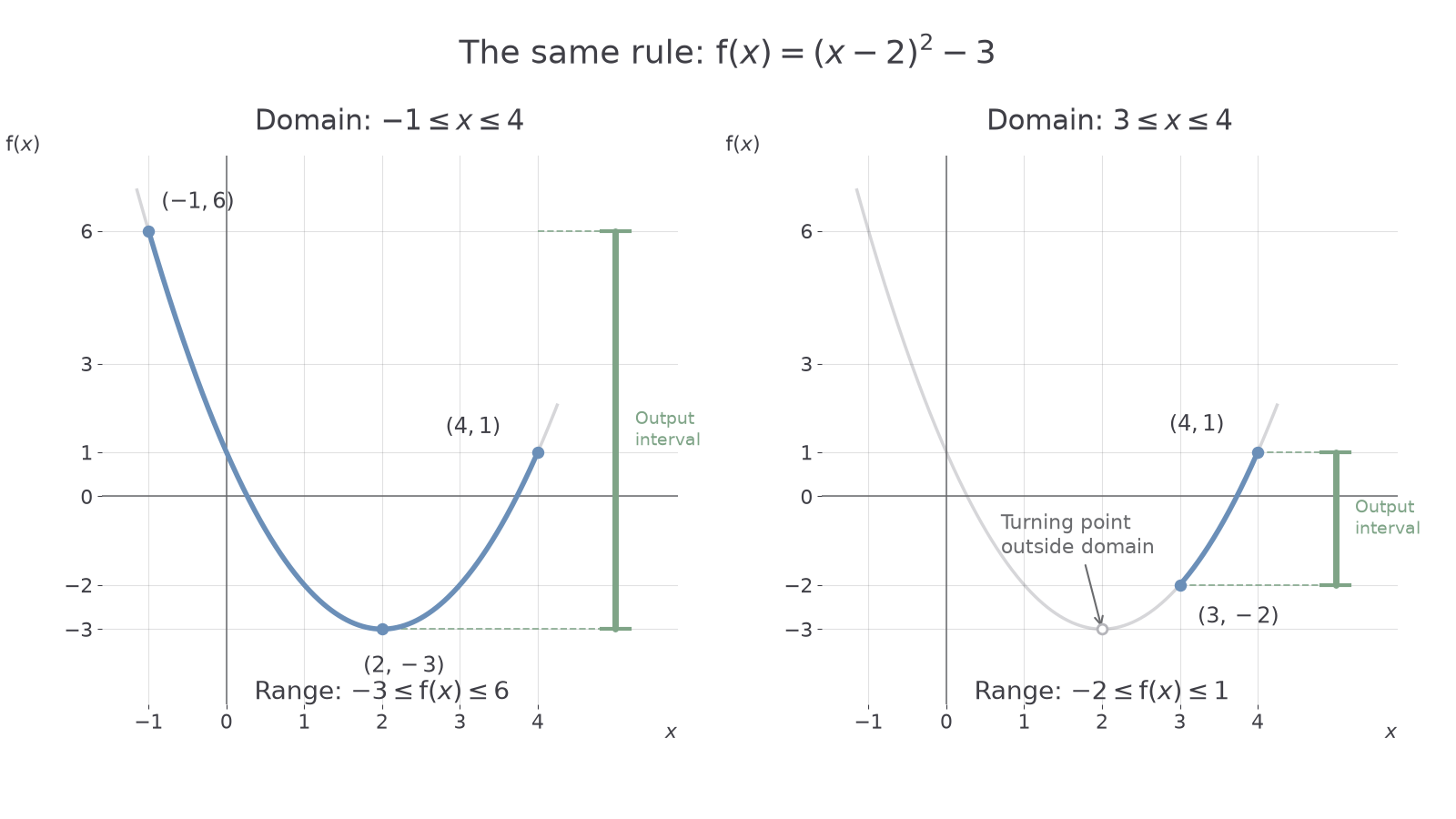
The squared distance is smallest at the allowed input nearest , and largest at the allowed input furthest from . This gives you a way to compare the necessary candidates without plotting a detailed graph.
Range of a completed-square quadratic
For a quadratic in the form
check the boundary outputs and check the turning-point output if is allowed. The sign of determines whether the turning point is a minimum or a maximum. Include an extreme output only if an allowed input actually reaches it.
Not on the formulae sheet: learn it.
Now use the rule from the opening question. Both endpoints are allowed, but the lowest point lies between them.
Worked example 7: a minimum inside the domain
Question. The function is given by , with domain . Work out the range.
Plan. Complete the square, then compare the turning-point output with both endpoint outputs.
Why this step? The endpoint values and miss the minimum . The square reaches zero at an input inside the domain.
Answer. .
Check. On this domain, the distance from runs from up to , so . Subtracting gives precisely the proposed range.
Worked example 8 changes only the domain. It now lies entirely to the right of the turning point, so that minimum output is unavailable.
Worked example 8: the turning point is excluded
Question. The function is given by , with domain . Work out the range.
Plan. Use the same completed-square form, but check whether its turning point is still allowed.
Why this step? Completing the square locates a potential extreme; the domain decides whether it can be used. The graph increases throughout the chosen interval.
Answer. .
Check. Here , so . Subtracting gives .
For a downward-opening quadratic the roles reverse: on all real inputs has a maximum of , so its range is . There is no smallest output because the subtracted square can grow without bound.
Two different rules can even share both a domain and a range. On , the rules and both produce exactly the outputs from to , yet at they give and . The domain and range tell you where a function starts and finishes; they do not tell you its whole rule.
Watch out
Wrong: use only the endpoint values to claim in Worked example 7. Right: include the interior minimum to obtain . A quadratic's turning point can give an output beyond both endpoint values.
The opening question is settled: the function can give between endpoint outputs and , because it turns. For your final check, use a new quadratic whose domain lies on just one side of its turn.
Quick Recap
- A function gives exactly one output for each allowed input; several inputs may share an output.
- The domain contains inputs. The range contains outputs, and should use the function's output notation.
- Exclude zero denominators and negative quantities inside real square roots; a root in a denominator also excludes zero.
- Endpoint calculations give the range when a continuous rule moves in one direction throughout the domain. For a quadratic, also check any allowed turning point.
The opening function reaches at , between its endpoint outputs of and . Its range is , because the domain includes the turning point.