2.1.4(e) - Coenzymes and cofactors
Some enzyme-controlled reactions need a non-protein helper before the enzyme can work at its normal rate. In this lesson you will learn the course distinction between cofactors and coenzymes, why chloride ions matter for amylase, and how vitamins can provide sources of coenzymes. The practical thread is PAG4-style rate evidence: comparing enzyme activity while keeping other variables controlled.
Enzymes Need Helpers
An enzyme's active site is shaped by the enzyme's tertiary structure, but the protein part of an enzyme is not always enough on its own. Some enzyme-controlled reactions need a small non-protein helper molecule or ion. Without that helper, the enzyme may form fewer enzyme-substrate complexes, catalyse the reaction more slowly, or not catalyse the reaction effectively.
This row uses two important terms.
Cofactor
A cofactor is a non-protein inorganic ion needed by some enzymes for normal enzyme-controlled reaction activity.
Coenzyme
A coenzyme is a non-protein organic helper molecule needed by some enzymes for normal enzyme-controlled reaction activity.
Different biochemistry sources sometimes use "cofactor" as a broad umbrella term that includes coenzymes. For this lesson, keep the exam distinction simple and useful: cofactors are inorganic ion helpers, and coenzymes are organic helper molecules. In both cases, the key idea is need. The helper is not the enzyme, not the substrate and not the product, but it helps the enzyme-controlled reaction happen properly.
Do not overgeneralise. The wording is "some" enzyme-controlled reactions need these helpers. Many enzyme questions will not involve cofactors or coenzymes at all.
Chloride And Amylase
The required example of a cofactor is the chloride ion, Cl-, for amylase.
Amylase is an enzyme that catalyses the breakdown of starch into smaller sugars. Starch is the substrate. The chloride ion is not another substrate; it is a helper ion that supports amylase activity. If a question asks for the cofactor for amylase, the precise answer is chloride ion or Cl-.
Write "chloride ion" or Cl-, not "chlorine". Chlorine is an element; chloride is the ion required in this example.
The need can be expressed as a cause-and-effect chain:
- Amylase is an enzyme that catalyses starch breakdown.
- Chloride ions act as cofactors for amylase.
- With the required cofactor present, amylase can catalyse the reaction at its normal rate.
- If the cofactor is absent or limiting, amylase activity may be lower.
This lesson does not require the detailed three-dimensional structure of amylase. It is enough to know that Cl- helps the enzyme's function, so chloride ion concentration can affect the rate measured in an amylase reaction.
Vitamins And Coenzymes
Coenzymes are organic helper molecules. You need to know that vitamins can be a source of coenzymes.
Vitamin
A vitamin is an organic molecule needed in small amounts in the diet because the organism cannot make enough of it for normal function.
Some vitamins are used directly as coenzymes, while others are used to make coenzymes. Either way, the biological point is the same: a shortage of the vitamin can limit the supply of the coenzyme, and that can reduce the activity of enzyme-controlled reactions that depend on it.
This row does not require you to memorise named coenzymes such as NAD, FAD or coenzyme A. Those names become important later in respiration. Here, the required statement is more general: vitamins can provide a source of coenzymes needed by some enzyme-controlled reactions.
Using The Word Source Precisely
Weak answer: "Vitamins are enzymes."
Better answer: "Vitamins can be a source of coenzymes, which are organic helper molecules needed by some enzymes."
The better answer is creditworthy because it keeps the categories separate: enzyme, coenzyme and vitamin are not the same thing.
Comparison Map
The comparison is small, but it prevents several common exam mistakes.
[DIAGRAM: cofactor_coenzyme_comparison_map: Lesson 39: Coenzymes and cofactors - diagram 01; asset_slug: 039_m02_1_4_coenzymes_and_cofactors__diagram_01; recommended_method: drawn_biology; description: deterministic 16:9 comparison map distinguishing inorganic cofactors from organic coenzymes, using chloride ion for amylase and vitamins as coenzyme sources, with a PAG4 rate-evidence reminder.]
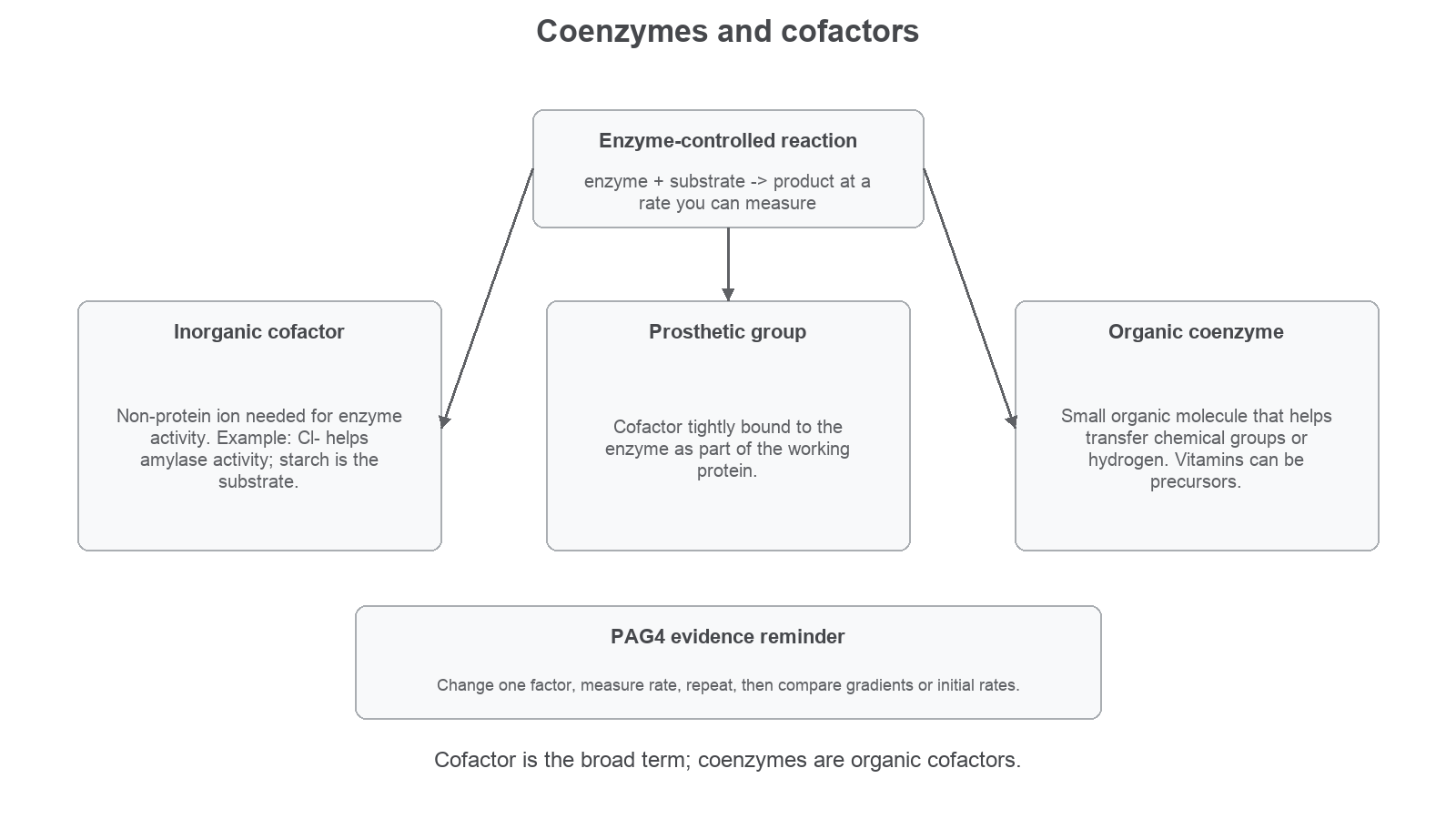
| Feature | Cofactor | Coenzyme |
|---|---|---|
| Meaning in this lesson | Inorganic ion helper | Organic helper molecule |
| Required example or source | Chloride ion, Cl-, for amylase | Vitamins as a source of coenzymes |
| What it is not | Not the substrate starch | Not the enzyme itself |
| Why it matters | Needed by amylase for normal activity | Needed by some enzymes for normal activity |
Use precise category language. A substrate binds to an active site and is converted into product. A cofactor or coenzyme helps the enzyme-controlled reaction, but is not simply the substrate being broken down. A vitamin is a source of a coenzyme, not automatically the enzyme itself.
Cofactor: inorganic ion helper, such as Cl- for amylase. Coenzyme: organic helper molecule, with vitamins as sources.
PAG4 Rate Evidence
PAG4 is about rates of enzyme-controlled reactions. For this row, the practical idea is not a whole new method; it is how rate evidence can show that a helper is needed.
In an amylase investigation, starch can be tested with iodine. If starch is still present, iodine turns blue-black. When starch has been broken down, the iodine remains orange-brown. A simple endpoint rate can be estimated using:
Endpoint Rate
Interpreting Cofactor Evidence
A student compares amylase activity in two tubes.
Tube A contains starch, amylase, buffer and a chloride-ion source. Starch disappears after 40 s.
Tube B contains starch, amylase and the same buffer, but no added chloride-ion source. Starch disappears after 100 s.
For Tube A:
For Tube B:
Tube A has the higher rate. If pH, temperature, enzyme concentration, starch concentration and total volume were controlled, this supports the conclusion that chloride ions help amylase activity.
The control wording is important. A faster reaction with chloride ions only supports the cofactor conclusion if other factors that affect amylase rate are kept the same. Otherwise, a temperature or pH difference could explain the rate change.
PAG4 Rate Evidence Continued
This is the limit of the practical treatment for this lesson. Full effects of pH, temperature, enzyme concentration and substrate concentration belong to the neighbouring enzyme-rate lesson; inhibitors belong to the next enzyme lesson.
For this row, the core answer is need: some enzyme-controlled reactions require helper molecules or ions, including chloride ions for amylase and vitamin-derived coenzymes for some enzymes.