2.1.3(c) - ADP and ATP as phosphorylated nucleotides
In this lesson you are learning the structure of ADP and ATP as OCR expects it: both are phosphorylated nucleotides made from adenine, ribose and inorganic phosphate groups. The focus is deliberately narrow. Later lessons use ATP in respiration, photosynthesis, active transport and muscle contraction, but this lesson is about recognising and describing the molecule accurately.
Phosphorylated Nucleotides
A nucleotide is built from three kinds of component: a nitrogenous base, a pentose sugar and at least one phosphate group. ADP and ATP are nucleotides because they have all three. They are described as phosphorylated because phosphate groups are part of their structure.
Phosphorylated nucleotide
A nucleotide that contains a nitrogenous base, a pentose sugar and phosphate group or groups.
For this OCR row, the required components are very specific:
| Molecule | Nitrogenous base | Pentose sugar | Inorganic phosphate groups |
|---|---|---|---|
| ADP | Adenine | Ribose | 2 |
| ATP | Adenine | Ribose | 3 |
The letter A in ADP and ATP stands for adenosine, but the base inside adenosine is adenine. This distinction matters in exam answers. If a question asks for the nitrogenous base, the answer is adenine, not adenosine.
Use the exact component words: adenine, ribose and inorganic phosphate. Those three words are the core of this OCR learning outcome.
The first check is deliberately direct: it tests whether the component words are secure before you compare ADP with ATP.
Adenine And Ribose Core
ADP and ATP share the same core: adenine joined to ribose. Adenine is the nitrogenous base. Ribose is a pentose sugar, meaning it is a five-carbon sugar.
Adenosine
Adenosine is adenine joined to ribose. It is not the same as adenine alone.
The names become easier to decode once this is clear:
| Name part | Meaning |
|---|---|
| Adenosine | Adenine plus ribose |
| Diphosphate | Two phosphate groups |
| Triphosphate | Three phosphate groups |
So ADP is adenosine diphosphate: adenine + ribose + two phosphate groups. ATP is adenosine triphosphate: adenine + ribose + three phosphate groups.
Be careful with a common shortcut. Students sometimes say "ATP contains adenosine as its base." That is not precise enough. ATP contains adenosine as the base-sugar part of the molecule, but its nitrogenous base is adenine.
Phosphate Count
The structural difference between ADP and ATP is the number of phosphate groups. ADP has two inorganic phosphate groups. ATP has three inorganic phosphate groups.
This is why their full names contain di and tri:
dimeans two, so adenosine diphosphate has two phosphate groups.trimeans three, so adenosine triphosphate has three phosphate groups.
[DIAGRAM: atp_adp_phosphate_count: Lesson 031: ADP and ATP as phosphorylated nucleotides - diagram 01; asset_slug: 031_m02_1_3_adp_and_atp_as_phosphorylated_nucleotides__diagram_01; recommended_method: drawn_biology; description: A clean 16:9 schematic comparing ADP and ATP. Both show adenine joined to ribose, with ADP carrying two inorganic phosphate groups and ATP carrying three. Labels identify adenine, ribose, inorganic phosphates, phosphorylated nucleotide, ADP and ATP.]
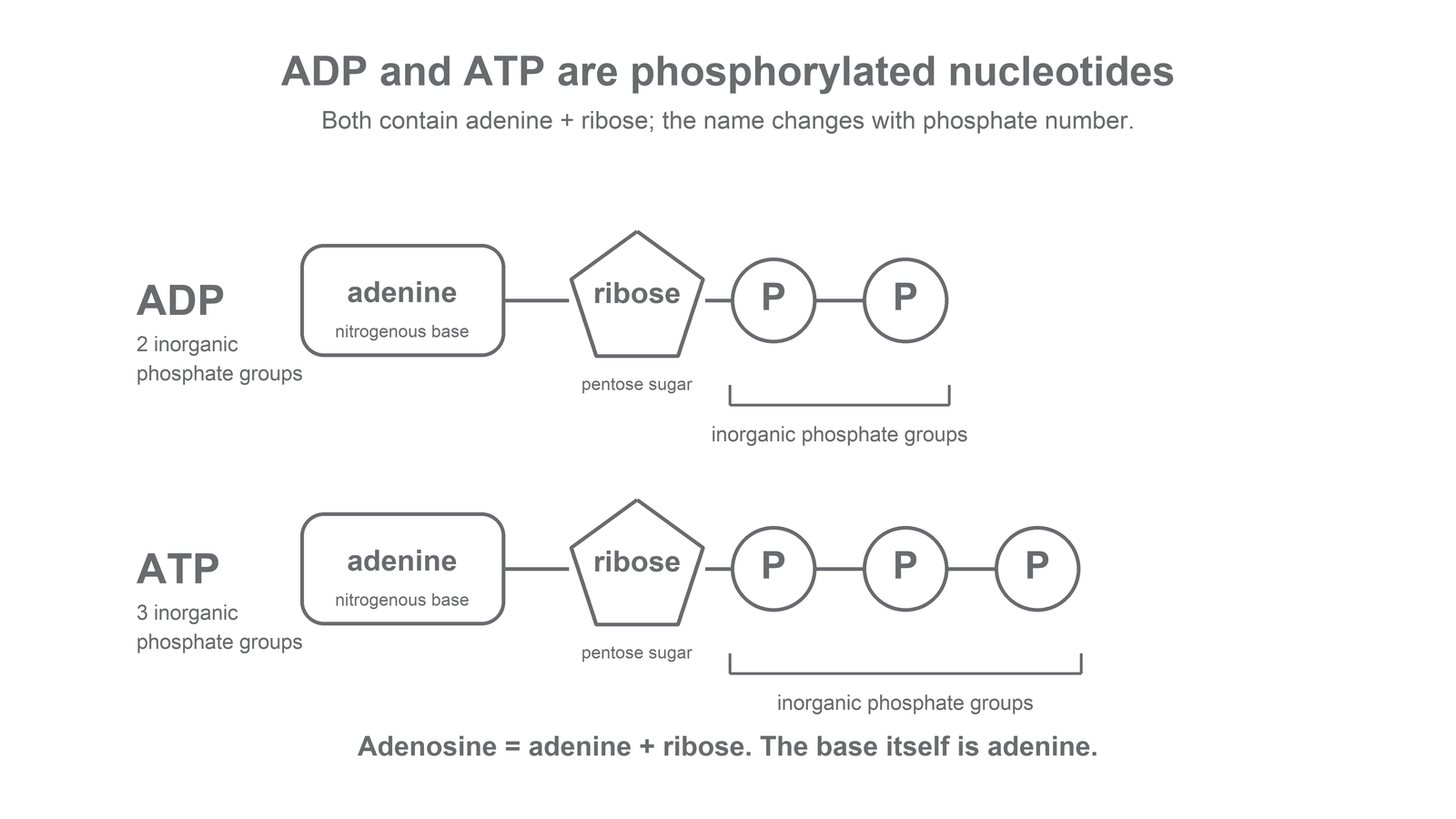
Use the diagram as a structure map rather than as a full chemical formula. OCR does not require you to draw the complete chemical structure here. The important learning decision is to see the shared adenine-ribose core and then count the phosphate groups.
Comparing ADP And ATP
Question: Compare the structure of ADP with the structure of ATP.
A strong answer starts with similarity, then gives the precise difference:
Both ADP and ATP contain adenine and ribose, so both are adenosine-based phosphorylated nucleotides. ADP has two inorganic phosphate groups, whereas ATP has three inorganic phosphate groups.
Now try the same comparison without the scaffold. Aim for shared components first, then the phosphate difference.
Structure And Energy Language
This lesson is structural, but ATP is important because cells can use ATP hydrolysis in energy-requiring processes. Hydrolysis means a bond is broken using water. In many biological contexts, ATP is hydrolysed to ADP and an inorganic phosphate group.
Keep that context in proportion. The row you are learning here does not require the details of respiration, photosynthesis, ATP synthase, muscle contraction or active transport. It only needs the structure of ADP and ATP as phosphorylated nucleotides.
The safest wording is:
- ATP can be hydrolysed to ADP and inorganic phosphate.
- ATP can provide chemical energy for energy-requiring processes.
- ATP does not "produce energy"; energy is transferred or made available in a cell process.
If a question is only asking about structure, answer with components and phosphate count. Do not launch into a respiration or photosynthesis explanation unless the question actually asks for it.
The next check uses common wrong statements as distractors, so look for the one option that gets both the shared core and the phosphate count right.
OCR Precision Check
For this specification point, precision is more valuable than extra detail. A full-credit description of ATP can be short:
ATP is a phosphorylated nucleotide made from adenine, ribose and three inorganic phosphate groups.
A full-credit description of ADP is just as direct:
ADP is a phosphorylated nucleotide made from adenine, ribose and two inorganic phosphate groups.
Common traps are easy to avoid if you ask yourself what the question is naming:
| If the question asks for... | Write... | Avoid... |
|---|---|---|
| Nitrogenous base | Adenine | Adenosine |
| Pentose sugar | Ribose | Deoxyribose |
| Difference between ADP and ATP | Phosphate number | Vague answers such as "ATP has more energy" |
| Structural components | Adenine, ribose, phosphate groups | Respiration pathways or ATP yield details |
OCR Precision Check Summary
ADP and ATP are phosphorylated nucleotides with the same adenine-ribose core; ADP has two inorganic phosphate groups and ATP has three.
Explain It Back
Use this as a self-explanation check after the section above. It is for diagnosing what you can already explain, not for learning new material from scratch.