2.1.2(k)-(m) - Amino acids, peptide bonds and protein structure
This lesson builds proteins from the bottom up: amino acid template, peptide bond, polypeptide, then four levels of protein structure. The emphasis is using precise bond language, because peptide bonds are not the same as the interactions that stabilise folding.
Amino Acid Template
An amino acid has a central carbon bonded to four groups:
| Group | Role |
|---|---|
| amino group, | part of the general amino acid structure |
| carboxyl group, | part of the general amino acid structure |
| hydrogen atom | part of the general amino acid structure |
| R group | variable side group that differs between amino acids |
[DIAGRAM: amino_acid_peptide_protein_structure: Lesson 024: Amino acids, peptide bonds and protein structure - diagram 01; asset_slug: 024_m02_1_2_amino_acids_peptide_bonds_and_protein_structure__diagram_01; recommended_method: drawn_biology; description: Deterministic diagram showing general amino acid structure, peptide bond formation and four protein structure levels.]
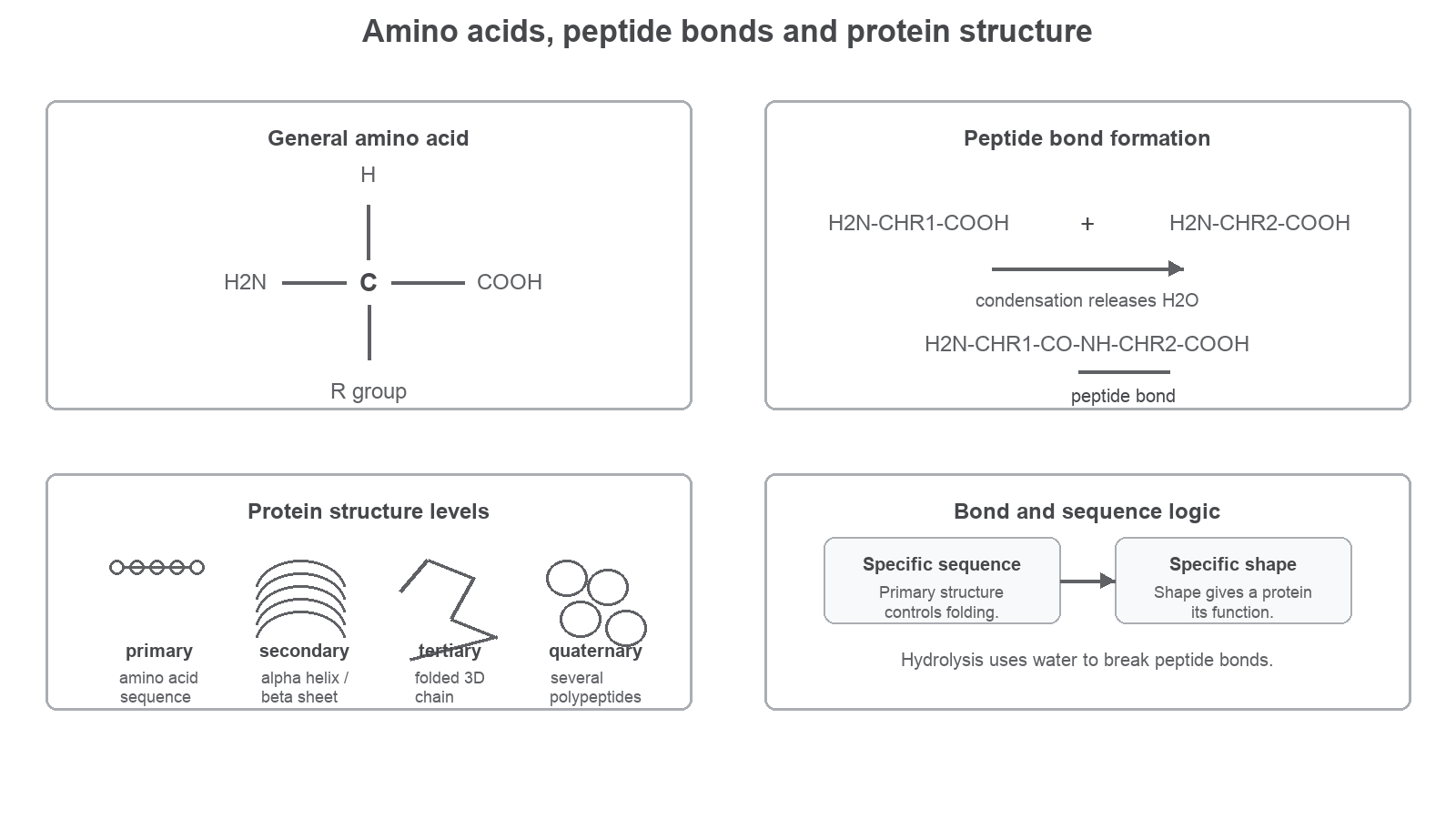
The R group is why amino acids can have different properties. Some R groups are hydrophobic, some are hydrophilic, and some can form ionic or disulfide bonds.
Peptide Bonds
A peptide bond forms between the carboxyl group of one amino acid and the amino group of another. This is a condensation reaction, so water is released.
Two amino acids joined by one peptide bond form a dipeptide. Many amino acids joined by peptide bonds form a polypeptide.
Hydrolysis is the reverse process. Water is used to break peptide bonds, separating amino acids or shorter peptides.
Bond And Water Count
Four amino acids joined in one chain have three peptide bonds.
To form the chain from separate amino acids, three condensation reactions release three water molecules.
To hydrolyse the chain completely, three water molecules are used to break the three peptide bonds.
Four Levels Of Structure
Protein structure has four levels.
| Level | Meaning |
|---|---|
| Primary | the amino acid sequence in a polypeptide |
| Secondary | local folding such as alpha helices or beta-pleated sheets, stabilised by hydrogen bonds |
| Tertiary | the overall three-dimensional shape of one polypeptide |
| Quaternary | the association of more than one polypeptide chain or subunit |
Primary structure is not "no shape"; it is the exact sequence that determines how later folding can occur. Quaternary structure is not just a very complicated tertiary structure. It requires more than one polypeptide chain.
Interactions That Stabilise Folding
Peptide bonds hold the amino acid backbone together. Other interactions stabilise secondary, tertiary or quaternary structure.
| Interaction | What it involves | Where it matters |
|---|---|---|
| Hydrogen bonds | attraction involving polar groups | secondary structure and some higher-level folding |
| Hydrophobic interactions | non-polar R groups clustering away from water | tertiary and quaternary structure |
| Hydrophilic interactions | polar/charged R groups interacting with water or other polar groups | protein surface and folding |
| Disulfide bonds | covalent bond between sulfur-containing R groups | tertiary or quaternary structure |
| Ionic bonds | attraction between oppositely charged R groups | tertiary or quaternary structure |
Hydrophobic interactions are not covalent bonds. They describe the tendency of non-polar groups to cluster away from water. Disulfide bonds are covalent and stronger.
Using Structure Language
A strong protein-structure answer uses the right level and the right interaction.
For example:
- "The primary structure changes" means the amino acid sequence changes.
- "Hydrogen bonds stabilise secondary structure" is different from "peptide bonds form the primary chain."
- "Quaternary structure changes" is only appropriate if more than one polypeptide chain is involved.
Using Structure Language Summary
Proteins are built from amino acids joined by peptide bonds, then folded and associated through named interactions into primary, secondary, tertiary and quaternary structures.