2.1.4(a)-(b) - Enzymes as intracellular and extracellular catalysts
This lesson is about what enzymes do for living organisms, before the detailed mechanism of enzyme action is taught. You will learn why metabolism depends on enzyme-catalysed reactions, how enzymes affect both structure and function, and how to use catalase and amylase as precise examples of intracellular and extracellular catalysis.
Enzymes And Metabolism
Living organisms are chemical systems. Cells constantly build molecules, break molecules down, move substances between forms, detoxify harmful products and release energy. These reactions cannot usually happen fast enough at normal body or cell temperatures unless they are catalysed.
Enzyme
An enzyme is a biological catalyst: it increases the rate of a chemical reaction and is not used up by that reaction.
The phrase "not used up" matters. A cell does not need a new enzyme molecule for every single reaction event, although enzymes can be damaged or degraded over time like other proteins.
Metabolism
Metabolism is the sum of all the chemical reactions taking place in an organism or cell.
Metabolism includes anabolic reactions, which build larger molecules from smaller ones, and catabolic reactions, which break larger molecules into smaller ones. This lesson does not require the detailed enzyme mechanism, such as active sites or induced fit. For now, the key idea is that enzymes make metabolic reactions happen at biologically useful rates.
Enzymes affect both structure and function.
| Level | How enzymes can affect structure | How enzymes can affect function |
|---|---|---|
| Cellular | catalysed reactions build, modify or break down cell molecules | reactions such as detoxification, respiration or digestion-related processing happen fast enough |
| Whole organism | many cells together build and maintain tissues, secretions and body systems | digestion, movement, homeostasis, growth and repair depend on many enzyme-controlled reactions |
Linking an enzyme reaction to biological levels
Suppose an enzyme catalyses the breakdown of a harmful molecule inside a cell.
At the cellular level, this protects proteins, membranes and other cell components from damage. That is a structural effect because cell components are preserved.
At the functional level, the cell can keep carrying out normal metabolic reactions. Across many cells, this helps the whole organism keep tissues working.
An OCR-style answer should move from the reaction to the biological consequence. "Enzymes speed reactions" is true, but it is usually stronger to say what reaction is sped up and why that matters for cells or the whole organism.
Intracellular Catalysis By Catalase
An intracellular reaction is a reaction that occurs inside a cell. The required example for this lesson is catalase.
Intracellular Reaction
An intracellular reaction is a chemical reaction that takes place inside a cell.
Catalase catalyses the breakdown of hydrogen peroxide, H2O2, into water and oxygen:
Catalase Reaction
Hydrogen peroxide is produced during some metabolic reactions and is harmful if it accumulates. It can damage cell components, so catalase protects cellular structure. By removing hydrogen peroxide quickly, catalase also protects cell function, because enzymes, membranes and other cell systems can continue working.
In many eukaryotic cells catalase is associated with peroxisomes, but the core OCR example is simpler: catalase is an intracellular enzyme because the reaction it catalyses happens inside cells.
Do not write that catalase is intracellular just because it is "in the body". Intracellular means inside cells.
Here is the reasoning chain an examiner can credit:
- Catalase is an enzyme, so it catalyses a reaction.
- The substrate is hydrogen peroxide.
- The reaction occurs inside cells, so catalase is an intracellular enzyme.
- Breaking down hydrogen peroxide protects cell structure and cell function.
Extracellular Catalysis By Amylase
An extracellular reaction is a reaction that occurs outside cells. The required example for this lesson is amylase.
Extracellular Reaction
An extracellular reaction is a chemical reaction that takes place outside cells.
Amylase is made by cells, but it is secreted before it catalyses its main digestive reaction. Once outside the secreting cells, amylase catalyses the breakdown of starch into smaller sugars such as maltose.
This distinction is a common source of mistakes. An extracellular enzyme can still be made inside a cell. What makes it extracellular is where the catalysed reaction takes place.
Amylase shows how enzymes can act at a whole-organism level. A starch molecule is too large to be absorbed directly as a useful sugar. By catalysing starch breakdown outside cells in a digestive fluid or lumen, amylase helps produce smaller carbohydrate products that can later be absorbed and used in metabolism by cells across the organism.
In a practical context, amylase activity can be followed by testing for starch with iodine. If starch is still present, iodine turns blue-black. When amylase has broken down the starch, the iodine remains orange-brown. The full investigation of enzyme-rate factors belongs to a later enzyme lesson, but this is useful evidence that amylase catalyses starch breakdown.
Now use the location rule, not just the enzyme's origin.
Comparing Intracellular And Extracellular Roles
Both catalase and amylase are enzymes, so both are biological catalysts. The difference in this lesson is the location of the catalysed reaction.
[DIAGRAM: intracellular_extracellular_enzyme_roles: Lesson 36: Enzymes as intracellular and extracellular catalysts - diagram 01; asset_slug: 036_m02_1_4_enzymes_as_intracellular_and_extracellular_catalysts__diagram_01; recommended_method: drawn_biology; description: deterministic comparison diagram showing catalase catalysing hydrogen peroxide breakdown inside a cell and amylase being secreted to catalyse starch breakdown outside cells.]
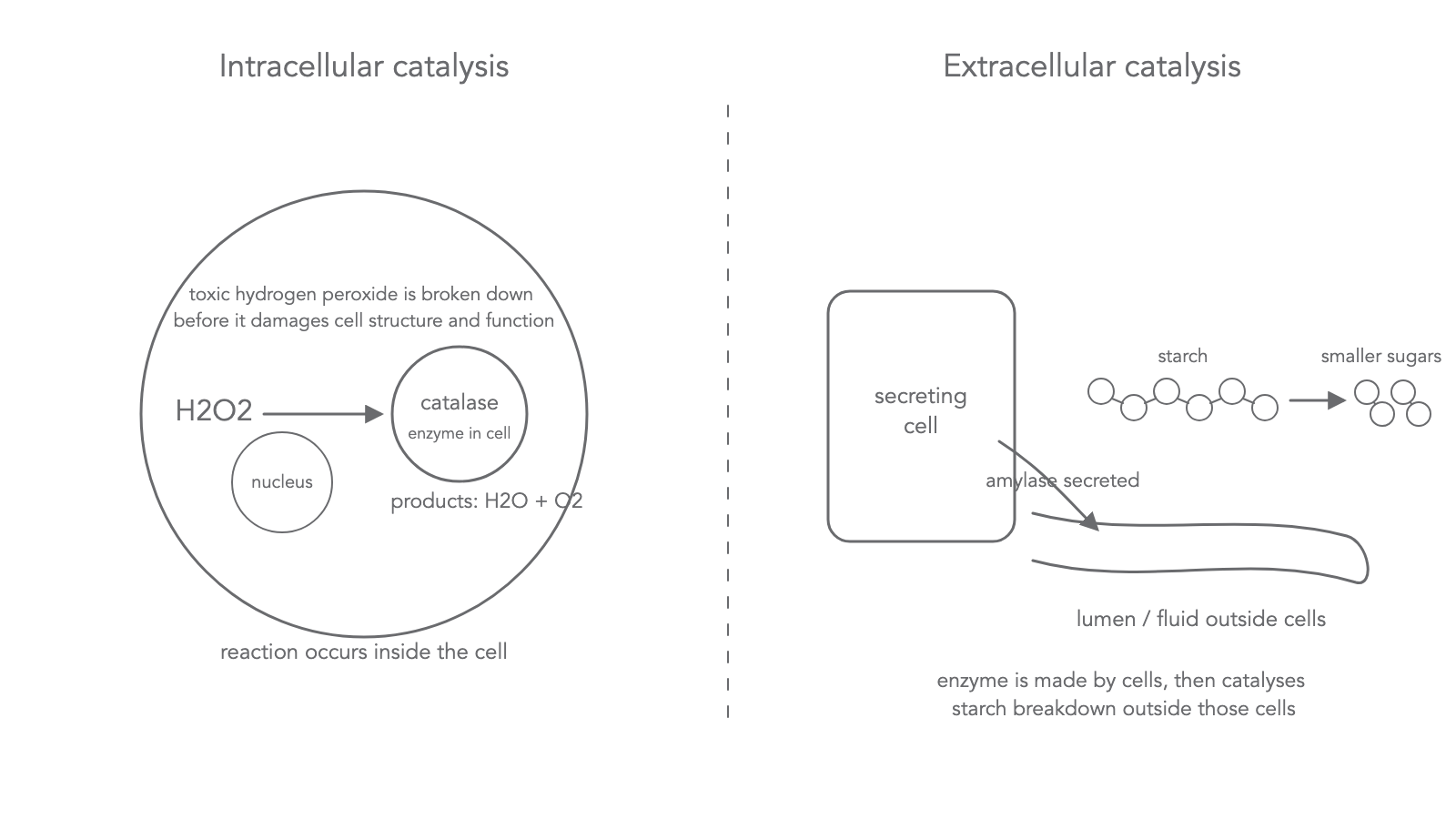
Use this comparison to keep your answer precise.
| Feature | Catalase | Amylase |
|---|---|---|
| Required role in this lesson | intracellular enzyme | extracellular enzyme |
| Reaction location | inside cells | outside cells after secretion |
| Example substrate | hydrogen peroxide | starch |
| Biological importance | protects cell components and cell metabolism | helps digest starch into smaller sugars for later absorption |
| Structure-function link | protects cell structure so cell function can continue | helps whole-organism nutrition by making large carbohydrate molecules easier to process |
The whole-organism wording does not mean every enzyme must work outside cells. Catalase can still matter at a whole-organism level because many cells rely on it. Amylase can still depend on cells because cells make and secrete it. The difference is the site of catalysis.
Intracellular and extracellular describe where the enzyme-catalysed reaction happens, not whether the enzyme was made by a cell.
Using The Examples Precisely
This lesson is short, but OCR-style answers can still lose marks through vague wording. Compare these two answers:
| Weak answer | Better answer |
|---|---|
| "Catalase helps the body by breaking things down." | "Catalase catalyses the breakdown of hydrogen peroxide inside cells, preventing damage to cell components." |
| "Amylase is outside the body and digests food." | "Amylase is secreted and catalyses starch breakdown outside cells, so it is an extracellular enzyme." |
The better answers name the enzyme, the reaction or substrate, the reaction location and the biological consequence.
For this row, the safe named examples are catalase for intracellular catalysis and amylase for extracellular catalysis. Do not turn the answer into an active-site, pH, temperature, cofactor or inhibitor answer unless the question clearly moves into a later enzyme row.
Using The Examples Precisely Continued
A strong final summary is:
Enzymes catalyse metabolic reactions that affect structure and function. Catalase is the intracellular example because it breaks down hydrogen peroxide inside cells; amylase is the extracellular example because it breaks down starch outside cells after secretion.