2.1.3(g) - Transcription and translation
In this lesson you learn how the information in a gene is used to make a polypeptide. OCR expects the mechanism, not just the slogan "DNA makes protein": transcription makes an mRNA copy of the gene, then translation uses that mRNA at a ribosome to join amino acids in the correct sequence. The named roles of RNA polymerase, mRNA, tRNA and rRNA are the core of this lesson.
The Whole Route From Gene To Polypeptide
A gene is a length of DNA with a base sequence that can be used to make a polypeptide. The DNA itself normally remains in the nucleus of a eukaryotic cell, so the information is first copied into messenger RNA. The mRNA then moves to a ribosome, where its base sequence is used to assemble amino acids into a polypeptide.
Transcription
Transcription is the production of an RNA copy of a gene from a DNA template.
Translation
Translation is the use of an mRNA base sequence at a ribosome to assemble amino acids into a polypeptide.
The two words are easy to mix up, so anchor them to their products:
| Process | Main site in a eukaryotic cell | What is made | Key molecule roles |
|---|---|---|---|
| Transcription | Nucleus | mRNA copy of the gene | RNA polymerase makes the RNA strand |
| Translation | Ribosome in cytoplasm or on rough endoplasmic reticulum | Polypeptide | mRNA is read, tRNA brings amino acids, rRNA forms part of the ribosome |
[DIAGRAM: transcription_translation_overview: Lesson 35: Transcription and translation - diagram 01; asset_slug: 035_m02_1_3_transcription_and_translation__diagram_01; recommended_method: drawn_biology; description: A clean 16:9 pathway diagram showing a gene in DNA inside a nucleus, RNA polymerase producing mRNA, mRNA leaving the nucleus, a ribosome containing rRNA reading mRNA codons, tRNA anticodons pairing with codons, and amino acids being joined into a polypeptide.]
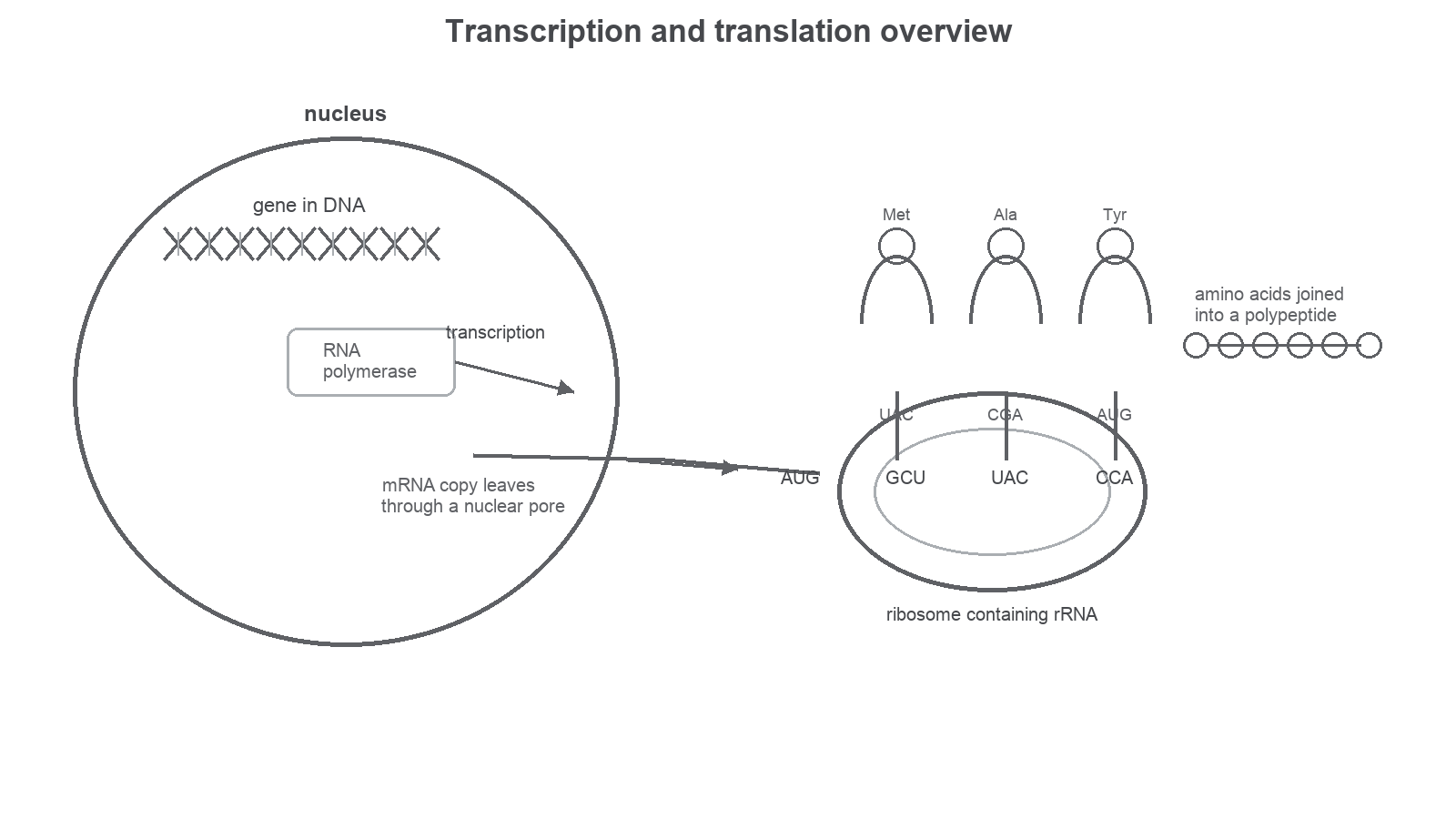
The diagram is not meant to replace the sequence. It shows the handover of information: DNA base sequence -> mRNA base sequence -> amino acid sequence in a polypeptide.
Transcription copies the gene into mRNA; translation uses that mRNA to build the polypeptide.
Transcription Makes mRNA
During transcription, the DNA strands separate in the region of the gene being transcribed. One DNA strand acts as the template. Free RNA nucleotides align by complementary base pairing with exposed bases on the template strand. In RNA, uracil, U, is used instead of thymine, T.
RNA polymerase is the enzyme that joins the RNA nucleotides together to form an mRNA strand. The mRNA is complementary to the DNA template strand. Once made, the mRNA separates from the DNA and can leave the nucleus through a nuclear pore.
The useful OCR-level sequence is:
- DNA strands separate at the gene.
- RNA polymerase uses one DNA strand as a template.
- Complementary RNA nucleotides line up against exposed DNA bases.
- RNA polymerase joins the RNA nucleotides to form mRNA.
- The mRNA leaves the nucleus and moves to a ribosome.
Transcribing A Short Template Sequence
Suppose a short section of the DNA template strand has the sequence:
DNA template: TAC CGA AAA
Use complementary base pairing, remembering that RNA uses U instead of T.
T on DNA pairs with A on RNA, A pairs with U, C pairs with G, and G pairs with C.
mRNA made: AUG GCU UUU
This is an mRNA sequence, not a polypeptide. The amino acid sequence is produced later during translation.
The Three RNA Roles
OCR names three RNA types in this row: mRNA, tRNA and rRNA. They are all RNA, but they do different jobs in the same overall pathway.
| RNA type | Full name | Main role in this lesson |
|---|---|---|
| mRNA | Messenger RNA | Carries the copied base sequence from the gene to the ribosome. Its codons are read during translation. |
| tRNA | Transfer RNA | Carries a specific amino acid and has an anticodon that pairs with a complementary mRNA codon. |
| rRNA | Ribosomal RNA | Forms part of the ribosome and helps position mRNA and tRNA so amino acids can be joined. |
Codon
A codon is a sequence of three bases on mRNA.
Anticodon
An anticodon is a sequence of three bases on tRNA that is complementary to an mRNA codon.
The important tRNA idea is matching. A tRNA does not bring a random amino acid. Its anticodon pairs with a complementary codon on the mRNA, and that tRNA carries the corresponding amino acid. This allows the mRNA base sequence to control the order of amino acids in the polypeptide.
Ribosomal RNA is often under-described. At this level, treat rRNA as a working part of the ribosome, not just decoration. The ribosome holds the mRNA and tRNAs in position and helps catalyse peptide bond formation between amino acids.
Translation Builds The Polypeptide
Translation starts when mRNA associates with a ribosome. The ribosome reads the mRNA codons in order. A tRNA with a complementary anticodon pairs with the first codon and brings its specific amino acid. Another tRNA pairs with the next codon and brings the next amino acid.
The ribosome helps form a peptide bond between adjacent amino acids. The first tRNA can then leave, and the ribosome moves along the mRNA to the next codon. Repeating this process produces a growing chain of amino acids: a polypeptide.
The sequence is:
- mRNA binds to a ribosome.
- tRNA anticodons pair with complementary mRNA codons.
- Each tRNA brings a specific amino acid.
- Peptide bonds form between adjacent amino acids.
- The ribosome moves along the mRNA codon by codon.
- A polypeptide is released when translation stops.
You do not need detailed ribosomal site names for this row. The OCR-safe focus is the role of mRNA, tRNA, rRNA and the ordered joining of amino acids.
From mRNA Codons To tRNA Anticodons
Use the mRNA sequence from the previous example:
mRNA: AUG GCU UUU
Complementary tRNA anticodons would be:
tRNA anticodons: UAC CGA AAA
Each tRNA carries a specific amino acid. The ribosome helps join those amino acids with peptide bonds, forming a polypeptide with amino acids in the order specified by the mRNA codons.
Exam Precision And Common Errors
OCR questions on this topic often reward a clear sequence with the correct molecule names. The safest way to answer is to state where the information starts, what RNA polymerase produces, how the ribosome uses mRNA, and how tRNA and rRNA contribute to building the polypeptide.
A high-precision answer avoids these common errors:
| Error | Correction |
|---|---|
| "DNA leaves the nucleus." | mRNA leaves the nucleus; DNA remains in the nucleus in eukaryotic cells. |
| "Transcription makes protein." | Transcription makes mRNA. Translation makes a polypeptide. |
| "tRNA is translated into protein." | tRNA brings amino acids; it is not part of the final polypeptide. |
| "rRNA carries the code." | mRNA carries the codons; rRNA forms part of the ribosome. |
| "RNA uses thymine." | RNA uses uracil, U, instead of thymine, T. |
For "Describe transcription and translation" questions, write in process order. Jumping straight from DNA to amino acids without naming mRNA, tRNA and the ribosome loses the mechanism.