1.2.2(h), 1.2.2(j)-(l) - Responses, dissection, fieldwork and ICT
In this lesson you are learning how to choose and carry out four broad practical technique families: measuring responses in organisms, dissecting organs safely, sampling in the field, and using ICT to collect or process data. The focus is not detailed physiology, ecology or anatomy; it is the practical decision-making that makes biological evidence safe, ethical and valid. A strong answer links the biological question to the method, the risk controls, and the type of data collected.
Choosing A Practical Route
A practical technique is a way of turning a biological question into evidence. The first decision is not "Which apparatus do I remember?" but "What kind of evidence would answer the question?"
[DIAGRAM: practical_technique_decision_map: Lesson 011: Organism responses, dissection, fieldwork and ICT techniques - diagram 01; asset_slug: 011_m01_2_2_organism_responses_dissection_fieldwork_and_ict_techniques__diagram_01; recommended_method: drawn_biology; description: Four-route decision map linking biological question types to organism-response measurements, safe dissection, fieldwork sampling, and ICT/data logging/software processing.]
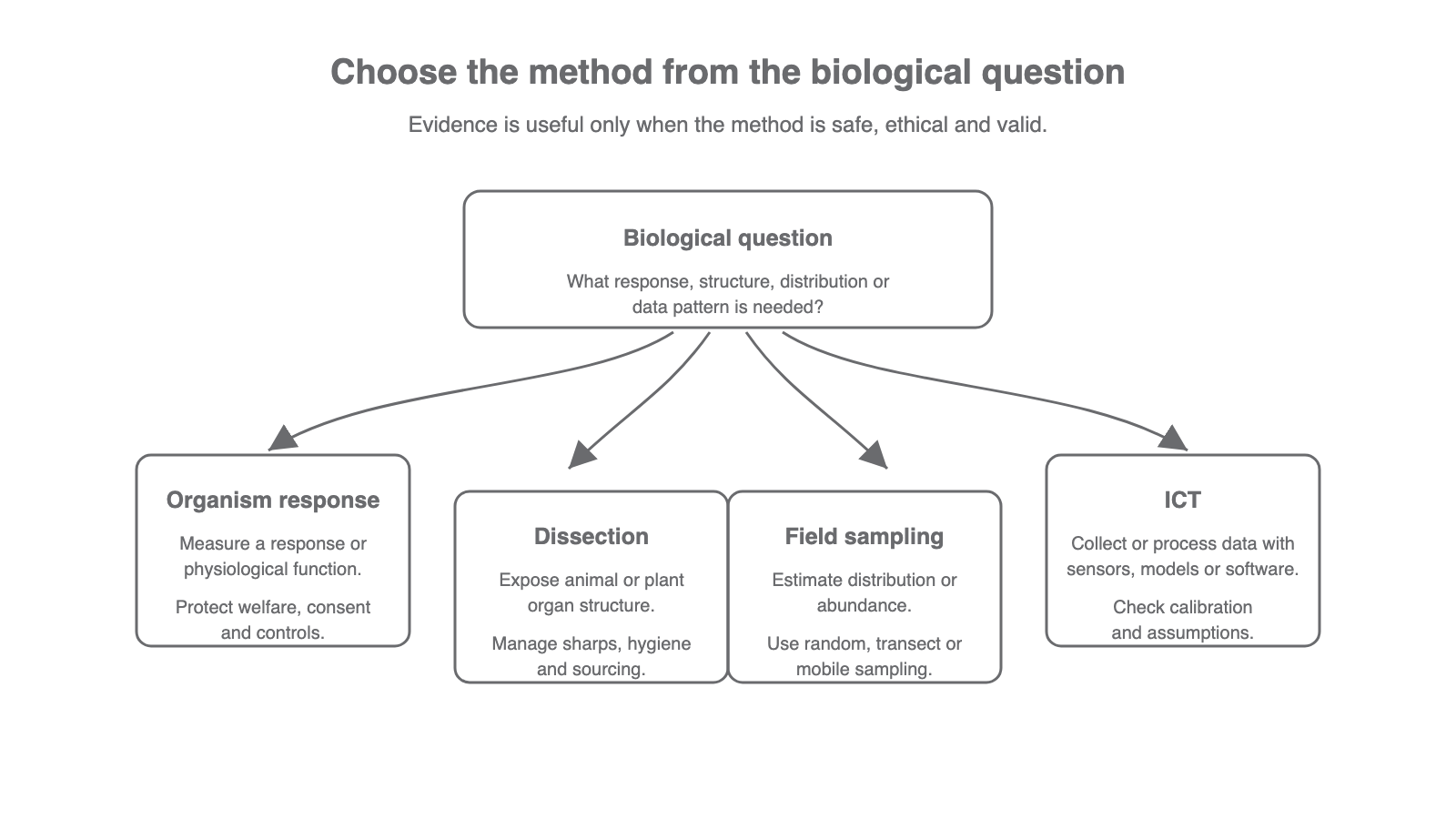
The same practical question can often involve more than one row from this lesson. For example, an investigation into how exercise affects pulse rate uses human participants, so it needs ethical consent and safety control. If pulse is recorded continuously with a sensor, it also uses ICT. If the results are processed in a spreadsheet, the ICT choice affects the quality of the final evidence.
Validity
Validity is the extent to which a method measures what it is intended to measure, so that the conclusion follows from the evidence rather than from an uncontrolled factor.
Use this route when choosing a method:
| Biological question | Technique family | Evidence produced | Key practical concern |
|---|---|---|---|
| Does an organism respond to a stimulus? | Safe and ethical use of organisms | Change in response or physiological function | Welfare, consent, hazard and control variables |
| What structures are present in an organ? | Safe dissection | Observations of visible structure | Sharps, hygiene, tissue source and careful technique |
| How are organisms distributed in a habitat? | Fieldwork sampling | Counts, frequency, abundance or presence/absence | Representative sampling and equal sampling effort |
| How can data be collected or processed efficiently? | ICT, data logger, modelling or software | Time series, model output, processed data or graphs | Calibration, sampling interval, assumptions and units |
Choosing The Practical Route
A student asks whether soil moisture affects the abundance of a plant species along a slope.
The method should include fieldwork sampling because abundance must be estimated from the habitat. A transect is suitable if the slope forms an environmental gradient. ICT could also be useful if a data logger or sensor records soil moisture at each sampling point. The conclusion should compare plant abundance with moisture data, but it should be cautious because a correlation alone does not prove that soil moisture is the only cause.
That is the kind of routing decision you should make before writing a detailed method.
Safe Ethical Organism Measurements
When organisms are used in a practical, the method must protect the organism and still produce useful evidence. This applies to plant responses, animal responses and physiological functions such as pulse rate or heart rate.
Physiological function
A physiological function is a measurable activity of a living organism, organ or system, such as pulse rate, heart rate, breathing rate, temperature change or growth response.
For human participants, consent is necessary but not enough on its own. A harmless procedure such as measuring pulse rate before and after gentle exercise may be suitable with willing participants and appropriate risk control. A hazardous or harmful procedure is not acceptable just because someone agrees to it.
For animal investigations in a school or college setting, OCR's practical guidance restricts laboratory animal work to small invertebrates. The ethical aim is to minimise harm and distress, use the smallest appropriate number of organisms, and return or maintain organisms appropriately. A useful shorthand is replace, reduce and refine: use a non-animal or lower-impact method where suitable, use only the number needed for meaningful evidence, and improve the method to reduce harm.
For plant investigations, organisms still need responsible treatment. Healthy plant material should be sourced responsibly, controlled conditions should be chosen deliberately, and the method should not damage habitats unnecessarily.
| Practical context | Suitable method decision | Unsafe or weak decision |
|---|---|---|
| Exercise and pulse rate | Willing participants, low-risk activity, stop if unwell, record recovery safely | Forcing participation or using a harmful exposure |
| Daphnia heart rate | Small invertebrates, brief observation, suitable temperature range, return to appropriate conditions | Extreme temperatures or chemical exposure that causes avoidable harm |
| Phototropism | Similar seedlings, controlled light direction, regular measurements, minimal handling | Different seedling ages and uncontrolled light, making the response hard to interpret |
| Field organism counts | Minimise disturbance, replace turned stones, return animals quickly | Removing organisms permanently or damaging the habitat |
For an ethics question, do not write only "get consent" or "do not harm animals". Link the safeguard to the organism or participant and to the method, such as "use only willing human participants and avoid harmful procedures" or "return invertebrates quickly to reduce stress and habitat disturbance".
The safest practical plans build ethics and validity into the same sequence.
Ethics And Validity In A Human Investigation
A class wants to measure how exercise affects pulse rate. A suitable plan is to use willing participants, choose gentle standardised exercise, exclude anyone for whom exercise may be unsafe, record resting pulse, record pulse immediately after exercise, and allow recovery.
This protects participants and improves validity. If one student runs hard while another walks slowly, the difference in pulse rate may be due to exercise intensity rather than the intended comparison.
Now apply the same standard to an unsuitable human-subject proposal.
Safe Dissection Of Organs
Dissection is used to observe the internal or external structure of an animal or plant organ. In this lesson, the required skill is safe use of instruments and biological material, not detailed recall of any one organ's anatomy.
Dissection
Dissection is the careful cutting and separation of biological material to expose structures for observation.
A safe dissection starts before the first cut. The specimen should come from a reliable source. Animal tissue may carry biological risk, and preserved material may contain chemicals that need specific precautions. Plant organs can be used instead of, or as well as, animal organs.
Sharp instruments are not automatically the best tools for every step. Dissecting scissors are often safer for most cutting because they give more control and need less exposed blade handling. A scalpel is reserved for fine work when a clean, precise cut is needed.
| Safety or quality decision | Why it matters |
|---|---|
| Use a dissection tray or board | Protects the bench and stabilises the material |
| Cut away from the body and fingers | Reduces risk from sharp instruments |
| Count sharps out and back in | Prevents lost blades or needles causing injury |
| Only one student hands-on at a time | Reduces collision and confusion around sharps |
| Wear eye protection when material may flick or when using preserved material | Reduces risk from splashes or fragments |
| Wash hands and clean the bench after handling animal tissue | Reduces biological contamination risk |
| Rinse preserved material when instructed | Reduces contact with preservative residues |
| Dispose of tissue and sharps as instructed | Prevents injury, contamination and unsuitable waste handling |
Good dissection is also scientific. Cut gradually, expose structures without tearing them, keep the specimen moist if needed, and record observations clearly. Pulling tissue apart roughly may be faster, but it can destroy the very structures the practical is meant to reveal.
Fieldwork Sampling Techniques
Fieldwork sampling is used when it is not possible or sensible to count every organism in a habitat. A sample is a manageable subset of the habitat, chosen so that the results can support a fair conclusion.
Sampling
Sampling is collecting data from part of a population or habitat in order to estimate or compare patterns in the wider population or habitat.
The sampling technique should match the pattern being investigated.
Random sampling is useful when an area is large, fairly uniform, or when you want to reduce bias in choosing positions. A common method is to mark out a grid, generate random coordinates, place the quadrat at those coordinates, and record the organisms in each quadrat.
Systematic sampling is useful when there is a gradient, such as distance from shade to sunlight, shore to upper shore, or grassland into woodland. A line transect is a tape or rope laid between two points. A belt transect uses quadrats placed along the line, often at regular intervals, so abundance or frequency can be compared with distance.
Other sampling methods suit mobile organisms or specific habitats:
| Sampling method | Suitable use | Practical caution |
|---|---|---|
| Frame quadrat | Plants or slow-moving organisms in a fixed area | Use the same quadrat size and counting rule |
| Point quadrat | Short grassland or vegetation hits at fixed points | Keep points and spacing consistent |
| Kick sampling | Aquatic invertebrates from a stream bed | Standardise kick time and return organisms safely |
| Sweep netting | Invertebrates in long grass or water | Standardise sweep number and avoid unnecessary harm |
| Beating tray | Invertebrates from shrubs or branches | Return organisms quickly and avoid damaging branches |
| Capture-recapture | Estimating mobile animal populations | Use harmless marking and allow mixing before recapture |
Equal sampling effort is a key validity idea. If one site is sampled for 20 minutes with ten quadrats and another for 5 minutes with two quadrats, the difference in species recorded may be due to effort rather than a real habitat difference.
Fieldwork also needs risk and ethical control: check the site in advance, consider weather and tides where relevant, use suitable footwear and clothing, record data clearly in field conditions, collect all apparatus afterwards, avoid damaging habitats, and return animals as soon as possible.
Choosing Random Or Systematic Sampling
A student wants to compare the abundance of daisies in two similar areas of school field. Random quadrat sampling is suitable because the aim is to avoid choosing "good-looking" patches by bias.
A different student wants to investigate how plant abundance changes from a shaded wall to a sunny wall. A transect is more suitable because the question is about change along an environmental gradient.
The check below asks you to choose the method from the pattern being investigated.
ICT Data Logging And Software
ICT in practical biology is not just typing up results. It can be part of the method itself: collecting data, modelling biological structures or processes, or processing results so that patterns can be seen.
There are three common roles.
| ICT role | Example | Why it may be useful |
|---|---|---|
| Data logger or electronic sensor | pH probe, light meter, temperature probe, pulse monitor | Records at regular intervals, can capture rapid or continuous change, and may reduce reaction-time error |
| Computer modelling | 3D molecular model or epidemiological simulation | Allows a student to explore a structure or scenario that cannot be manipulated directly in the classroom |
| Software processing | Spreadsheet, graphing tool, fieldwork data software | Organises data, calculates summaries, plots graphs and supports clear reporting |
ICT improves evidence only when it is used thoughtfully. A pH probe that has not been calibrated may produce precise-looking but inaccurate numbers. A data logger set to record every 10 minutes may miss a rapid change that happens in the first minute. A model can help answer a question, but its output depends on the assumptions built into the model.
Calibration
Calibration is checking or adjusting an instrument against a known standard so that its readings are accurate.
A strong ICT method includes:
- the biological variable being measured or modelled;
- a suitable sensor, model or software tool;
- units and sampling interval;
- calibration or setup checks where needed;
- a plan for storing and processing data;
- a cautious conclusion that recognises limitations.
Data Logger Decision
A student measures pH during yoghurt production. A pH probe linked to a data logger is suitable because pH may change over time and regular readings can show the pattern. The probe should be calibrated with buffer solutions, rinsed between uses, and set to record at intervals short enough to detect the expected change.
The same logic applies to physiological measurements that change quickly over time.
Pulling The Skills Together
Across all four rows, the same practical logic keeps returning:
| Practical demand | What it asks you to do |
|---|---|
| Safe | Identify hazards, reduce risks, and use equipment or organisms responsibly |
| Ethical | Consider consent, welfare, disturbance, sourcing and environmental impact |
| Valid | Make sure the method answers the intended biological question |
| Reliable enough | Use repeats, sufficient sample size, comparable sampling effort or continuous data where appropriate |
| Clear data | Record units, conditions, methods and processing choices so another person can understand the evidence |
Do not overclaim from practical data. A small fieldwork sample may suggest a pattern, not prove a universal rule. A model may explore a possibility, not replace real evidence. A response in one organism may not apply to all organisms. Practical biology often earns marks for careful limits as well as for conclusions.
Pulling The Skills Together Summary
For these OCR practical rows, learn the technique as a decision chain: biological question, method choice, safety and ethics, controlled data collection, and cautious conclusion.
Explain It Back
Use this as a self-explanation check after the section above. It is for diagnosing what you can already explain, not for learning new material from scratch.