2.1.2(a) - Water, hydrogen bonding and biological roles
In this lesson you are learning why water is not just a background liquid in Biology. OCR wants you to explain how hydrogen bonding occurs between water molecules and then link water's properties to roles in living organisms. The route is molecule first, then property, then biological role, with examples from both prokaryotic and eukaryotic life.
Polar Water And Hydrogen Bonding
A water molecule contains two hydrogen atoms covalently bonded to one oxygen atom. The important biological idea is that the electron sharing in each O-H bond is unequal. Oxygen attracts the shared electrons more strongly than hydrogen does, so the oxygen end of the molecule has a partial negative charge and each hydrogen end has a partial positive charge.
Polar Molecule
A molecule with an uneven distribution of charge, giving different parts of the molecule partial positive and partial negative charges.
For water, this polarity makes neighbouring water molecules attract each other. A hydrogen bond forms between the partial positive hydrogen atom of one water molecule and the partial negative oxygen atom of another water molecule.
Hydrogen Bond
A weak attraction between a partial positive hydrogen atom in one molecule and a partial negative atom, such as oxygen, in another molecule.
This matters because the hydrogen bond is between water molecules, not inside a single water molecule. The O-H bonds within one water molecule are covalent bonds. The attraction from one water molecule to the next is the hydrogen bond.
[DIAGRAM: water_hydrogen_bonding_roles: Lesson 18: Water, hydrogen bonding and biological roles - diagram 01; asset_slug: 018_m02_1_2_water_hydrogen_bonding_and_biological_roles__diagram_01; recommended_method: drawn_biology; description: Stylised water molecules showing partial charges, dashed hydrogen bonds between different water molecules, and linked OCR roles of water as solvent, transport medium, coolant and habitat.]
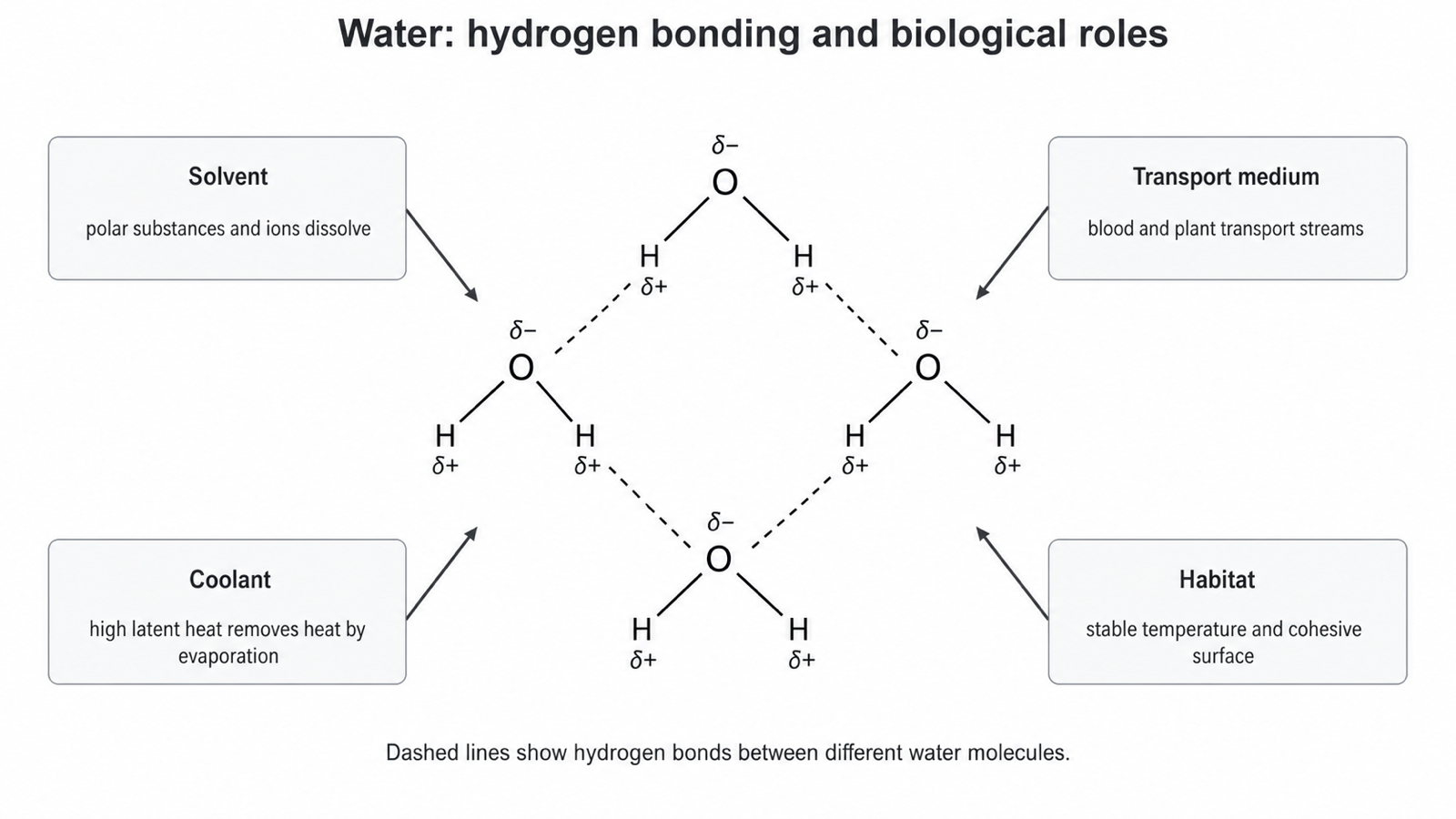
In liquid water, hydrogen bonds constantly form and break as molecules move. Each individual hydrogen bond is weak compared with a covalent bond, but there are many of them. Together, they give water several properties that living organisms depend on.
For this row, do not just write "water has hydrogen bonds". Credit comes from linking a property of water to a biological role and a clear example.
Here is the basic reasoning chain:
| Molecular feature | Property it helps explain | Biological role |
|---|---|---|
| Water molecules are polar | Water dissolves ions and many polar molecules | Solvent and reaction medium |
| Many hydrogen bonds form between water molecules | Water needs much energy to change temperature or evaporate | Temperature stability and cooling |
| Water molecules attract each other | Cohesion and surface tension | Movement of water columns and support at water surfaces |
Polar Water And Hydrogen Bonding Continued
The common error is to treat hydrogen bonding as a strong bond inside water. Keep the language precise: polar covalent bonds are within each water molecule; hydrogen bonds act between water molecules.
Water As A Solvent
A solvent is a liquid that dissolves a solute. Water is a useful biological solvent because its polar molecules can interact with charged ions and many polar molecules.
Solvent
A liquid in which a solute dissolves to form a solution.
When an ionic compound dissolves, water molecules orient around the ions. The partial negative oxygen end of water is attracted to positive ions. The partial positive hydrogen ends are attracted to negative ions. These attractions help separate ions from each other and keep them dispersed in solution.
Many polar biological molecules, such as glucose and some amino acids, also dissolve in water because they can form attractions with water molecules. This is why cytoplasm is an aqueous solution rather than a dry mixture of chemicals.
This solvent role is important in both prokaryotic and eukaryotic cells. A bacterial cell has cytosol where dissolved enzymes, substrates, ions and waste products can move and react. A eukaryotic animal or plant cell also contains cytosol and organelles surrounded by aqueous fluids. In both cases, water provides a medium for metabolic reactions because reactants can dissolve, move and collide.
Water's solvent role comes from polarity: charged and polar solutes can interact with the partial charges on water molecules.
There is a boundary to remember. Water is not a good solvent for non-polar substances such as many lipids. You do not need lipid structure in this lesson, but you do need the safe statement: water dissolves ions and many polar molecules well, not every biological substance.
Water As A Solvent Continued
Do not confuse "solvent" with "transport medium". Solvent describes dissolving. Transport medium describes carrying those dissolved substances from one place to another.
Water As A Transport Medium
Water can act as a transport medium because many biologically important substances dissolve in it and because water is a liquid over the temperatures most organisms experience. The transport role is therefore built on the solvent role, but it adds movement.
Transport Medium
A substance or fluid that carries materials from one place to another.
In animals, blood plasma is mostly water. It carries dissolved glucose, amino acids, ions, carbon dioxide, urea and hormones. The exact list depends on the organism and context, but the principle is the same: water allows substances to be transported in solution.
In plants, water helps carry dissolved mineral ions from roots and dissolved sugars in transport tissues. You will study xylem and phloem in more detail later, so the important point here is narrower: water's properties make it suitable as the fluid in which substances are moved around the plant.
Prokaryotes also depend on water as a transport medium at their scale. Dissolved nutrients can diffuse through aqueous surroundings and across cell surfaces, and dissolved substances move within the cytoplasm. A bacterium in a freshwater habitat, for example, is not using a circulatory system, but it still depends on substances being dissolved in water so they can reach the cell and move inside it.
One extra water property helps transport in narrow spaces: cohesion. Cohesion is attraction between water molecules. Because water molecules hydrogen bond with each other, they tend to stick together. This helps maintain continuous columns of water in plant transport tissues, although the full transpiration-stream mechanism belongs to a later plant transport lesson.
Distinguishing Solvent And Transport Roles
A student's answer says: "Water is useful because glucose dissolves in it."
That is a solvent point. To turn it into a transport point, the student must add movement: "Glucose dissolves in the water in blood plasma, so it can be carried from the small intestine or liver to respiring cells."
The transport answer has three pieces: dissolved substance, watery medium, and movement from one place to another.
Now use that distinction.
Water As A Transport Medium Continued
OCR answers are stronger when the example is concrete. "Water transports substances" is less precise than "water in blood plasma transports dissolved glucose and ions" or "water in cytoplasm allows dissolved substances to move within a cell."
Water As A Coolant
Water is useful as a coolant because hydrogen bonding makes it difficult for water molecules to move apart or evaporate. Energy must be transferred to disrupt many hydrogen bonds before water molecules gain enough kinetic energy to separate as vapour.
Two thermal properties are useful here.
| Property | Meaning | Biological importance |
|---|---|---|
| High specific heat capacity | A large amount of energy is needed to raise the temperature of water | Aquatic habitats and water-rich organisms change temperature more slowly |
| High latent heat of vaporisation | A large amount of energy is needed for water to evaporate | Evaporation removes heat from a surface |
In mammals, sweating can cool the body. Water in sweat evaporates from the skin surface. The evaporating water molecules take energy from the skin, so the skin loses thermal energy and cools. The biological effect depends on evaporation, not just sweat being present.
In plants, evaporation of water from leaf surfaces during transpiration can also remove heat. Do not turn this into a full transpiration lesson yet. For this row, the creditworthy link is that water's high latent heat of vaporisation allows evaporation to carry away heat.
The same thermal stability helps living cells. Both prokaryotic and eukaryotic cells contain a high proportion of water, so their internal conditions are buffered against rapid temperature change. This does not mean water makes temperature constant. It means water slows temperature change because hydrogen bonds absorb energy as they are disrupted.
Water As A Coolant Continued
A common weak answer says "water cools because it is cold". That is not the biological explanation. The explanation is about energy transfer during evaporation and the hydrogen bonding that gives water a high latent heat of vaporisation.
Water As A Habitat
Water is also a habitat. This means it provides the external environment in which organisms live, not just a liquid inside their cells.
Habitat
The place or environment where an organism lives.
Several properties of water support aquatic habitats:
| Water property | Habitat role |
|---|---|
| Liquid over a wide range of biological temperatures | Provides a continuous medium for aquatic organisms |
| High specific heat capacity | Reduces rapid temperature changes in ponds, lakes, rivers and seas |
| Good solvent for ions and polar substances | Allows dissolved mineral ions, nutrients and waste products to move |
| Allows gases such as oxygen and carbon dioxide to be present in solution | Supports respiration and photosynthesis in aquatic organisms |
| Ice is less dense than liquid water | Ice can float, leaving liquid water below as a habitat |
| Cohesion and surface tension | Supports small organisms at the water surface |
For prokaryotes, examples include aquatic bacteria and cyanobacteria. They live surrounded by water, take up dissolved substances, release waste products into an aqueous environment, and depend on dissolved gases. For eukaryotes, examples include algae, protoctists, aquatic plants, fish and other aquatic animals.
Be careful with examples. "A fish lives in water" is true, but on its own it does not explain why water is a suitable habitat. A stronger answer links a property to the role: water contains dissolved oxygen for aerobic respiration in aquatic animals, or water's high specific heat capacity helps aquatic habitats resist rapid temperature change.
If a pond surface freezes, ice floats because solid water is less dense than liquid water. The ice layer can reduce further heat loss, while liquid water remains below it. This helps aquatic organisms survive below the frozen surface.
The density of ice is a habitat point, not a reason for water's solvent role. Keep each property linked to the correct biological role.
Building OCR-Style Answers
OCR can ask this topic as a one-mark precision check, a short explanation, or a longer outline. The safest structure is:
- Name the property.
- Explain the property from water structure where relevant.
- State the biological role.
- Give a prokaryotic or eukaryotic example.
For example:
| Weak answer | Stronger answer |
|---|---|
| Water is good because it is a solvent. | Water is polar, so ions and many polar molecules dissolve in it. This allows dissolved glucose and ions to be transported in blood plasma. |
| Water cools organisms. | Water has a high latent heat of vaporisation because many hydrogen bonds must be disrupted during evaporation. Evaporation of sweat removes thermal energy from skin. |
| Water is a habitat for fish. | Water has a high specific heat capacity, so aquatic habitats change temperature slowly; it also contains dissolved oxygen that aquatic eukaryotes such as fish can use for aerobic respiration. |
A Property-Role Outline
Question: Outline two ways in which properties of water support living organisms.
Answer:
- Water is polar, so ions and polar molecules dissolve in it. This allows cytosol in bacteria and eukaryotic cells to act as a medium for metabolic reactions.
- Water has a high latent heat of vaporisation because many hydrogen bonds must be disrupted when it evaporates. Evaporation of sweat from a mammal removes heat from the skin surface.
Why this works: each point names a property, explains the role, and gives a biological example. It does not wander into unrelated biological molecules.
Now practise the same reasoning in a compact longer response.
Building OCR-Style Answers Continued
The tight boundary for this lesson is water itself. You do not need to explain monomers, polymers, condensation reactions, lipids, proteins, nucleic acids, water potential or osmosis here. A small reminder may help an answer, but those are separate OCR rows.
Explain It Back
Use this as a self-explanation check after the section above. It is for diagnosing what you can already explain, not for learning new material from scratch.