2.1.3(e) - Semi-conservative DNA replication
In this lesson you learn how DNA can be copied before cell division while keeping the genetic information almost exactly the same. The key idea is semi-conservative replication: each new DNA molecule keeps one strand from the original molecule and gains one newly made complementary strand. You will also learn why this copying is accurate, and why rare random mutations can still occur.
Meaning Of Semi-Conservative
DNA replication is the copying of DNA. It is needed before a cell divides so that each daughter cell can receive genetic information from the original cell.
Semi-conservative replication
DNA replication in which each new DNA molecule contains one original strand from the parent DNA molecule and one newly synthesised complementary strand.
The word semi-conservative is a precise model. "Semi" means half. "Conservative" means kept. Half of each new DNA molecule is conserved from the original DNA molecule.
Imagine the two original DNA strands are called old strand 1 and old strand 2. After one round of semi-conservative replication:
| New DNA molecule | Strand kept from the original DNA | Strand newly made |
|---|---|---|
| Molecule A | old strand 1 | new complementary strand |
| Molecule B | old strand 2 | new complementary strand |
The original double-stranded molecule is not kept whole. Its two strands separate, and each strand becomes a template for making a new partner strand.
Semi-conservative means each daughter DNA molecule has one old strand and one new strand.
Enzyme Sequence
Semi-conservative replication depends on the structure of DNA. The two strands are held together by hydrogen bonds between complementary base pairs. Adenine pairs with thymine, and guanine pairs with cytosine. If the strands are separated, each strand carries enough information to act as a template for the other strand.
Template strand
A DNA strand whose base sequence is used to determine the complementary base sequence of a newly synthesised DNA strand.
The sequence is:
- DNA helicase breaks the hydrogen bonds between complementary bases.
- The two original DNA strands separate.
- Free DNA nucleotides line up beside each exposed template strand by complementary base pairing.
- DNA polymerase joins the DNA nucleotides together, forming the new complementary strand.
- Two DNA molecules are produced, each with one original strand and one newly synthesised strand.
The diagram shows the exact old/new-strand logic. Focus on the template role of each original strand rather than trying to memorise extra replication enzymes.
[DIAGRAM: semi_conservative_replication_sequence: Lesson 33: Semi-conservative replication with helicase and DNA polymerase - diagram 01; asset_slug: 033_m02_1_3_semi_conservative_dna_replication__diagram_01; recommended_method: drawn_biology; description: A clean 16:9 drawn biology diagram showing one original DNA molecule separating at a replication fork by helicase, DNA polymerase adding complementary nucleotides to each template strand, and two daughter DNA molecules each containing one original strand and one newly synthesised strand.]
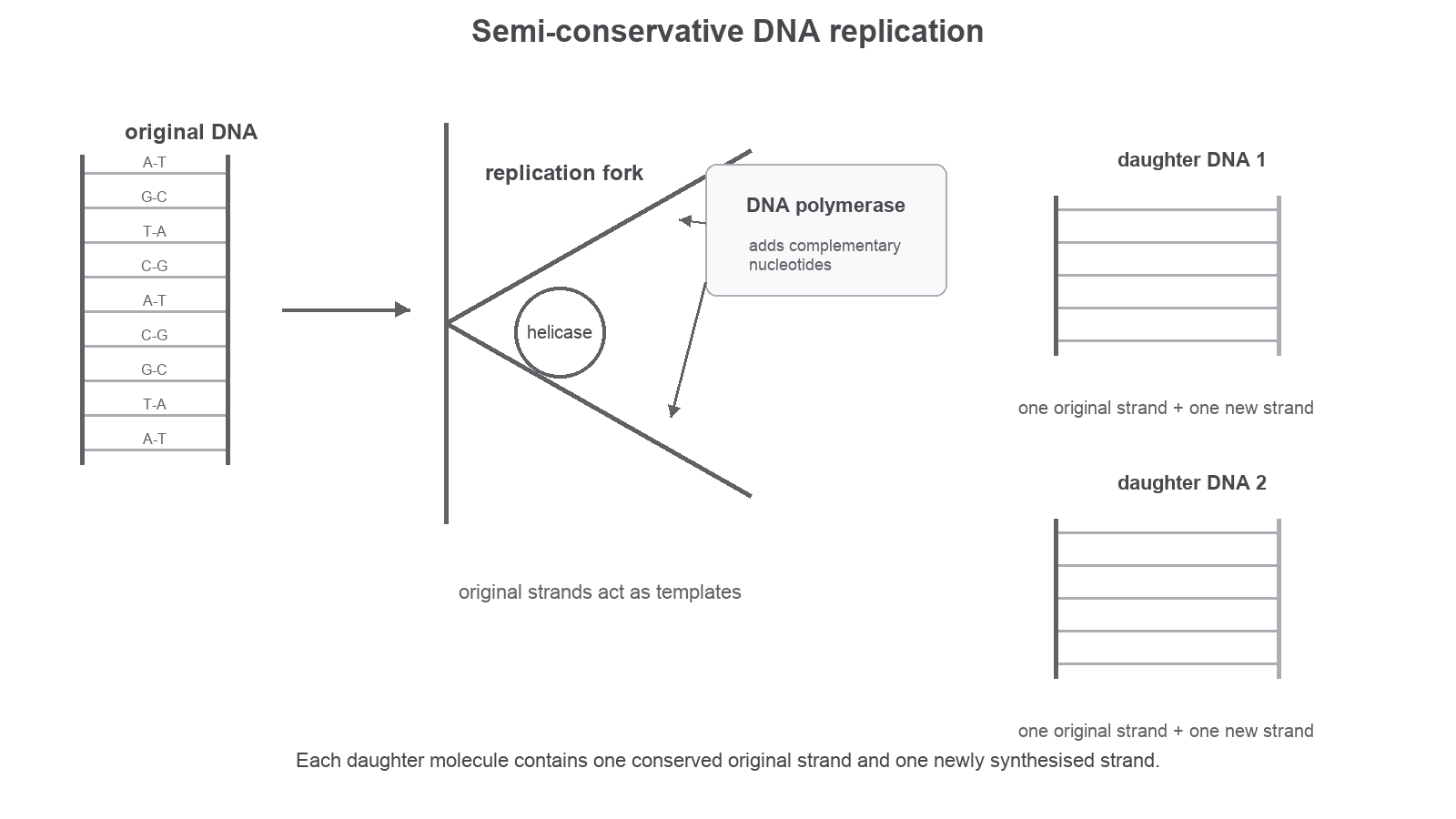
Do not describe helicase as "breaking the DNA strands". It breaks the hydrogen bonds between the bases. The sugar-phosphate backbone of each original strand remains intact, so each separated strand can be copied.
Do not describe DNA polymerase as "adding bases". It joins DNA nucleotides into a new strand. Each nucleotide includes a base, sugar and phosphate, so "DNA nucleotides" is the safer term.
Accuracy And Conservation
Replication conserves genetic information because the order of bases in each original strand determines the order of bases in the new strand. This is possible because base pairing is specific:
| Base on template strand | Base added to new strand |
|---|---|
| A | T |
| T | A |
| G | C |
| C | G |
Copying A Template Strand
A template strand has the base sequence:
A T G C C A
The new complementary strand will be:
T A C G G T
This is not a random sequence. It follows directly from complementary base pairing.
DNA polymerase is important for accuracy because it catalyses the joining of DNA nucleotides in the new strand and works from the template strand. If the correct complementary nucleotides are joined in the correct order, the genetic information is conserved in the DNA molecules passed to daughter cells.
Accuracy matters because genes are base sequences. If the base sequence is copied accurately, the same genetic instructions can be passed on. This is why replication is essential before cell division: each new cell needs a complete and accurate copy of the DNA.
For an "Explain why replication conserves genetic information" question, link template strands to complementary base pairing and then to the same base sequence being passed on.
Random Spontaneous Mutations
DNA replication is accurate, but it is not perfectly error-free. A mutation is a change in the DNA base sequence. In this lesson, the important point is that mutations can occur randomly and spontaneously.
Random spontaneous mutation
A change in the DNA base sequence that occurs by chance, without being directed by the organism's needs and without requiring a named external mutagen.
Random means the mutation does not occur because the cell or organism "needs" it. A bacterium does not mutate deliberately to survive an antibiotic; a random mutation may already be present, and the environment may later affect whether cells with that mutation survive.
Spontaneous means the mutation can arise naturally, for example if a base is copied incorrectly and the error is not corrected. Many copying errors are corrected, but if a change remains in the DNA base sequence, it can be passed on when that DNA is replicated again.
At this point in the course, you do not need to distinguish between types of mutation such as substitution, insertion or deletion. Those labels belong to a later genetics boundary. Here, keep the answer at the level of a random, spontaneous change in DNA base sequence.
Exam Precision
OCR-style questions on this idea often reward exact wording. The biology is not long, but small wording errors can change the meaning.
| Weak wording | Why it loses precision | Stronger wording |
|---|---|---|
| Helicase breaks the DNA. | It is unclear whether the backbone is being broken. | Helicase breaks hydrogen bonds between complementary bases. |
| DNA polymerase joins bases together. | Bases alone are not joined to make the strand. | DNA polymerase joins DNA nucleotides to form a new strand. |
| Replication is conservative. | That means the whole original molecule is kept together, which is not this model. | Replication is semi-conservative because each new molecule has one old and one new strand. |
| Mutations happen because the organism needs them. | This wrongly suggests directed change. | Mutations are random and spontaneous changes in DNA base sequence. |
When describing the process, use sequence words. A strong answer might say:
"Helicase breaks hydrogen bonds between complementary bases, separating the DNA strands. Each original strand acts as a template. Free DNA nucleotides pair with exposed bases by complementary base pairing. DNA polymerase joins the nucleotides to form new complementary strands. Each new DNA molecule contains one original strand and one newly synthesised strand."