2.1.2(h)-(i) - Triglycerides, phospholipids and ester bonds
In this lesson you are learning how triglycerides and phospholipids are built from glycerol and fatty acids. The key specification idea is structural: where the fatty acid chains attach, what saturated and unsaturated means, and how ester bonds form and break in triglycerides. Keep the boundary tight: lipid properties, cholesterol and full membrane structure come later.
Glycerol And Fatty Acids
Triglycerides and phospholipids are examples of lipid macromolecules. They are large biological molecules, but they are not polymers made from many repeating monomers in the same way that starch or a protein is. Their structure is built around glycerol and fatty acids.
Glycerol
Glycerol is a small three-carbon molecule with three hydroxyl groups, each able to form a bond to a fatty acid.
Fatty acid
A fatty acid has a carboxyl group at one end and a hydrocarbon chain made mainly from carbon and hydrogen atoms.
The hydrocarbon chain is the part that may be saturated or unsaturated.
| Fatty acid type | Structural feature | Exam-safe description |
|---|---|---|
| Saturated fatty acid | No carbon-carbon double bonds in the hydrocarbon chain | The carbon chain has only single bonds between neighbouring carbon atoms, so it carries the maximum number of hydrogen atoms possible |
| Unsaturated fatty acid | At least one carbon-carbon double bond in the hydrocarbon chain | The carbon chain does not carry the maximum possible number of hydrogen atoms; a double bond often produces a bend in simplified diagrams |
The word "saturated" refers to hydrogen atoms on the carbon chain, not to water, solubility or whether the molecule is found in animals or plants. An exam question can give a structural description and expect you to identify the fatty acid type from the bonds.
Triglyceride Structure
A triglyceride contains one glycerol molecule joined to three fatty acids. Each fatty acid is attached to one of glycerol's three hydroxyl positions. The fatty acids may be the same as each other, or they may be different lengths and different levels of saturation.
The bond between glycerol and each fatty acid is an ester bond. A triglyceride therefore has three ester bonds.
[DIAGRAM: triglyceride_phospholipid_structure: Lesson 022: Triglyceride and phospholipid structure - diagram 01; asset_slug: 022_m02_1_2_triglycerides_phospholipids_and_ester_bonds__diagram_01; recommended_method: drawn_biology; description: A clean 16:9 drawn biology schematic comparing a triglyceride with a phospholipid. The triglyceride panel shows a glycerol backbone, three ester bonds and three fatty acid tails, including saturated and unsaturated chain examples. The phospholipid panel shows a glycerol backbone, two fatty acid tails, ester bonds and a phosphate-containing head group.]
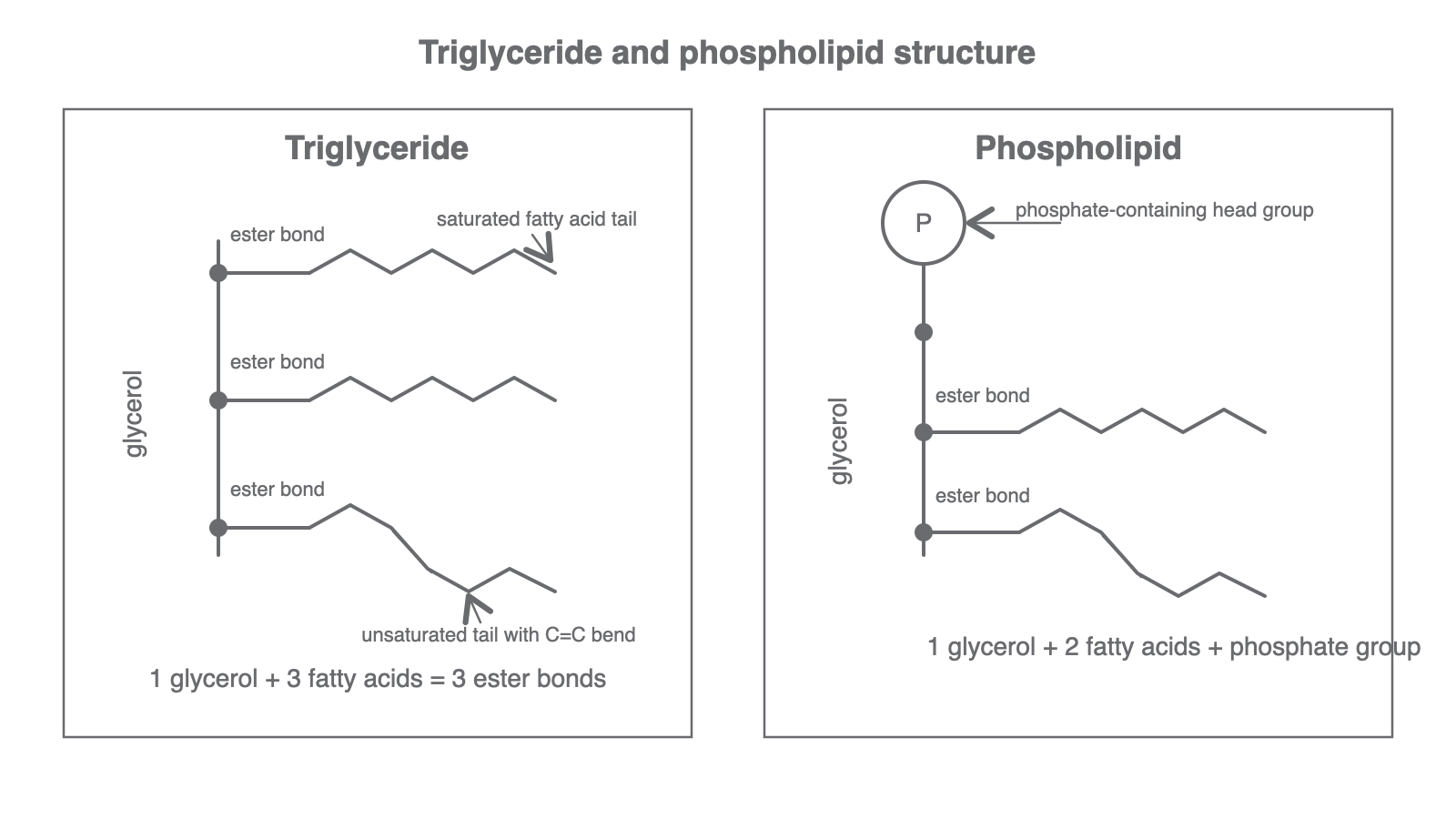
Use the diagram to anchor the count. One glycerol has three attachment positions, so a triglyceride can carry three fatty acid chains. Three chains means three joins to glycerol, and those joins are the three ester bonds.
If a question asks for the bond in a triglyceride, answer "ester bond". Do not write glycosidic bond or peptide bond; those belong to different biological molecules.
The specification uses triglycerides as examples of lipids and macromolecules here. The detailed reasons triglycerides are useful storage molecules are in the next lipid-properties lesson, so for this lesson the main target is the structure.
Condensation And Hydrolysis
Triglycerides are synthesised by condensation reactions. In this context, a condensation reaction joins a fatty acid to glycerol and releases one molecule of water.
The ester bond forms between:
- the hydroxyl group on glycerol
- the carboxyl group on a fatty acid
Because three fatty acids join to one glycerol, making one triglyceride forms three ester bonds and releases three water molecules.
Counting Water Molecules In Triglyceride Synthesis
One glycerol molecule reacts with three fatty acids to form one triglyceride.
Step 1: each fatty acid needs one join to glycerol.
Step 2: each join is an ester bond formed by condensation.
Step 3: each condensation releases one water molecule.
So one triglyceride contains three ester bonds and its synthesis releases three water molecules.
Hydrolysis is the reverse process. Hydrolysis uses water to break chemical bonds. Complete hydrolysis of a triglyceride breaks all three ester bonds, producing glycerol and three fatty acids.
Explaining Triglyceride Hydrolysis
A triglyceride is completely hydrolysed.
There are three ester bonds to break. One water molecule is used to break each ester bond. The products are one glycerol molecule and three fatty acid molecules.
A common error is to say that hydrolysis "makes water". That reverses the process. Condensation releases water; hydrolysis uses water.
Phospholipid Structure
A phospholipid has a similar glycerol-based starting pattern, but the third position is different. Instead of three fatty acids, a typical phospholipid has:
- one glycerol molecule
- two fatty acid chains
- a phosphate-containing group attached at the third position
This means a phospholipid has two fatty acid tails rather than three. The phosphate-containing part is often called the head group. The head-and-tail language is useful for recognising the structure, but the full properties and membrane roles are outside this lesson's main boundary.
Do not memorise the diagram as "one straight tail and one bent tail" as if every phospholipid must look exactly like that. The required idea is that fatty acids can be saturated or unsaturated, and phospholipids contain two fatty acid chains plus a phosphate-containing group.
| Feature | Triglyceride | Phospholipid |
|---|---|---|
| Glycerol present | Yes | Yes |
| Fatty acid chains | Three | Two |
| Phosphate-containing group | No | Yes, at the third position |
| Main bond focus in this lesson | Three ester bonds in triglyceride synthesis and breakdown | Structural recognition of two tails and a phosphate-containing head group |
Exam Precision Checks
This topic often rewards small, precise structural statements. Strong answers name the molecule, the smaller components, and the bond or reaction type.
For example, "a triglyceride has fatty acids" is too loose for a synthesis question. A better answer is: "one glycerol molecule joins to three fatty acids by condensation reactions, forming three ester bonds and releasing three water molecules."
Exam Precision Checks Summary
For this row, the centre of the lesson is the structural count: triglyceride equals glycerol plus three fatty acids joined by three ester bonds; phospholipid equals glycerol plus two fatty acids plus a phosphate-containing head group.
Explain It Back
Use this as a self-explanation check after the section above. It is for diagnosing what you can already explain, not for learning new material from scratch.
Use this final diagnostic check after you have revised the lesson, not before.