2.1.1(e)-(f) - Magnification, resolution and microscope comparisons
This lesson separates two ideas students often merge: magnification makes an image bigger, while resolution makes close structures distinguishable. You will also practise the magnification formula and choose between light, transmission electron and scanning electron microscopes from evidence.
Bigger Versus Clearer
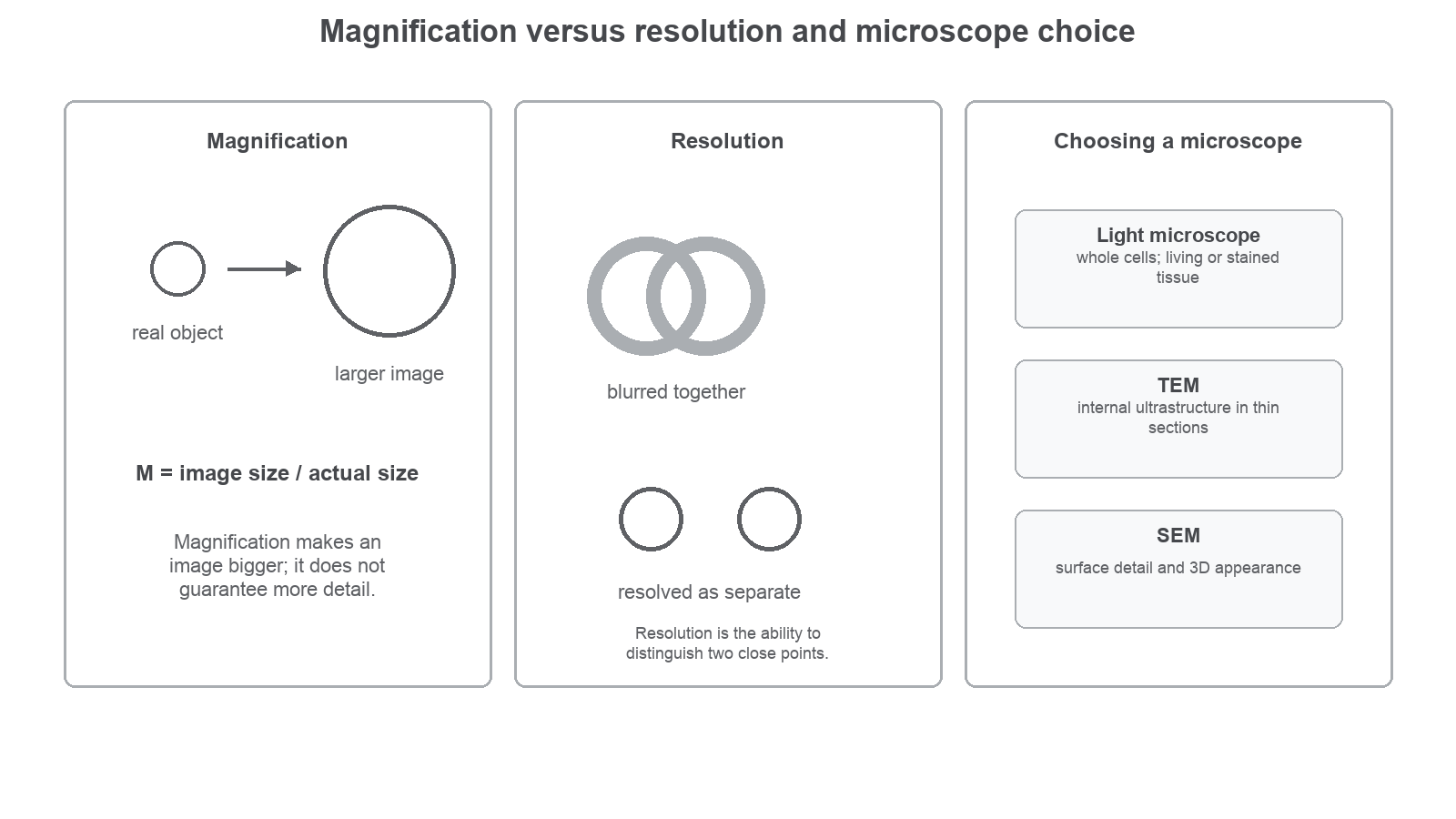
Magnification is how many times larger the image is than the real object. Resolution is the ability to distinguish two close points as separate.
If a microscope has poor resolution, increasing magnification only gives a larger blurred image. It does not reveal extra detail. This is why a cell can look bigger without its internal structures becoming clearer.
[DIAGRAM: magnification_resolution_comparison: Lesson 014: Magnification versus resolution and microscope comparison - diagram 01; asset_slug: 014_m02_1_1_magnification_resolution_and_microscope_comparisons__diagram_01; recommended_method: drawn_biology; description: Deterministic visual comparing magnified blurred points, resolved separate points, and light/TEM/SEM decision cues.]
Magnification
The ratio of image size to actual size.
Resolution
The ability to distinguish two close points or structures as separate.
Magnification Formula
The magnification formula is:
Magnification
Magnification is a ratio, so it has no unit. The image size and real size must be in the same unit before using the formula.
Useful conversions:
| Unit conversion | Meaning |
|---|---|
| 1 mm = 1000 micrometres | useful for light microscope cell sizes |
| 1 micrometre = 1000 nanometres | useful for very small structures |
| 1 m = 1,000,000 micrometres | useful for standard form |
Finding Actual Size
An image of a cell is 36 mm wide. The magnification is x400.
Rearrange:
Substitute:
Convert:
The actual cell width is 90 micrometres.
Microscope Resolution
Light microscopes use visible light. They are useful for living cells, stained cells, whole cells and tissues, but their resolving power is limited by the wavelength of light.
Electron microscopes use beams of electrons, which can give much higher resolving power. This allows smaller cell structures to be distinguished. The specification does not require exact magnification or resolution numbers for each microscope, so use relative comparison rather than memorising values.
Transmission electron microscopes, or TEMs, pass electrons through thin sections. They are useful for internal ultrastructure. Scanning electron microscopes, or SEMs, scan a specimen surface and produce a surface-detail image with a three-dimensional appearance.
If asked to choose a microscope, use the evidence in the question: living or colour observation suggests light microscopy; internal ultrastructure suggests TEM; surface detail suggests SEM.
Choosing A Microscope
Microscope choice depends on what information is needed.
| Need | Best microscope | Reason |
|---|---|---|
| Observe living cells or natural colour | Light microscope | specimen can be living and viewed with visible light |
| Identify internal organelles in a thin section | TEM | high resolution internal detail |
| Study surface projections such as cilia shape | SEM | surface detail with three-dimensional appearance |
| Measure actual size from a light microscope image | Light microscope with calibrated scale | graticule or scale information gives real size |
The safest answers do not overclaim. A TEM image can show internal detail in a thin section, but not a natural-colour living cell. An SEM image can show surface shape, but not internal organelle arrangement.
Calculation And Judgement
Magnification calculations and microscope-choice questions often test the same habit: use the evidence, keep units consistent and avoid vague words.
A good calculation answer shows:
- the formula or rearrangement
- a unit conversion if needed
- substitution
- the final value with the correct unit, or no unit for magnification
Calculation And Judgement Summary
Magnification is size ratio; resolution is separable detail. Microscope choice depends on the evidence needed, not on memorising exact resolution numbers.