2.1.3(d)(i)-(ii) - DNA structure and DNA precipitation
DNA stores genetic information because its structure is stable, specific and copyable. In this lesson you learn how two antiparallel DNA polynucleotides are held together by complementary base pairing, how this produces a double helix, and how a simple precipitation practical can release visible DNA-rich material from cells.
DNA Molecule Model
DNA stands for deoxyribonucleic acid. In OCR Biology, the structure you need here is a molecule made from two DNA polynucleotide strands. A polynucleotide is a chain of nucleotides; you have already met nucleotide structure and phosphodiester-linked polynucleotides in the previous lesson, so this lesson focuses on how two strands fit together to make DNA.
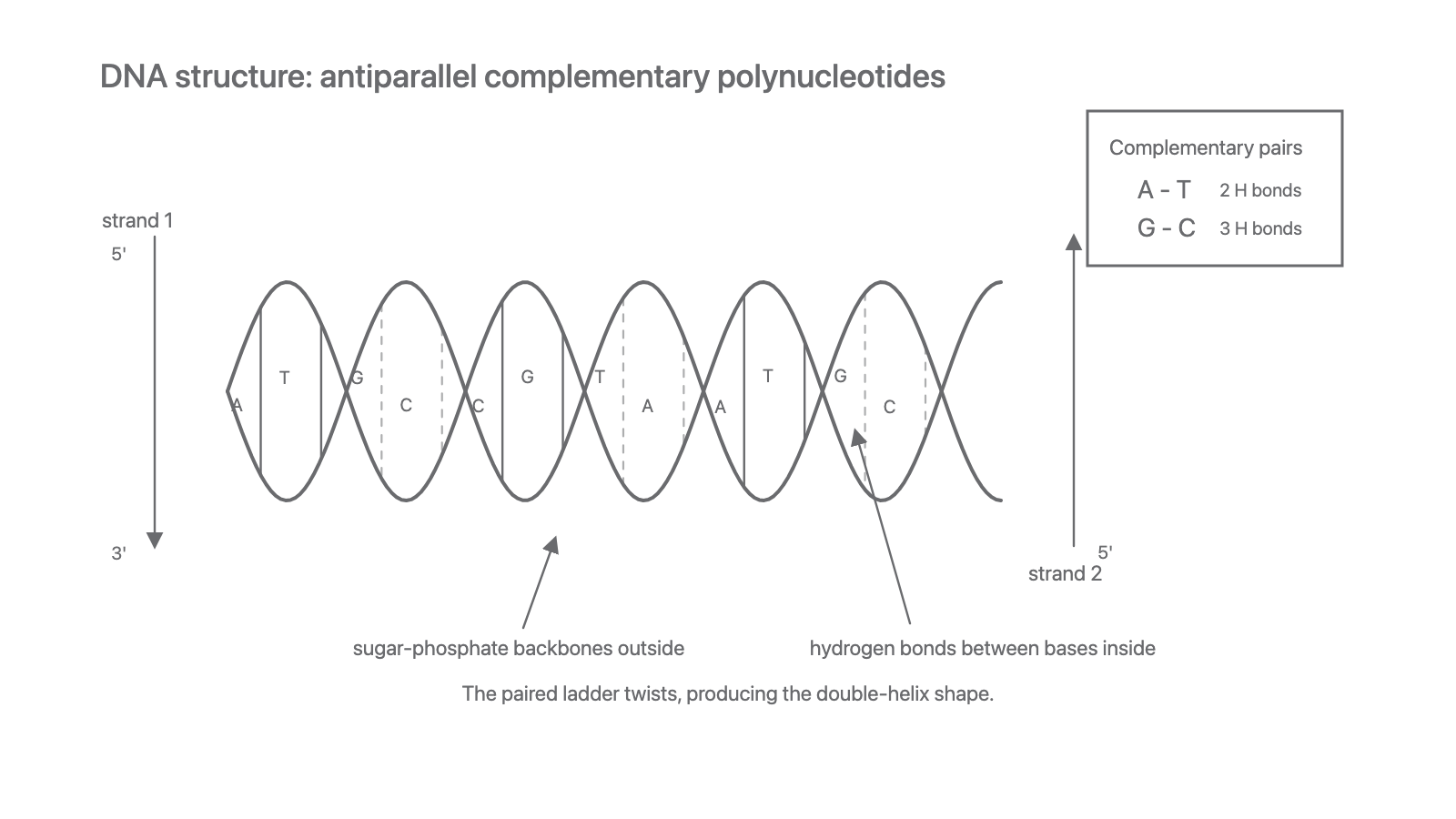
Each DNA strand has a sugar-phosphate backbone. In the double-stranded molecule, the two backbones run along the outside and the bases point inwards. The bases are the part that can pair with a base on the opposite strand.
Complementary base pairing
Specific pairing of DNA bases in which adenine pairs with thymine, and guanine pairs with cytosine.
Complementary base pairing means the base on one strand determines the base opposite it. If one strand has A, the opposite base is T. If one strand has G, the opposite base is C. This is not a random attraction; it is a specific structure-function relationship in the DNA molecule.
The diagram shows the core model. Use it to keep three ideas together: two backbones outside, bases inside, and the strands running in opposite directions.
[DIAGRAM: dna_double_helix_model: Lesson 32: DNA structure and DNA precipitation - diagram 01; asset_slug: 032_m02_1_3_dna_structure_and_dna_precipitation__diagram_01; recommended_method: drawn_biology; description: A clean 16:9 drawn biology diagram of a DNA double helix showing two antiparallel sugar-phosphate backbones, base pairs inside, A-T and G-C complementary pairs, hydrogen bonds and twisting into a double-helix shape.]
Antiparallel Strands
The two DNA strands are antiparallel. This means they run in opposite directions. You may see the ends labelled 5' and 3', but for this row the important idea is simpler: one strand runs one way, while the other strand runs the opposite way.
Antiparallel orientation matters because the bases on the two strands are correctly positioned to form complementary pairs. The strands are not two identical chains sitting side by side. They are two chains with opposite direction and matching base partners.
| Feature | Correct description | Common error to avoid |
|---|---|---|
| Strand direction | The two polynucleotide strands are antiparallel. | Saying both strands run in the same direction. |
| Base position | Bases point inwards and pair with bases on the opposite strand. | Putting the bases on the outside of the molecule. |
| Backbone position | Sugar-phosphate backbones are on the outside. | Treating the backbone as the part that carries the base sequence. |
Hydrogen bonds form between the complementary bases. These bonds hold the two strands together across the middle of the molecule. A-T pairs and G-C pairs fit because their bases can form the correct hydrogen-bonding pattern.
For "Describe the structure of DNA", include all three of these ideas: two antiparallel polynucleotide strands, complementary base pairs held by hydrogen bonds, and a double-helix shape.
Double Helix Shape
The base pairs make the two strands into a paired structure, rather like a ladder at first: the sugar-phosphate backbones are the sides and the hydrogen-bonded base pairs are the rungs. DNA is not a flat ladder, though. The paired strands twist, producing the double-helix shape.
Double helix
The twisted shape of a DNA molecule formed from two antiparallel polynucleotide strands held together by complementary base pairs.
This shape is important because it links the molecule's stability with its information-carrying role. The sugar-phosphate backbones protect the base pairs on the inside, while the base sequence remains available as stored genetic information.
Do not turn this into a detailed chemistry answer. OCR needs the structure named in the row: hydrogen bonding, complementary base pairs, antiparallel DNA polynucleotides and twisting into a double helix. Details such as major and minor grooves, exact helix dimensions and chromatin packing are outside this lesson boundary.
Precipitating DNA Practical
The practical investigation in this row is purification of DNA by precipitation. Precipitation means making a dissolved substance come out of solution as a solid. In a school DNA extraction, the visible solid is best described as a DNA-rich precipitate, because it may still contain some RNA, protein or salts.
The method works because DNA is inside cells and is associated with other cell material. A good method must release the DNA, separate it from some unwanted material, and then make it come out of solution.
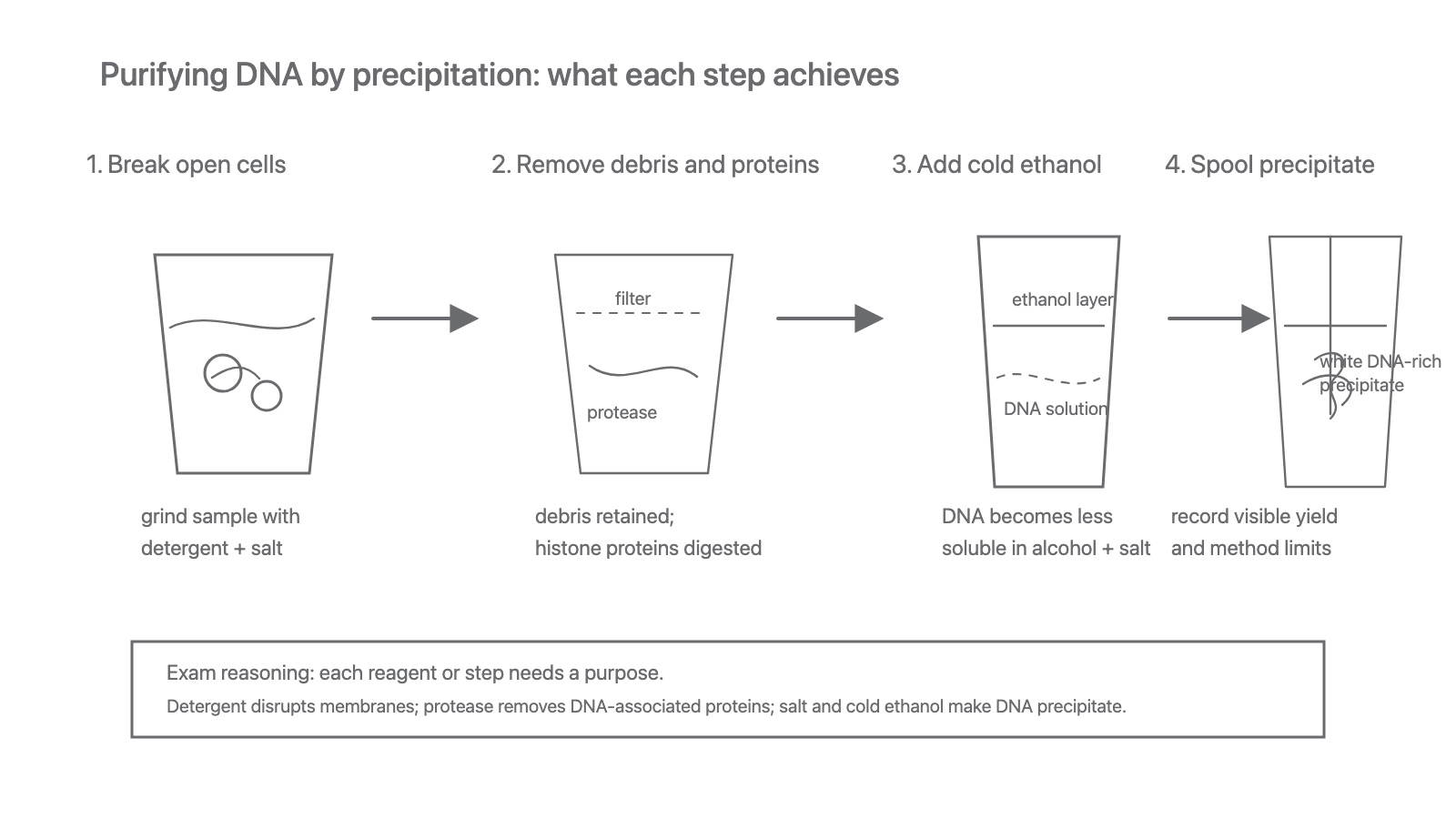
[DIAGRAM: dna_precipitation_workflow: Lesson 32: DNA structure and DNA precipitation - diagram 02; asset_slug: 032_m02_1_3_dna_structure_and_dna_precipitation__diagram_02; recommended_method: drawn_biology; description: A clean 16:9 drawn biology workflow diagram showing DNA precipitation steps: breaking open cells with detergent and salt, filtering/removing debris and proteins with protease, adding cold ethanol, and spooling a white DNA-rich precipitate.]
| Method step | Purpose |
|---|---|
| Crush or grind the sample | Breaks up tissue and can open plant cell walls, increasing DNA release. |
| Add detergent | Disrupts plasma membranes and nuclear membranes, releasing DNA. |
| Add salt | Helps DNA become less soluble and helps it clump when alcohol is added. |
| Add protease | Digests DNA-associated proteins such as histones and other proteins. |
| Filter the mixture | Removes larger insoluble debris from the DNA-containing solution. |
| Add cold ethanol carefully | DNA is not soluble in cold alcohol, so DNA-rich material precipitates and can be spooled. |
Cold ethanol is used because it improves visible precipitation and helps reduce enzyme activity that could damage DNA. Ethanol is flammable, so it must be kept away from flames, and the practical needs eye protection, hygienic handling of biological material, and the risk controls set by the teacher or local guidance.
Explaining Reagent Purpose
A student adds detergent to a mashed fruit sample before filtering it. The strong explanation is:
"Detergent disrupts the phospholipid membranes around the cells and nuclei. This releases DNA into the solution so that it can later be precipitated."
The weaker explanation is "detergent breaks down the cells" because it does not identify membranes or link the step to DNA release.
After the detergent step, protease has a different purpose. It does not release DNA by breaking membranes. It digests proteins, including DNA-associated proteins, so the DNA-rich material is less contaminated by protein.
Judging The Method
A practical answer should connect each observation to the method. Seeing white stringy material after adding alcohol supports that DNA-rich material has precipitated, but it does not prove the sample is pure DNA. A careful conclusion says what the method supports and what its limits are.
Here is the reasoning sequence:
- Cells must be opened so DNA can enter solution.
- Membranes and proteins must be dealt with because DNA is inside nuclei and associated with proteins.
- Cold ethanol must be added because DNA is insoluble in alcohol in the presence of salt.
- The visible white/stringy material is recorded as DNA-rich precipitate, not automatically pure DNA.
In method-evaluation questions, do not just name a missing reagent. Link the missing reagent to the consequence for DNA release, protein removal or precipitation.
For example, if a method uses salt and ethanol but no detergent, the problem is not just "detergent is missing". The consequence is that cell-surface and nuclear membranes may not be disrupted properly, so less DNA may be released into the solution.