2.1.2(p) - Inorganic ions in biological processes
Inorganic ions are small charged particles, but they are involved in many of the biological processes you meet across the course. This lesson keeps the boundary tight: you need to recognise the required ion symbols, know whether each ion is positive or negative, and connect each one with a sensible biological role cue. The aim is precision, not a long tour of every later mechanism.
Ions And Symbols
An ion is an atom or group of atoms with an overall charge. The charge matters because it affects how the particle dissolves in water, interacts with proteins, moves through channels or carriers, and contributes to electrical or pH gradients.
Inorganic ion
A charged atom or charged group of atoms that is not part of a large carbon-based biological molecule.
There are two useful groups.
| Type of ion | Charge | OCR examples in this lesson |
|---|---|---|
| Cation | Positive | Ca2+, Na+, K+, H+, NH4+ |
| Anion | Negative | NO3-, HCO3-, Cl-, PO4^3-, OH- |
The number and sign in the symbol are not decoration. Ca2+ means a calcium ion with a 2+ charge. Ca means a calcium atom. Ca+ would be the wrong ion for this specification row.
The symbols with several atoms need special care. NH4+ is ammonium, NO3- is nitrate, HCO3- is hydrogencarbonate, PO4^3- is phosphate, and OH- is hydroxide. Hydrogencarbonate is often called bicarbonate in physiology sources, but OCR uses hydrogencarbonate.
Cation Role Cues
Cations are positive ions. In biological systems they are usually dissolved in water, distributed unevenly between compartments, or bound briefly to proteins and other molecules. You do not need every later mechanism here, but you should have a role cue for each required cation.
| Cation | Name | Useful biological role cue |
|---|---|---|
Ca2+ | calcium ion | Mineralised tissues such as bones and teeth; signalling in muscle contraction, synapses and blood clotting. |
Na+ | sodium ion | Major extracellular ion; membrane potentials and cotransport contexts. |
K+ | potassium ion | Major intracellular ion; membrane potentials and stomatal opening contexts. |
H+ | hydrogen ion | pH, acid-base changes and proton gradients used in ATP synthesis. |
NH4+ | ammonium ion | A form of fixed nitrogen in plant and nitrogen-cycle contexts. |
For exam precision, separate the ion from the element. Sodium as an element has the symbol Na; a sodium ion is Na+. Potassium as an element has the symbol K; a potassium ion is K+. Calcium has a 2+ charge in the required symbol, so write Ca2+, not Ca+.
If a question asks for an ion, include the charge. A symbol without the charge may describe the element rather than the ion.
For example, an answer about nerve impulses might mention Na+ and K+ because these ions form electrochemical gradients across membranes. This lesson does not require a full action-potential sequence; it only requires you to recognise the ions and their role cue.
Anion Role Cues
Anions are negative ions. Some are single atoms, such as chloride. Others are groups of atoms, such as nitrate, hydrogencarbonate, phosphate and hydroxide. The group stays together as one charged ion in the symbol.
| Anion | Name | Useful biological role cue |
|---|---|---|
NO3- | nitrate ion | Fixed nitrogen source used by plants to make amino acids, proteins and nucleic acids. |
HCO3- | hydrogencarbonate ion | Carbon dioxide transport and blood buffering contexts. |
Cl- | chloride ion | Charge balance, chloride shift and acid-base contexts. |
PO4^3- | phosphate ion | ATP, nucleotides, phospholipids and mineralised tissues. |
OH- | hydroxide ion | Alkaline ion that can combine with H+ and change pH. |
Phosphate is a good example of why role cues are more useful than isolated memorisation. A phosphate group is part of ATP, and ATP links energy release to cellular work. Phosphate is also part of nucleotides, so it appears in DNA and RNA, and it is present in phospholipids. The required recognition symbol in this row is PO4^3-.
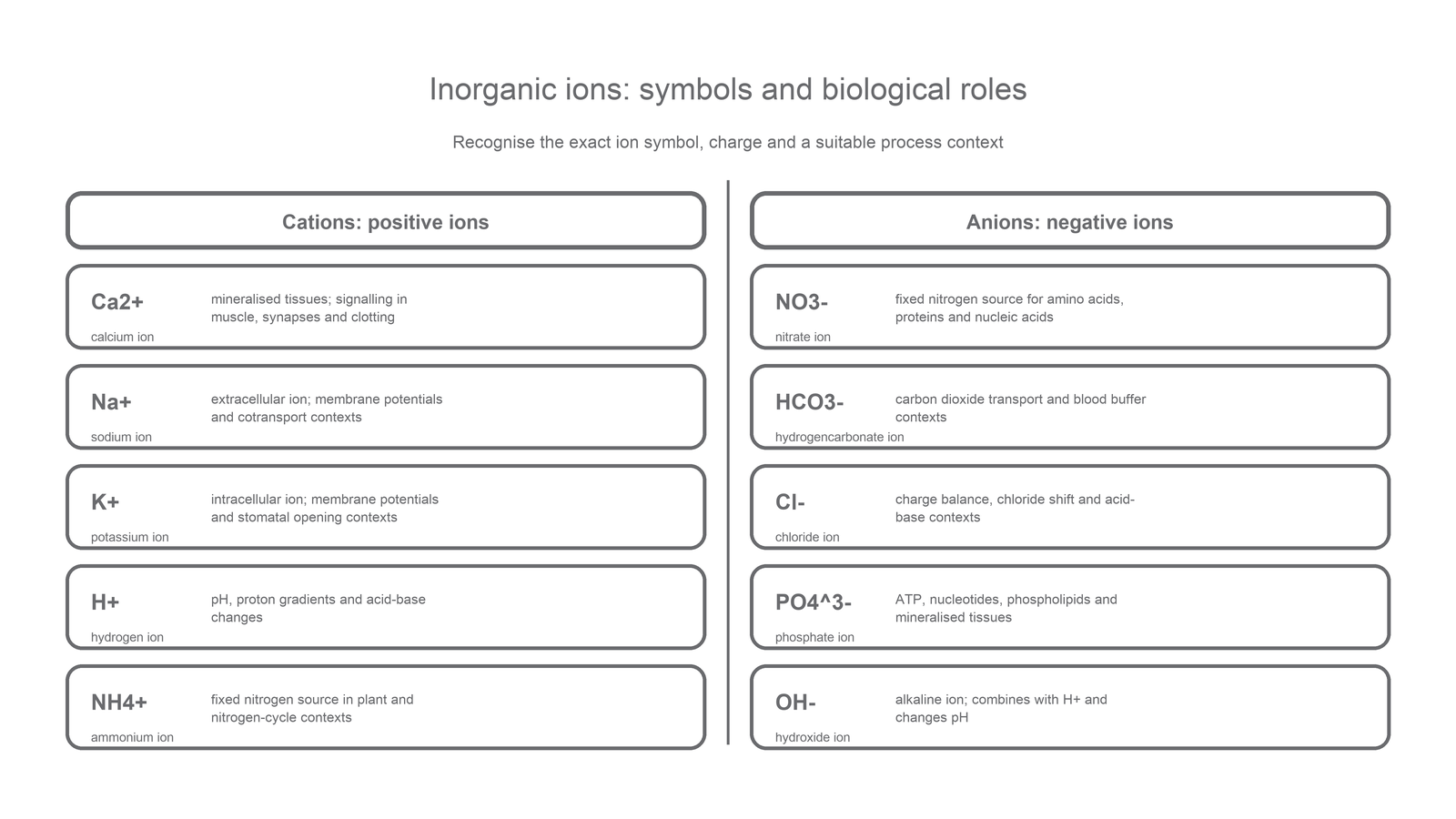
The diagram gathers the required cations and anions with short role cues. Use it as a checking map, not as a separate mechanism to memorise.
[DIAGRAM: inorganic_ion_roles_map: Lesson 26: Inorganic ion symbols and biological roles - diagram 01; asset_slug: 026_m02_1_2_inorganic_ions_in_biological_processes__diagram_01; recommended_method: drawn_biology; description: A clean 16:9 role-map diagram with two columns, grouping OCR-required cations and anions by symbol, charge group, ion name and concise biological role cue.]
Using Ion Clues
Many biological questions give a process cue, then expect you to identify the correct ion. The useful habit is to ask: is the question about pH, charge across a membrane, a nitrogen source, a carbon dioxide buffer, ATP, or mineralised tissue?
Matching A Context To An Ion
A question says that carbon dioxide produced by respiring cells is carried in the blood plasma mainly as an ion. The clue is carbon dioxide transport and blood buffering, so the ion is hydrogencarbonate, HCO3-.
A question says that a plant uses an ion absorbed by its roots as a nitrogen source for making amino acids. A suitable ion is nitrate, NO3-, and ammonium, NH4+, may also be a nitrogen-source context.
A question says that an ion gradient across a membrane is used to drive ATP synthesis. The clue is a proton gradient, so the ion is hydrogen, H+.
Notice the level of detail in the examples. You are not being asked in this lesson to describe carbon dioxide transport, nitrogen cycling or oxidative phosphorylation step by step. You are learning the ion symbols and the biological context that makes each one recognisable.
Boundaries And Common Errors
The exact boundary for this lesson is the required set of inorganic ions and their symbols. It is useful to know short biological role cues, but do not turn this row into a detailed lesson on nerves, muscles, respiration, photosynthesis, kidney control, blood clotting, plant mineral deficiencies or nutrient cycles.
Common errors are usually symbol errors.
| Error | Why it loses precision | Better answer |
|---|---|---|
Writing Ca for calcium ion | This is the element symbol, not the ion. | Ca2+ |
Writing PO4- for phosphate | The charge is wrong for the required OCR symbol. | PO4^3- |
| Mixing nitrate and ammonium | Both contain nitrogen, but they are different ions with different symbols and charges. | NO3- and NH4+ |
Calling HCO3- carbonic acid | Carbonic acid is a molecule, not the hydrogencarbonate ion. | HCO3- |
Treating OH- as the same as H+ | They have opposite charges and opposite pH effects. | OH- is hydroxide; H+ is hydrogen ion. |
For this row, full-credit precision means the correct ion name, the correct symbol and charge, and a role cue that stays inside the lesson boundary.