2.1.2(f)-(g) - Starch, glycogen and cellulose structure-function
This lesson is about how a small difference in glucose bonding changes the job of a carbohydrate. Starch, glycogen and cellulose are all polysaccharides made from glucose, but they are not interchangeable: their linkage pattern and branching decide whether they are useful for storage or support. The key skill is to explain the link from structure to function using precise biological terms.
Glucose To Polysaccharides
Glucose is a small, soluble monosaccharide. That makes it useful because it can be transported in solution and used as a respiratory substrate, but it also creates a problem: a high concentration of free glucose molecules would lower the water potential of a cell. Water could then move into the cell by osmosis.
A storage molecule solves this by joining many glucose monomers into one much larger polysaccharide. The same mass of glucose stored as a few large polymer molecules has a much smaller effect on water potential than thousands of separate glucose molecules. The polymer can also be stored compactly and hydrolysed later when glucose is needed.
Polysaccharide
A carbohydrate polymer made from many monosaccharide units joined by glycosidic bonds.
For this OCR row, the important polysaccharides are starch, glycogen and cellulose.
| Molecule | Main glucose form | Main biological role |
|---|---|---|
| Starch | alpha-glucose | Energy storage in plants |
| Glycogen | alpha-glucose | Energy storage in animals |
| Cellulose | beta-glucose | Structural support in plant cell walls |
The table is a starting point, not a full answer. A good structure-function explanation must say what feature of the molecule produces the function. For example, "glycogen stores glucose" is not enough. A stronger answer says that glycogen is highly branched, so it has many ends where glucose units can be removed quickly.
Starch In Plants
Starch is the storage polysaccharide in plants. It is not one single chain type. It is a mixture of amylose and amylopectin, and both are made from alpha-glucose.
Amylose is an unbranched chain of alpha-glucose molecules joined by alpha-1,4 glycosidic bonds. The chain coils into a compact helix. That compact shape helps plant cells store glucose without taking up too much space.
Amylopectin is also made from alpha-glucose, but it is branched. Most glucose units are joined by alpha-1,4 glycosidic bonds along the chains. Branch points are formed by alpha-1,6 glycosidic bonds. Branching gives amylopectin more ends than amylose, so enzymes can remove glucose units from more places when the plant needs glucose.
The diagram compares the four structures in this lesson. Use it to connect each structure to a function, not just to remember a shape.
[DIAGRAM: polysaccharide_structure_function_map: Lesson 21: Starch, glycogen and cellulose structure-function - diagram 01; asset_slug: 021_m02_1_2_starch_glycogen_and_cellulose_structure_function__diagram_01; recommended_method: drawn_biology; description: A clean 16:9 schematic comparing amylose coil, amylopectin branch, glycogen highly branched granule and cellulose beta-linked parallel chains with hydrogen bonds, using exact labels for alpha-1,4, alpha-1,6, beta-1,4 and function links.]
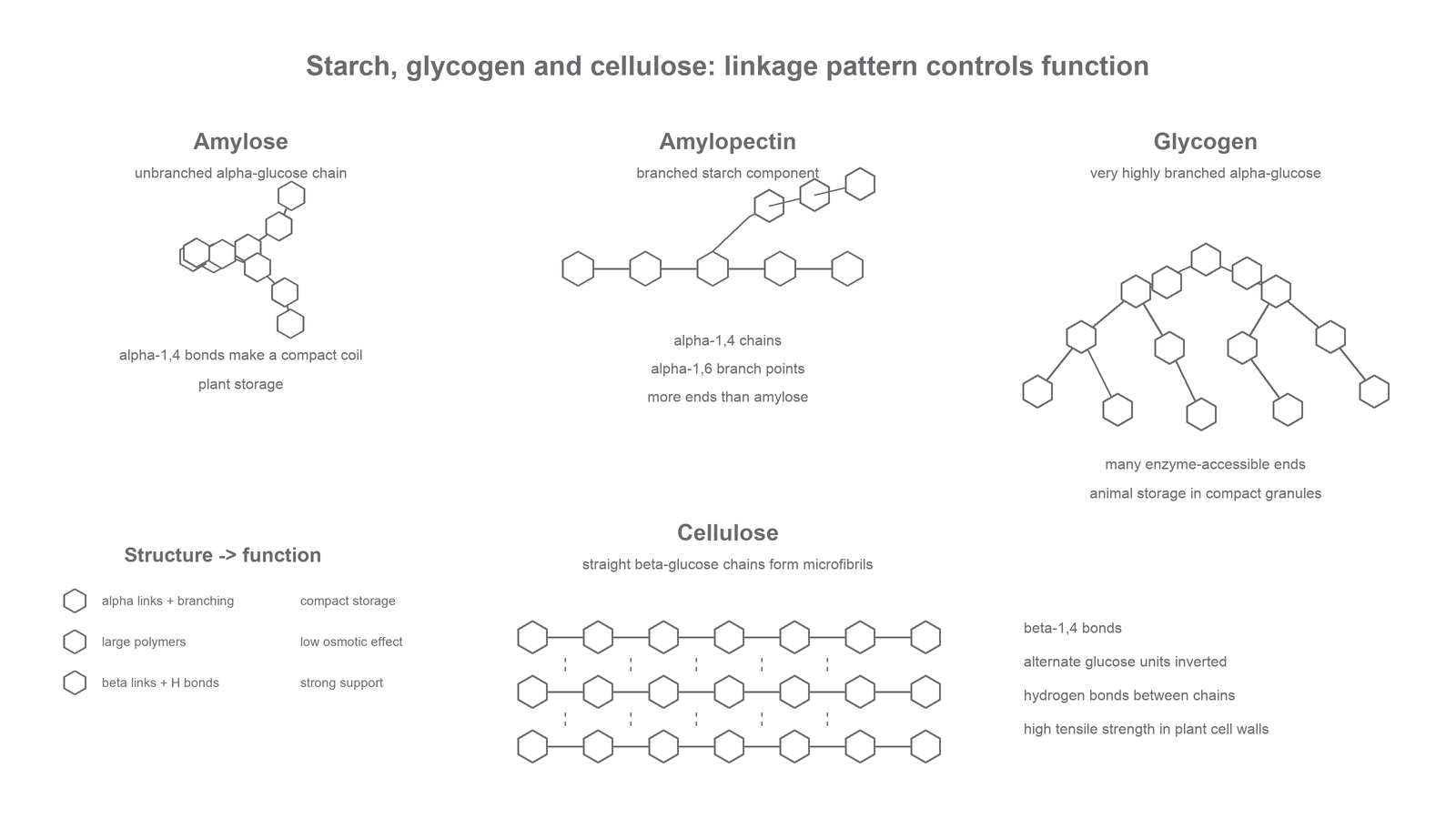
Starch is useful for plant storage because it is large, compact and relatively insoluble. It can remain inside plant cells as a store of glucose, then be broken down when glucose is needed for respiration or for making other biological molecules. The detailed chemical test for starch is not part of this lesson; here the focus is structure and function.
If asked to describe starch structure, name both amylose and amylopectin. If the question is specifically about amylose, do not add alpha-1,6 branches; amylose is unbranched.
Glycogen Storage
Glycogen is the storage polysaccharide in animals. It is made from alpha-glucose and has alpha-1,4 glycosidic bonds in its chains plus alpha-1,6 glycosidic bonds at branch points. In that way it is similar to amylopectin.
The key difference is degree of branching. Glycogen is more highly branched than amylopectin. This gives glycogen many terminal glucose units, often called chain ends. Enzymes can act at these ends, so glucose can be released quickly when an animal cell needs it.
This matters in tissues with changing energy demand, such as liver and muscle. Liver glycogen can help supply glucose to the body, while muscle glycogen provides a local glucose store for muscle activity. The metabolic pathways that control this are outside this lesson; the structure-function point is the branching.
Explaining Branching
A weak answer says: "Glycogen is branched, so it is good for storage."
A stronger answer says: "Glycogen is highly branched, so it has many ends where glucose units can be removed by enzymes. This allows rapid release of glucose when animal cells need it for respiration."
Glycogen is also compact and stored as granules. Like starch, it allows glucose to be stored with much less osmotic effect than the same number of separate glucose molecules.
Cellulose Support
Cellulose is different because it is made from beta-glucose, not alpha-glucose. Beta-glucose molecules join by beta-1,4 glycosidic bonds. Because of this linkage, alternate glucose units are inverted, so the chain is straight rather than coiled or highly branched.
Straight cellulose chains can lie parallel to each other. Hydrogen bonds form between hydroxyl groups on neighbouring chains. Individually, each hydrogen bond is weak, but many hydrogen bonds together hold the chains firmly side by side. The result is a cellulose microfibril with high tensile strength.
Tensile Strength
The ability to resist being stretched or pulled apart.
Cellulose microfibrils are important in plant cell walls. They give support, help maintain cell shape, and resist the internal pressure that develops when water enters plant cells. This is a structural role, not a glucose-storage role, because most animals do not have enzymes that hydrolyse beta-1,4 glycosidic bonds in cellulose.
| Feature | Cellulose consequence | Function |
|---|---|---|
| Beta-1,4 glycosidic bonds | Straight chains | Chains pack closely together |
| Alternate glucose units inverted | Regular extended structure | Parallel chains can align |
| Many hydrogen bonds between chains | Strong microfibrils | Support in plant cell walls |
| No branching | Fibres rather than compact granules | Structural strength rather than rapid glucose release |
Precision In Explanations
The common error in this topic is to know the general role but lose the structural precision. OCR-style questions often reward the exact bond type or the exact comparison. "Branched" is not always enough. "Alpha-1,6 branch points" is stronger when the question asks about amylopectin or glycogen. "Made of glucose" is not enough for cellulose. "Beta-1,4 bonds form straight chains that hydrogen-bond into microfibrils" is the function-linked explanation.
Use this sequence when answering structure-function questions:
- Name the molecule.
- State the monomer and bond pattern.
- Describe the shape or property produced by that pattern.
- Link that property to the function in living organisms.
Choosing The Relevant Feature
Question: Explain why glycogen can release glucose more rapidly than amylose.
Answer: Glycogen is highly branched, with alpha-1,6 glycosidic bonds at branch points, whereas amylose is unbranched. The many branches give glycogen many chain ends, so enzymes can remove glucose from many points at the same time.
Notice what the answer does not do. It does not describe cellulose, iodine tests, respiration pathways or detailed digestion. It stays inside the comparison asked for and links structure to function directly.
Precision In Explanations Continued
Use that diagnostic answer to check whether you are explaining the cause of the function, not just naming the function.
The same glucose monomer can produce very different biological functions because alpha or beta linkage, branching and hydrogen bonding change the three-dimensional structure of the polysaccharide.