2.1.3(a)-(b) - Nucleotides and phosphodiester-linked polynucleotides
Nucleic acids such as DNA and RNA are built from smaller monomers called nucleotides. In this lesson you will learn what a nucleotide contains, how DNA and RNA nucleotides differ, and how nucleotides join into polynucleotides through phosphodiester bonds. This is the molecular foundation for later lessons on DNA structure, replication and protein synthesis, but those later processes are not the target here.
The parts of a nucleotide
A nucleotide is the monomer used to make nucleic acids. Each nucleotide has three parts: a phosphate group, a pentose sugar and a nitrogenous base. A pentose sugar has five carbon atoms. The nitrogenous base is the part that varies between nucleotide types, while the sugar and phosphate help form the repeating backbone of a polynucleotide.
Nucleotide
A monomer of a nucleic acid made from a phosphate group, a pentose sugar and a nitrogenous base.
Do not reduce a nucleotide to "a base". The base is only one component. The full nucleotide includes the sugar and phosphate group as well.
[DIAGRAM: nucleotide_and_phosphodiester_backbone: Lesson 030: Nucleotides and phosphodiester-linked polynucleotides - diagram 01; asset_slug: 030_m02_1_3_nucleotides_and_phosphodiester_linked_polynucleotides__diagram_01; recommended_method: drawn_biology; description: Exact grey-line schematic on a white background showing a nucleotide as phosphate group, pentose sugar and nitrogenous base, plus two adjacent nucleotides joined by a phosphodiester bond in a sugar-phosphate backbone.]
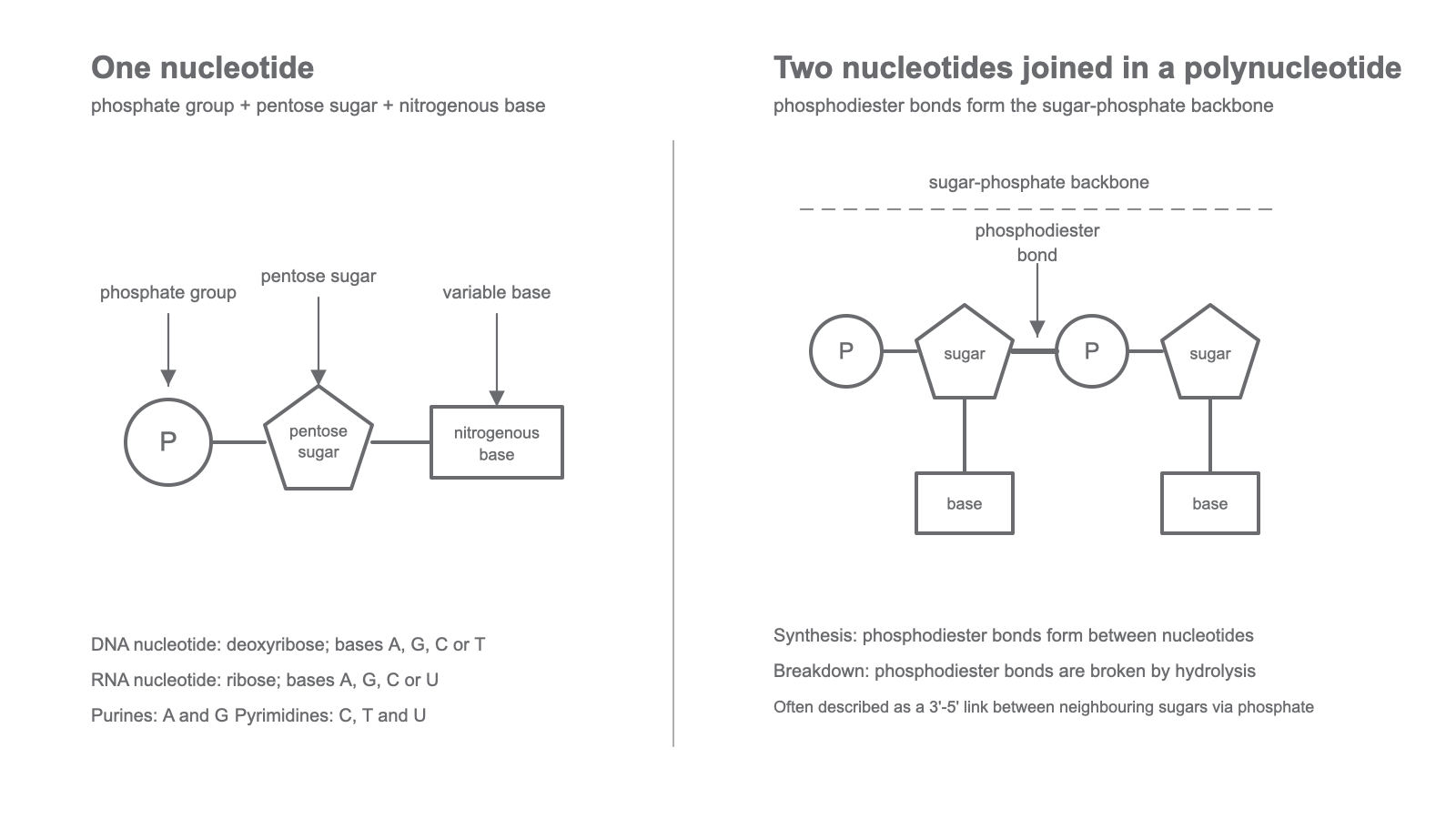
The diagram separates two ideas that are often blurred. One nucleotide has three components. A polynucleotide is many nucleotides joined together, with the sugars and phosphates forming a repeating backbone.
DNA and RNA nucleotides
OCR expects you to identify the differences between DNA nucleotides and RNA nucleotides. The most important difference is the type of pentose sugar. DNA nucleotides contain deoxyribose. RNA nucleotides contain ribose.
The bases also differ. DNA nucleotides can contain adenine, guanine, cytosine or thymine. RNA nucleotides can contain adenine, guanine, cytosine or uracil.
| Feature | DNA nucleotide | RNA nucleotide |
|---|---|---|
| Pentose sugar | Deoxyribose | Ribose |
| Bases that may be present | Adenine, guanine, cytosine, thymine | Adenine, guanine, cytosine, uracil |
| Base found here but not in the other nucleic acid | Thymine | Uracil |
The bases can also be grouped by ring type. Adenine and guanine are purines. Cytosine, thymine and uracil are pyrimidines. For this lesson, that classification is enough: you do not need to use ring diagrams to explain why they are purines or pyrimidines.
In an OCR-style answer, "DNA has thymine and RNA has uracil" is incomplete if the question asks for nucleotide differences. Include the pentose sugar: deoxyribose in DNA nucleotides and ribose in RNA nucleotides.
Later lessons use base pairing, hydrogen bonds, antiparallel strands and the double helix. Keep those ideas out of your answer unless the question has clearly moved on to DNA structure.
Purines and pyrimidines
Purines and pyrimidines are categories of nitrogenous base. The safest way to learn them is as two short groups:
| Group | Bases |
|---|---|
| Purines | Adenine and guanine |
| Pyrimidines | Cytosine, thymine and uracil |
A useful check is that the two purines are present in both DNA and RNA nucleotides. Cytosine is also present in both, but thymine is associated with DNA nucleotides and uracil with RNA nucleotides.
Identifying a nucleotide component
A student is told that molecule X is a nitrogenous base found in RNA but not DNA. The phrase "found in RNA but not DNA" points to uracil. Uracil is a pyrimidine, so the full identification is "uracil, a pyrimidine base".
Notice the order of reasoning: first identify the base from the DNA/RNA clue, then classify it as a purine or pyrimidine. Do not call the whole nucleotide a purine or a pyrimidine; only the nitrogenous base is being classified.
Phosphodiester bonds in polynucleotides
A polynucleotide is a polymer made from many nucleotide monomers. Adjacent nucleotides are joined by phosphodiester bonds. A phosphodiester bond is a covalent bond involving a phosphate group and the pentose sugars of neighbouring nucleotides.
During synthesis, phosphodiester bonds form between nucleotides. This is a condensation reaction, so a water molecule is released when the bond forms. During breakdown, phosphodiester bonds are broken. This is hydrolysis, so water is used to break the bond.
Phosphodiester bond
A covalent bond that links nucleotides in a polynucleotide by joining the phosphate group of one nucleotide to the pentose sugar of another.
The repeated sugar-phosphate-sugar-phosphate pattern is called the sugar-phosphate backbone. The nitrogenous bases project from this backbone. At this point, do not add hydrogen bonds or complementary base pairs to your answer unless the question asks about DNA structure rather than a single polynucleotide.
Classifying bond changes
A short polynucleotide is synthesised from separate nucleotides. Because nucleotide monomers are being joined into a polymer, phosphodiester bonds are formed. If the same polynucleotide is digested into separate nucleotides, phosphodiester bonds are broken by hydrolysis.
That distinction is a common mark-scheme hinge: formation for synthesis, breakage for breakdown.
Using models to inspect nucleotide structure
This specification row is linked to PAG10, which can involve computer modelling. A molecular model such as RasMol or Mol* can help you inspect where the phosphate groups, pentose sugars and nitrogenous bases sit in a nucleic-acid structure. For this lesson, the useful modelling skill is not "memorise a pretty shape"; it is using the model to make accurate identifications.
A good modelling note might record:
| Model observation | Biological interpretation |
|---|---|
| Repeating phosphate and sugar units | Evidence of a sugar-phosphate backbone |
| Bases attached to sugars | Bases are components of nucleotides, not separate monomers in the polymer |
| Ribose or deoxyribose label in the model file | Helps decide whether a nucleotide belongs to RNA or DNA |
| Bond between neighbouring sugar-phosphate units | Identifies where phosphodiester bonds link nucleotides |
The model has limits. It can help you visualise a structure, but your written answer still needs biological terms: nucleotide, phosphate group, pentose sugar, nitrogenous base, purine, pyrimidine and phosphodiester bond.
Precision check
The main errors in this lesson are all small wording errors that change the biology. A nucleotide is not just a base. A nitrogenous base is not joined to the next nucleotide by a hydrogen bond in a single polynucleotide. DNA nucleotides contain deoxyribose; RNA nucleotides contain ribose. Phosphodiester bonds join nucleotides into a polynucleotide backbone.
Nucleotides are phosphate-sugar-base monomers. DNA and RNA nucleotides differ in sugar type and in thymine/uracil use. Polynucleotides form when phosphodiester bonds join nucleotide sugars and phosphates into a backbone.
Use this final diagnostic explanation to test whether the pieces fit together.