2.1.3(f) - The nature of the genetic code
In this lesson you learn how the base sequence in a gene determines the sequence of amino acids in a polypeptide. The focus is the nature of the genetic code: it is triplet, non-overlapping, degenerate and universal. The lesson stays at the level of the code itself, with only a light bridge to mRNA because the detailed mechanisms of transcription and translation come next.
The Code Connects Sequences
A gene is a length of DNA whose base sequence can determine the amino acid sequence in a polypeptide. The amino acid sequence is the primary structure of a protein. The genetic code is the set of rules that connects the order of bases in a gene to the order of amino acids in the polypeptide made from that gene.
Genetic code
The rules by which a sequence of bases is interpreted as a sequence of amino acids in a polypeptide.
The key word is sequence. DNA is a sequence of bases, not a sequence of amino acids. A polypeptide is a sequence of amino acids. The genetic code is the bridge between those two different kinds of sequence.
The code is read in groups of three bases. A group of three bases is called a triplet. When the triplet is on mRNA it is usually called a codon. Keep the wording precise: a DNA gene has a base sequence; mRNA has codons; the polypeptide has amino acids.
[DIAGRAM: gene_triplet_code_to_primary_structure: Lesson 034: The nature of the genetic code - diagram 01; asset_slug: 034_m02_1_3_the_nature_of_the_genetic_code__diagram_01; recommended_method: drawn_biology; description: Deterministic 16:9 grey-line schematic showing a DNA coding-strand example grouped into non-overlapping triplets, corresponding mRNA codons, resulting amino-acid sequence as primary structure, plus compact panels for triplet/non-overlapping, degenerate and universal properties.]
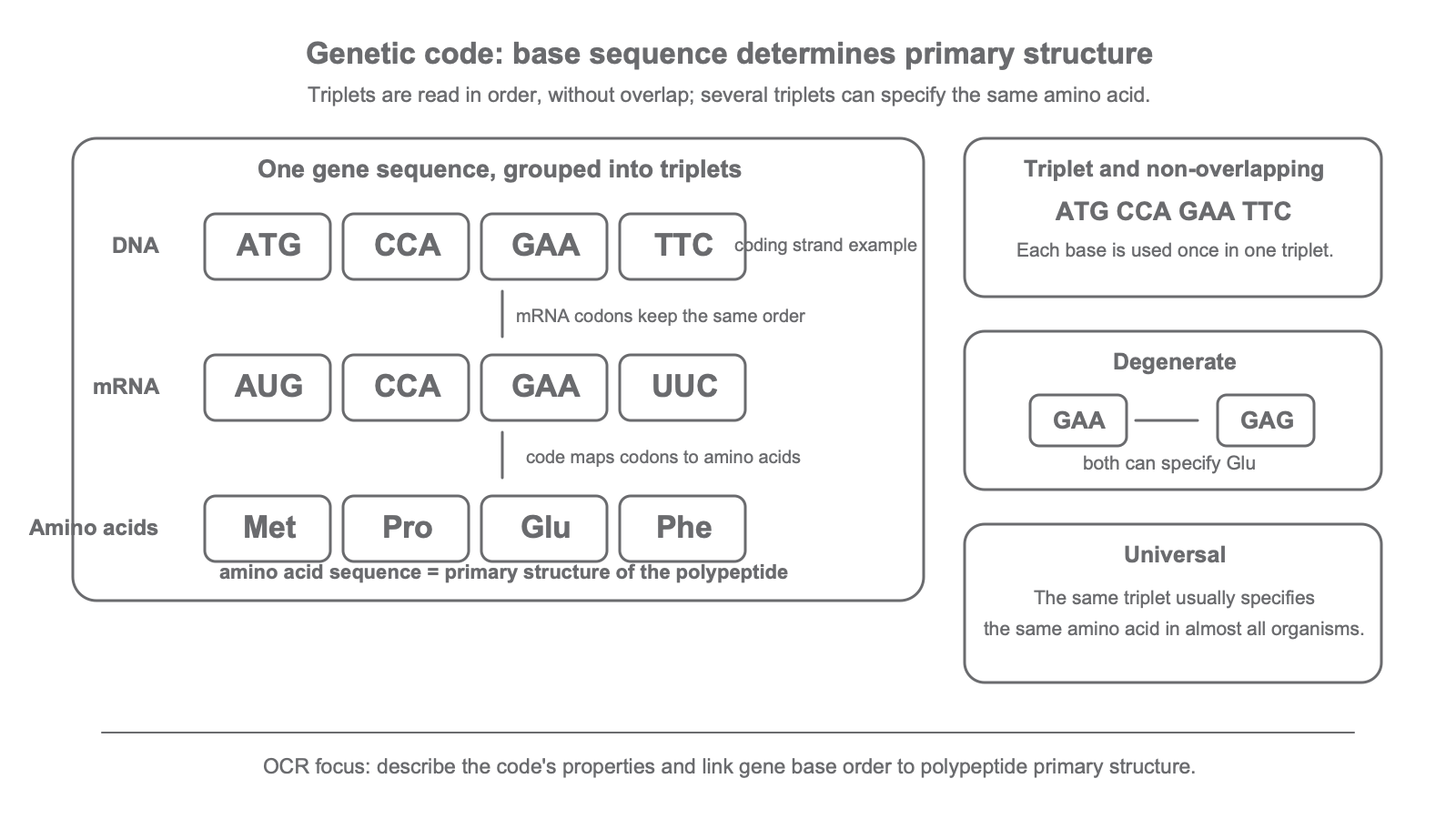
The diagram is not asking you to memorise a codon table. It shows the logic: if the base sequence is grouped into triplets in a fixed order, the order of triplets determines the order of amino acids, so the gene determines the primary structure of the polypeptide.
Triplet And Non-Overlapping
There are four DNA bases: adenine, thymine, cytosine and guanine. A one-base code could only make four different instructions. A two-base code could make 4 x 4 = 16 different instructions. That is not enough for the 20 amino acids commonly found in proteins.
A triplet code gives:
Number Of Possible Triplets
That is enough possible triplets to specify the amino acids used in proteins. You do not need to memorise every codon in a codon table here. You do need the triplet idea: three bases code for one amino acid.
The code is also non-overlapping. This means each base is used in only one triplet as the sequence is read. For example, this base sequence:
A T G C C A G A A
is read as:
ATG | CCA | GAA
It is not read by sliding along one base at a time as ATG, then TGC, then GCC, and so on. That sliding pattern would reuse bases and would be overlapping, which is not the property being tested.
Grouping A Sequence Into Triplets
A section of a gene has the base sequence TACGGTCTA. To read it as a non-overlapping triplet code from the first base, group the bases in threes:
TAC | GGT | CTA
There are three triplets, so this section could specify three amino acids in the polypeptide. You do not need to know which amino acids they are unless a codon table is supplied.
Now try the same grouping without the scaffold.
The Degenerate Code
The genetic code is degenerate. In biology this does not mean damaged or worse. It means that more than one triplet can code for the same amino acid.
Degenerate code
A genetic code in which more than one triplet or codon can code for the same amino acid.
This follows naturally from the triplet calculation. There are 64 possible triplets but only 20 commonly used amino acids. Some amino acids must therefore have more than one triplet that can specify them.
Be careful with the direction of the idea. Degenerate does not mean that one triplet randomly chooses several amino acids. In a given context, a triplet has a specific meaning. Degenerate means the reverse: several different triplets may lead to the same amino acid.
Using Degeneracy In Reasoning
Suppose two mRNA codons, GAA and GAG, both specify the amino acid glutamate. If a gene change led to GAA becoming GAG in the mRNA, the amino acid at that position would stay as glutamate.
The reason is degeneracy: more than one codon can code for the same amino acid.
This idea explains why a change in a base sequence may or may not alter a protein. For this lesson, you do not need to classify mutation types. The point is simply that a changed triplet can sometimes still specify the same amino acid because the code is degenerate.
The Universal Code
The genetic code is universal. This means the same triplet or codon specifies the same amino acid in almost all organisms. The same code is used in bacteria, plants, animals and fungi.
Universal code
A genetic code in which the same triplet or codon specifies the same amino acid in almost all organisms.
The scientific caution is "almost all". A few rare exceptions exist, such as small differences in some mitochondrial genetic codes. For this course, the required property is still universal, so an exam answer should use that word and explain the main idea: the code is shared across organisms.
This matters because genes are portable biological information. If the code is the same in different organisms, then the base sequence of a gene can still specify the same amino acid sequence when it is interpreted in another organism. You do not need the details of genetic engineering for this row, but universality explains why the idea is biologically powerful.
When a question asks for the nature of the genetic code, write the property and its meaning. For example, "universal" alone is weaker than "universal: the same triplet codes for the same amino acid in almost all organisms."
Answer Precision
This lesson is short, but the wording must be sharp. Mark schemes often reward the exact link from bases to amino acids and then to primary structure.
| Weak wording | Why it loses precision | Stronger wording |
|---|---|---|
| DNA is a sequence of amino acids. | DNA is made from nucleotides with bases, not amino acids. | DNA contains a sequence of bases. |
| One base codes for one amino acid. | The code is triplet, not single-base. | Three bases / one triplet code for one amino acid. |
| The code overlaps. | This reuses bases in multiple triplets. | The code is non-overlapping; each base is read once in one triplet. |
| Degenerate means one codon codes for many amino acids. | The direction is reversed. | Degenerate means more than one triplet/codon can code for the same amino acid. |
| Universal means all organisms have the same genes. | Organisms have different genes and base sequences. | Universal means the same triplet usually specifies the same amino acid in almost all organisms. |
A strong answer to "Describe the nature of the genetic code" could say:
"The genetic code is triplet, so three bases code for one amino acid. It is non-overlapping, so each base is read once as part of one triplet. It is degenerate because more than one triplet can code for the same amino acid, and it is universal because the same triplet codes for the same amino acid in almost all organisms. Therefore the sequence of bases in a gene determines the sequence of amino acids in the polypeptide, which is its primary structure."
Answer Precision Summary
A gene's base sequence is read as non-overlapping triplets. Those triplets determine the amino acid sequence in a polypeptide, giving its primary structure; the code is degenerate and universal.
Explain It Back
Use this as a self-explanation check after the section above. It is for diagnosing what you can already explain, not for learning new material from scratch.