2.1.1(i)-(j) - Protein secretion organelles and the cytoskeleton
This lesson is about how eukaryotic cells coordinate internal structures to get useful proteins out of the cell and to move materials within the cell. You need the organelle sequence for protein secretion and the three key roles of the cytoskeleton: mechanical strength, intracellular transport and cell movement. You do not need detailed protein synthesis mechanisms in this lesson; the focus is the relationship between organelles and the cytoskeleton.
Secretion Overview
A secreted protein is a protein made by a cell and released outside the cell, where it can act elsewhere. Examples include digestive enzymes released by cells in glands, peptide hormones released by endocrine cells, and some proteins used in immune responses. The important idea is that secretion is not done by one organelle alone: it is a coordinated route through several cell structures.
Secretion
Secretion is the release of a useful substance made by a cell to the outside of that cell.
For a typical secreted protein, the route is:
- Ribosomes on the rough endoplasmic reticulum assemble the polypeptide.
- The rough endoplasmic reticulum folds and transports the protein in its internal space.
- Transport vesicles carry the protein to the Golgi apparatus.
- The Golgi apparatus modifies, sorts and packages the protein.
- Secretory vesicles move to the plasma membrane.
- The vesicle fuses with the plasma membrane and releases the protein by exocytosis.
[DIAGRAM: protein_secretion_pathway: Lesson 016: Protein secretion organelles and the cytoskeleton - diagram 01; asset_slug: 016_m02_1_1_protein_secretion_organelles_and_the_cytoskeleton__diagram_01; recommended_method: drawn_biology; description: A deterministic 16:9 pathway diagram showing the sequence for secretion of a protein: nucleus reminder, rough endoplasmic reticulum with ribosomes, transport vesicle, Golgi apparatus, secretory vesicle, plasma membrane and exocytosis, with labels and arrows in order.]
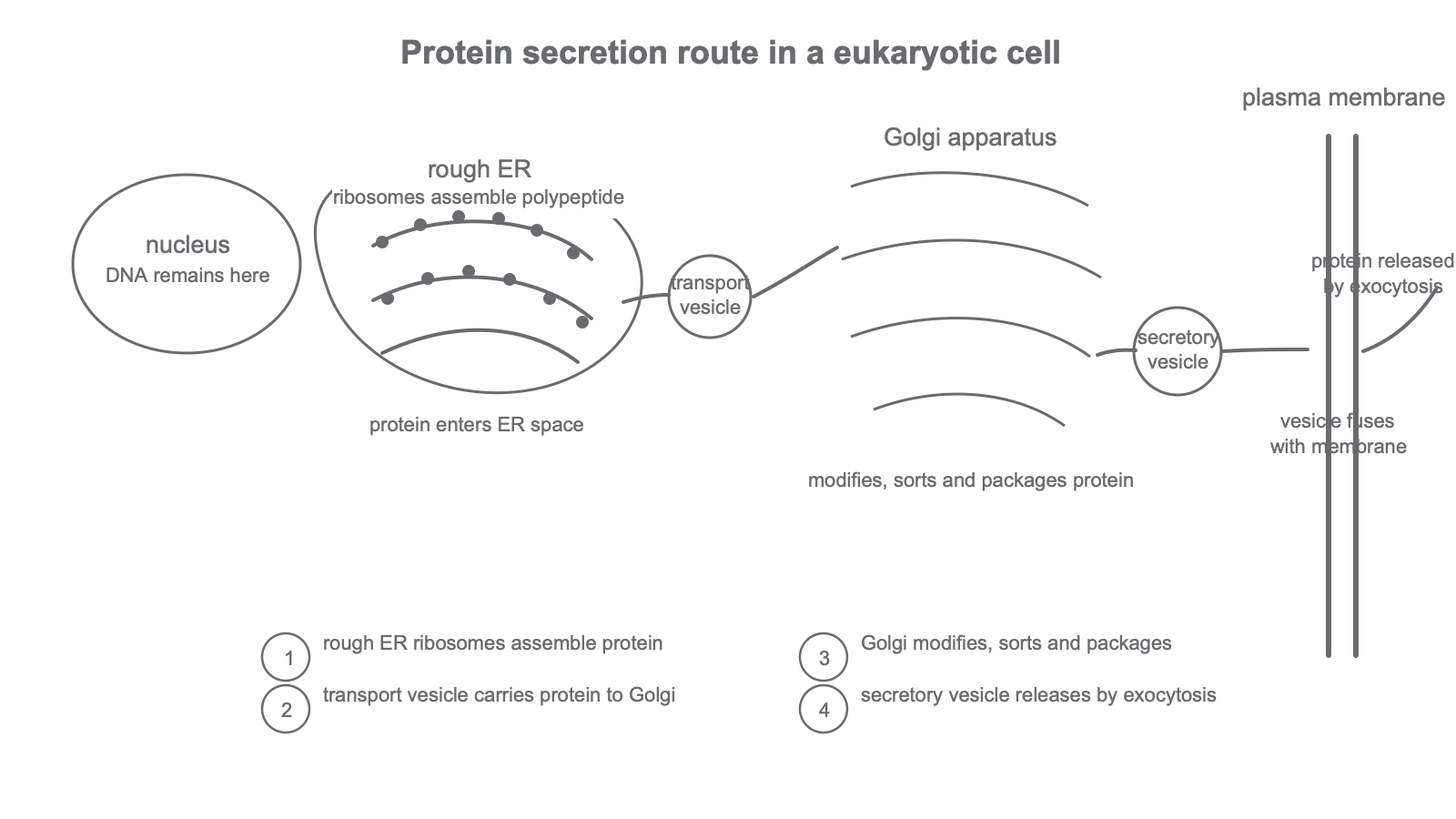
The nucleus appears in the diagram only as a reminder that eukaryotic cells have genetic information in a nucleus. Do not turn this lesson into transcription and translation detail. For this row, the assessed relationship is between the organelles that handle the protein after it is made at ribosomes on the rough ER.
If a question asks for organelles involved in secretion, give the sequence. "Rough ER, Golgi apparatus, secretory vesicle" is much stronger than a loose list of cell parts.
Rough ER To Golgi
The rough endoplasmic reticulum, or rough ER, is called rough because ribosomes are attached to its surface. Ribosomes are the site of protein synthesis. For proteins that will be secreted, the ribosomes are associated with rough ER, so the growing polypeptide can enter the ER space.
Rough endoplasmic reticulum
Rough endoplasmic reticulum is a membrane-bound organelle with ribosomes attached to its surface, involved in producing and transporting proteins.
Inside the rough ER, the protein can fold and be moved onwards. A small membrane-bound transport vesicle buds from the ER and carries the protein to the Golgi apparatus. A vesicle is not just a bubble in the vague sense; it is a membrane-bound sac that can move material between compartments.
The Golgi apparatus receives proteins from the rough ER side, processes them, sorts them and packages them into vesicles. For a secreted protein, the vesicle that leaves the Golgi is a secretory vesicle. It moves towards the plasma membrane, fuses with it, and releases its contents outside the cell by exocytosis.
Exocytosis
Exocytosis is the release of substances from a cell when a vesicle fuses with the plasma membrane and empties its contents outside the cell.
The word "interrelationship" matters. The point is not isolated organelle functions; it is that each structure hands the protein to the next part of the route.
| Structure | Main role in secretion |
|---|---|
| Ribosome on rough ER | Assembles the polypeptide. |
| Rough ER | Provides a membrane-bound route for folding and transport of the protein. |
| Transport vesicle | Carries protein from rough ER to Golgi apparatus. |
| Golgi apparatus | Modifies, sorts and packages the protein. |
| Secretory vesicle | Carries the final protein to the plasma membrane. |
| Plasma membrane | Fuses with the vesicle so the protein is released by exocytosis. |
Sequence Precision
A common error is to give true organelle facts in the wrong order. The Golgi apparatus is involved in processing and packaging proteins, but it does not assemble the polypeptide chain. Ribosomes assemble the polypeptide. The rough ER is involved because those ribosomes are attached to it.
Another common error is to include smooth ER as if all ER has the same role. Smooth ER is important in lipid synthesis and other cell functions, but the secretion route for proteins uses rough ER because rough ER has ribosomes.
The difference between free ribosomes and ribosomes on rough ER is also useful. Free ribosomes make proteins that usually stay in the cytoplasm or are used inside the cell. Ribosomes on rough ER are linked to proteins that enter the endomembrane route, including many proteins for secretion or for membranes.
Building A Full-Credit Sequence Answer
A gland cell secretes a digestive enzyme. Describe the interrelationship between the organelles involved.
Start with the protein's route, not a list:
- Ribosomes on rough ER assemble the polypeptide.
- The protein enters the rough ER and is transported in the ER.
- A vesicle buds from the rough ER and carries the protein to the Golgi apparatus.
- The Golgi apparatus modifies, sorts and packages the protein.
- A secretory vesicle carries the protein to the plasma membrane.
- The vesicle fuses with the plasma membrane and releases the enzyme by exocytosis.
This answer earns credit because it names the structures and shows how each one passes the protein to the next.
Cytoskeleton Strength And Transport
The cytoskeleton is a network of protein fibres in the cytoplasm. It is not a rigid bone-like skeleton. It is a dynamic internal framework that helps cells keep their shape, organise their contents and move materials.
Cytoskeleton
The cytoskeleton is a network of protein fibres in the cytoplasm that helps give cells mechanical strength, aids transport within cells and enables cell movement.
[DIAGRAM: cytoskeleton_roles: Lesson 016: Protein secretion organelles and the cytoskeleton - diagram 02; asset_slug: 016_m02_1_1_protein_secretion_organelles_and_the_cytoskeleton__diagram_02; recommended_method: drawn_biology; description: A deterministic 16:9 diagram of a eukaryotic cell showing cytoskeleton fibres supporting cell shape, vesicle or organelle transport along fibres, and cell movement using cilia/flagellum or a moving cell edge, with labels matching OCR roles.]
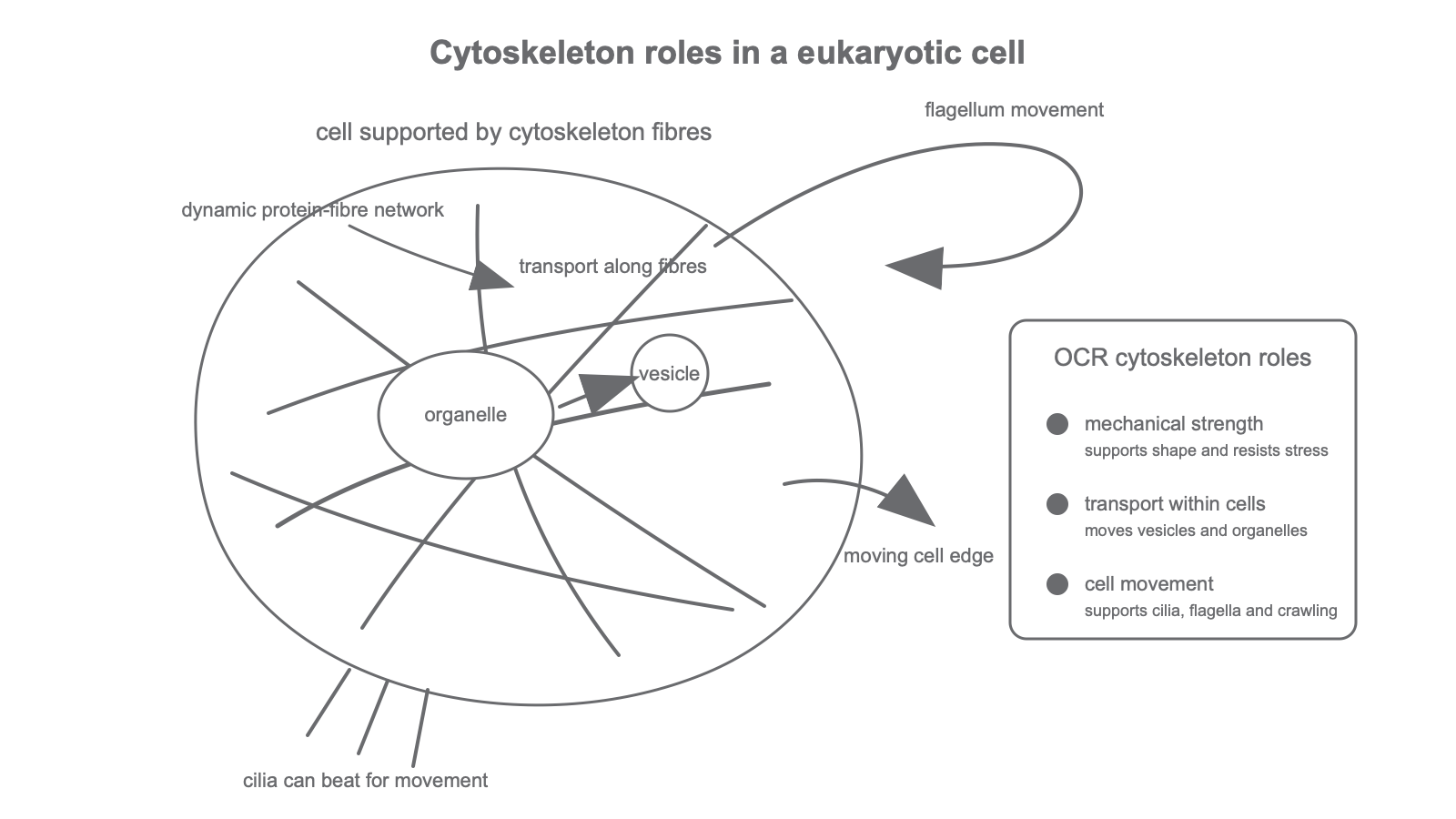
Mechanical strength means the cytoskeleton helps the cell resist deformation and maintain shape. This matters in cells that experience stress or need a stable arrangement of internal structures. The plasma membrane is thin and flexible; cytoskeletal fibres provide internal support and links that help stop the cell contents from becoming disorganised.
Transport within cells means cytoskeleton fibres can act as tracks. Vesicles and organelles can be moved along these tracks by motor proteins that use ATP. You do not need to memorise motor protein names here. The creditworthy idea is that the cytoskeleton aids movement of vesicles and organelles within the cytoplasm.
This transport role links back to secretion. A secretory vesicle still has to move from the Golgi apparatus to the plasma membrane. Cytoskeleton fibres help make that movement directed rather than leaving it only to random diffusion through the crowded cytoplasm.
Cytoskeleton Cell Movement
The cytoskeleton also enables movement of whole cells or movement of cell extensions. The exact movement depends on the cell type. Some cells use beating cilia or flagella. Some animal cells change shape and crawl across a surface. Sperm cells use a flagellum to swim, while some white blood cells can change shape as they move through tissues.
The point is not to memorise a long list of moving cells. It is to explain how an internal protein-fibre system can produce shape change or movement. Cytoskeletal fibres can be reorganised, and motor proteins can make fibres slide or move cargo. That gives cells a mechanism for movement rather than only passive drift.
There are three cytoskeleton roles to keep separate:
| Role | What it means | Example of good wording |
|---|---|---|
| Mechanical strength | Supports cell shape and helps resist stress. | "The cytoskeleton helps maintain the cell's shape." |
| Transport within cells | Moves vesicles or organelles through cytoplasm. | "Vesicles can move along cytoskeleton fibres." |
| Cell movement | Helps whole cells or cell extensions move. | "Cilia, flagella or crawling cell edges depend on cytoskeletal movement." |
If a question asks for the importance of the cytoskeleton, do not give only one role. The guidance names three: mechanical strength, intracellular transport and cell movement.
Exam Argument
This lesson is a good place to practise HSW2: using knowledge to present a scientific argument. A strong argument links structure to outcome. If a cell secretes a lot of protein, it should have many ribosomes on rough ER, well-developed Golgi apparatus, many vesicles and an active cytoskeleton. Each feature supports a stage in the route.
For example, a pancreatic cell that secretes digestive enzymes would be expected to have abundant rough ER and Golgi apparatus. Rough ER supports production and early transport of proteins; Golgi apparatus processes and packages them; vesicles release them by exocytosis. A cytoskeleton helps keep the cell organised and moves vesicles towards the plasma membrane.
When answering questions, watch the command word:
| Command | What your answer should do |
|---|---|
| State or identify | Name the correct structure, such as rough ER or Golgi apparatus. |
| Describe | Give the sequence or observable role. |
| Explain | Link the structure to its function in secretion, transport, strength or movement. |
| Suggest | Apply the same route to an unfamiliar secretory cell or disrupted cytoskeleton. |