2.1.2(j) - Lipid properties, cholesterol and biological functions
In this lesson you are learning how three lipid types do their jobs because of their properties: triglycerides, phospholipids and cholesterol. The important move is not just naming a lipid, but linking a property such as hydrophobicity, amphipathic structure or high energy content to a function in a living organism. OCR can ask this in unfamiliar prokaryotic or eukaryotic contexts, so the lesson focuses on transferable property-function reasoning.
Property-Function Links
A lipid property is a feature of the molecule that affects how it behaves. A lipid function is the biological role that follows from that behaviour. Strong answers link the two in one chain: property first, then the consequence for the organism or cell.
Hydrophobic
A hydrophobic region is non-polar and does not interact favourably with water, so it tends to be excluded from aqueous surroundings.
In this lesson, the key properties are:
| Lipid type | Key property to link | Main functions in this lesson |
|---|---|---|
| Triglyceride | Mostly hydrophobic; high energy content | Energy storage, insulation, protection and buoyancy |
| Phospholipid | Hydrophilic head and hydrophobic tails | Bilayer formation, membranes and compartmentalisation |
| Cholesterol | Mostly hydrophobic sterol with a small polar region | Regulation of membrane fluidity and permeability |
The word "hydrophobic" does not mean that water actively pushes the lipid away like a magnet. The exam-safe explanation is that non-polar lipid regions cannot form favourable interactions with polar water molecules. In cells, this means hydrophobic regions become shielded inside droplets or bilayers.
For property-function questions, avoid one-word answers. Write the property and its consequence, for example: "hydrophobic fatty-acid tails point inwards, so a phospholipid bilayer can separate two aqueous regions."
This is also where hydrophilic regions matter. A hydrophilic region is polar or charged enough to interact with water. Phospholipid heads and the small polar part of cholesterol can sit near aqueous surroundings, while hydrophobic regions are held away from water.
Triglycerides For Energy Storage
Triglycerides are well suited to long-term energy storage because they are energy-rich and mostly hydrophobic. They contain many C-H bonds and relatively little oxygen compared with carbohydrates. When triglycerides are respired, their fatty acids can release a large amount of energy that cells can use to generate ATP.
Do not write that triglycerides "produce energy" by themselves. A better biological chain is: triglycerides are hydrolysed to fatty acids and glycerol; fatty acids can be respired; respiration transfers energy to ATP.
Triglycerides are also insoluble in water. That is useful because storage droplets do not dissolve into the cytoplasm and do not strongly affect the water potential of the cell. A cell can store a compact supply of chemical energy without having many separate soluble molecules in solution.
Linking Triglyceride Properties To Function
Question focus: explain why triglycerides are suitable energy stores in animals.
A strong answer would link several properties to functions: triglycerides have many C-H bonds, so they have a high energy content per gram; they are insoluble, so they can be stored as droplets without dissolving in cytoplasm; they are compact, so a large amount of energy can be stored in a small volume.
In animals, triglycerides stored in adipose tissue can also help with thermal insulation and cushioning around organs. In seeds, lipid stores can provide respiratory substrate during germination before the seedling can photosynthesise enough for itself. In some aquatic organisms, low-density lipid stores can contribute to buoyancy.
Phospholipids Form Membranes
Phospholipids are amphipathic molecules. This means one part is hydrophilic and another part is hydrophobic. The phosphate-containing head is hydrophilic, while the fatty-acid tails are hydrophobic.
Amphipathic
An amphipathic molecule has both a hydrophilic region and a hydrophobic region.
In water, phospholipids form bilayers. The hydrophilic heads face the aqueous solutions on each side of the membrane. The hydrophobic tails point inwards, away from water, forming a hydrophobic core.
That arrangement explains the main functions of phospholipids:
| Property | Consequence | Function |
|---|---|---|
| Hydrophilic heads | Can face cytoplasm, extracellular fluid or organelle contents | Membrane surfaces interact with aqueous environments |
| Hydrophobic tails | Form a hydrophobic core | Barrier to many ions and polar molecules |
| Amphipathic shape | Bilayers form in water | Cell-surface membranes and organelle membranes can form |
This is a structure-function explanation. The membrane is not just "made of phospholipids"; the different regions of each phospholipid explain why the bilayer can separate two watery compartments.
[DIAGRAM: lipid_property_function_comparison: Lesson 023: Lipid properties and membrane function - diagram 01; asset_slug: 023_m02_1_2_lipid_properties_cholesterol_and_biological_functions__diagram_01; recommended_method: drawn_biology; description: A clean 16:9 drawn comparison showing a hydrophobic triglyceride storage droplet, an amphipathic phospholipid bilayer with hydrophilic heads facing water and hydrophobic tails shielded inside, and cholesterol molecules between tails labelled as regulating fluidity and permeability.]
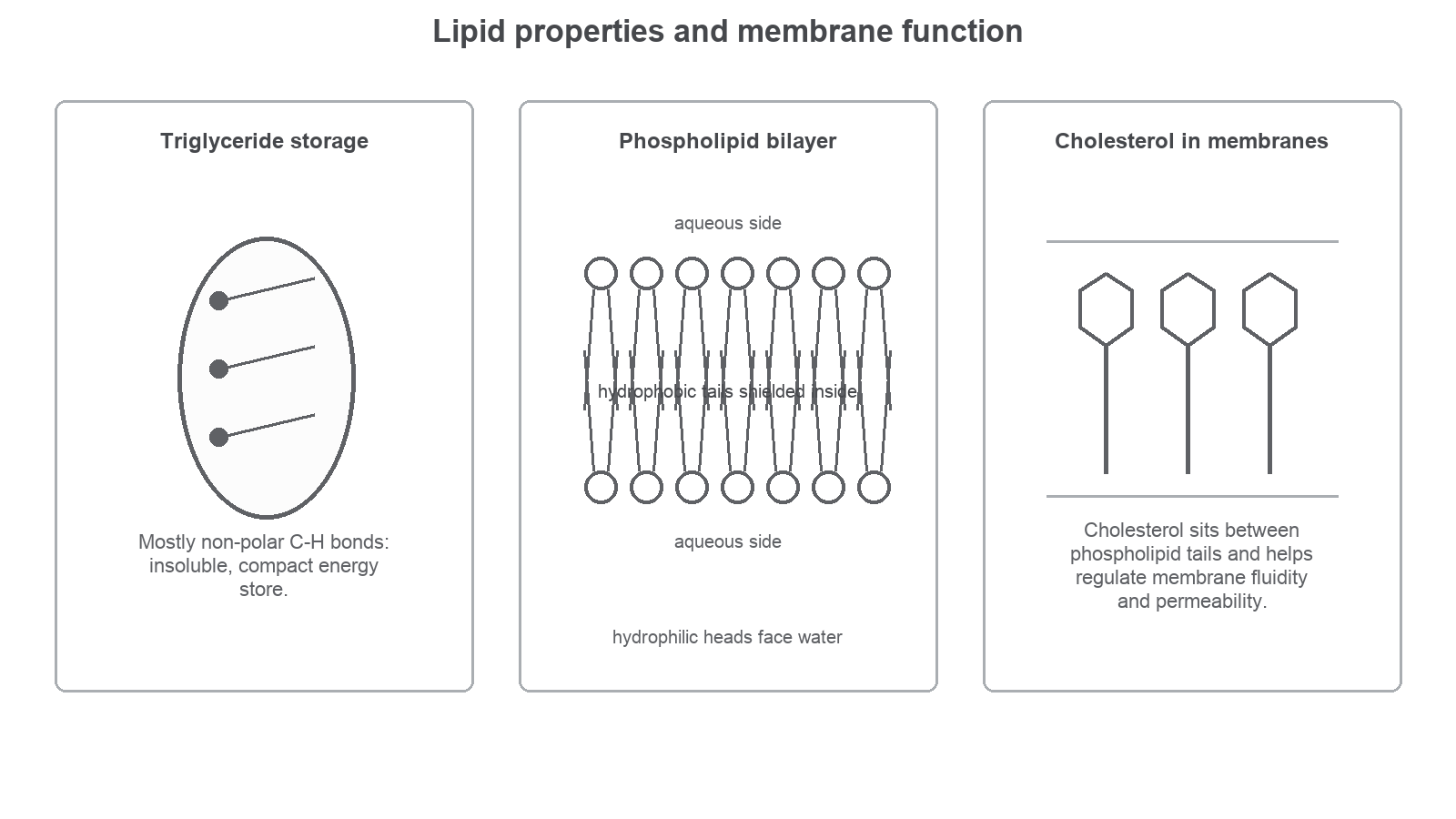
Phospholipid bilayers are important in both prokaryotic and eukaryotic cells. A prokaryotic cell has a cell-surface membrane that controls exchange with the environment. A eukaryotic cell has a cell-surface membrane and also internal membrane-bound organelles, so bilayers allow compartmentalisation inside the cell.
Cholesterol And Membrane Function
Cholesterol is a lipid called a sterol. It is not a triglyceride and it is not a phospholipid. Its structure is mostly hydrophobic, but it has a small polar hydroxyl region. This lets cholesterol fit between phospholipid molecules in many animal cell membranes.
The key function to learn here is regulation of membrane fluidity and permeability. Cholesterol sits among the hydrophobic tails of phospholipids. This affects how closely the tails can pack together and how freely they move.
At higher temperatures, cholesterol can restrict excessive phospholipid movement, helping the membrane stay less fluid than it would otherwise be. At lower temperatures, cholesterol can prevent phospholipid tails packing too tightly, helping the membrane avoid becoming too rigid. You do not need a detailed temperature graph for this row; the important OCR-safe statement is that cholesterol helps regulate membrane fluidity.
Applying Cholesterol In A Membrane
A cell membrane with too little control of fluidity may become too leaky or too rigid under changing conditions. Cholesterol helps stabilise membrane behaviour by fitting among phospholipid tails, so the membrane's permeability and fluidity remain suitable for cell function.
Be careful with prokaryotic and eukaryotic contexts. Phospholipid bilayers are a common cell-membrane feature in both groups. Cholesterol is a major membrane lipid in animal eukaryotic cells, but it should not be treated as a required feature of all prokaryotic membranes. If a question gives information about an organism's membrane composition, use the information in the question and link each lipid to its property.
Applying Lipid Properties
OCR can ask lipid-property ideas through unfamiliar organisms, membrane damage, food-energy data or comparisons between molecules. The route stays the same: identify the lipid, name the relevant property, then link it to the function or observation.
Energy Content Data
Two dry food samples have the same mass. Sample A contains mostly carbohydrate and releases about 17 kJ g-1 when fully respired. Sample B contains mostly lipid and releases about 39 kJ g-1 when fully respired.
Sample B has the higher energy content because lipids contain more hydrogen and less oxygen relative to carbon than carbohydrates. More energy can be released from the oxidation of lipid molecules during respiration.
This kind of data question is not asking for diet advice. It is asking you to apply the molecular property: energy content depends on chemical composition. Similarly, a membrane damage question is usually asking for a property-function explanation: if phospholipids or cholesterol are damaged, the bilayer may become more permeable or its fluidity may change.
Applying Lipid Properties Summary
For this lesson, the high-value skill is a linked sentence: name the lipid property, then explain how that property gives a biological function in a prokaryotic or eukaryotic context.
Explain It Back
Use this as a self-explanation check after the section above. It is for diagnosing what you can already explain, not for learning new material from scratch.