2.1.4(c) - Mechanism of enzyme action
Enzymes speed up metabolic reactions because their three-dimensional structure lets specific substrates bind and react more easily. In this lesson you will learn how the active site, lock and key model, induced-fit model, enzyme-substrate complex, enzyme-product complex and activation energy fit into one clear mechanism.
Tertiary Structure And Specificity
An enzyme is a protein with a precise three-dimensional shape. For this lesson, the most important part of that shape is the active site.
Active Site
The active site is the region of an enzyme where the substrate binds and the enzyme-controlled reaction is catalysed.
The active site is formed by the enzyme's tertiary structure: the overall folding of its polypeptide chain or chains. Amino acid R groups in the active site give it a particular shape and chemical environment. That is why enzyme action is specific.
Specificity
Specificity is the ability of an enzyme to bind only a particular substrate, or a small group of similar substrates, because of the active site's shape and chemical properties.
Specificity does not mean the whole enzyme matches the substrate. It means the active site can bind the substrate in a way that allows catalysis. In OCR answers, the active site must be on the enzyme, not on the substrate.
Lock And Key Model
The lock and key hypothesis is a simple model of enzyme action. It says the substrate has a shape complementary to the enzyme's active site, so the substrate fits into the active site like a key into a lock.
This model is useful because it explains enzyme specificity. If the substrate is not complementary, it will not bind correctly, so the enzyme-substrate complex will not form.
The lock and key model is a model, not a full molecular description. It treats the active site as if it is already a rigid perfect fit before binding. That is a helpful starting point, but it does not explain as well how the enzyme helps the substrate reach the reacting state.
For a compare question, give both models. Lock and key: active site and substrate are complementary before binding. Induced fit: the active site changes shape slightly as the substrate binds.
Induced Fit And Complexes
The induced-fit hypothesis is the more refined model. It says the substrate is close enough in shape and chemical properties to bind, then binding causes a slight change in the enzyme's active site. This produces a better fit around the substrate.
The mechanism can be described as a sequence.
- The substrate binds to the active site.
- An enzyme-substrate complex forms.
- The active site changes shape slightly, producing induced fit.
- The substrate's bonds are held, strained or positioned so reaction is more likely.
- The substrate is converted into product or products, forming an enzyme-product complex.
- The products leave the active site.
- The enzyme is not used up and can catalyse another reaction.
The diagram connects the named complexes to the activation-energy idea. It is deliberately simplified: it shows the required OCR sequence, not every atom or side-chain interaction.
[DIAGRAM: enzyme_action_sequence_and_activation_energy: Lesson 37: Mechanism of enzyme action - diagram 01; asset_slug: 037_m02_1_4_mechanism_of_enzyme_action__diagram_01; recommended_method: drawn_biology; description: A clean 16:9 drawn biology diagram showing a substrate approaching a specific active site, enzyme-substrate complex formation, induced fit straining substrate bonds, enzyme-product complex/product release, and a small energy profile comparing uncatalysed and enzyme-catalysed activation energy.]
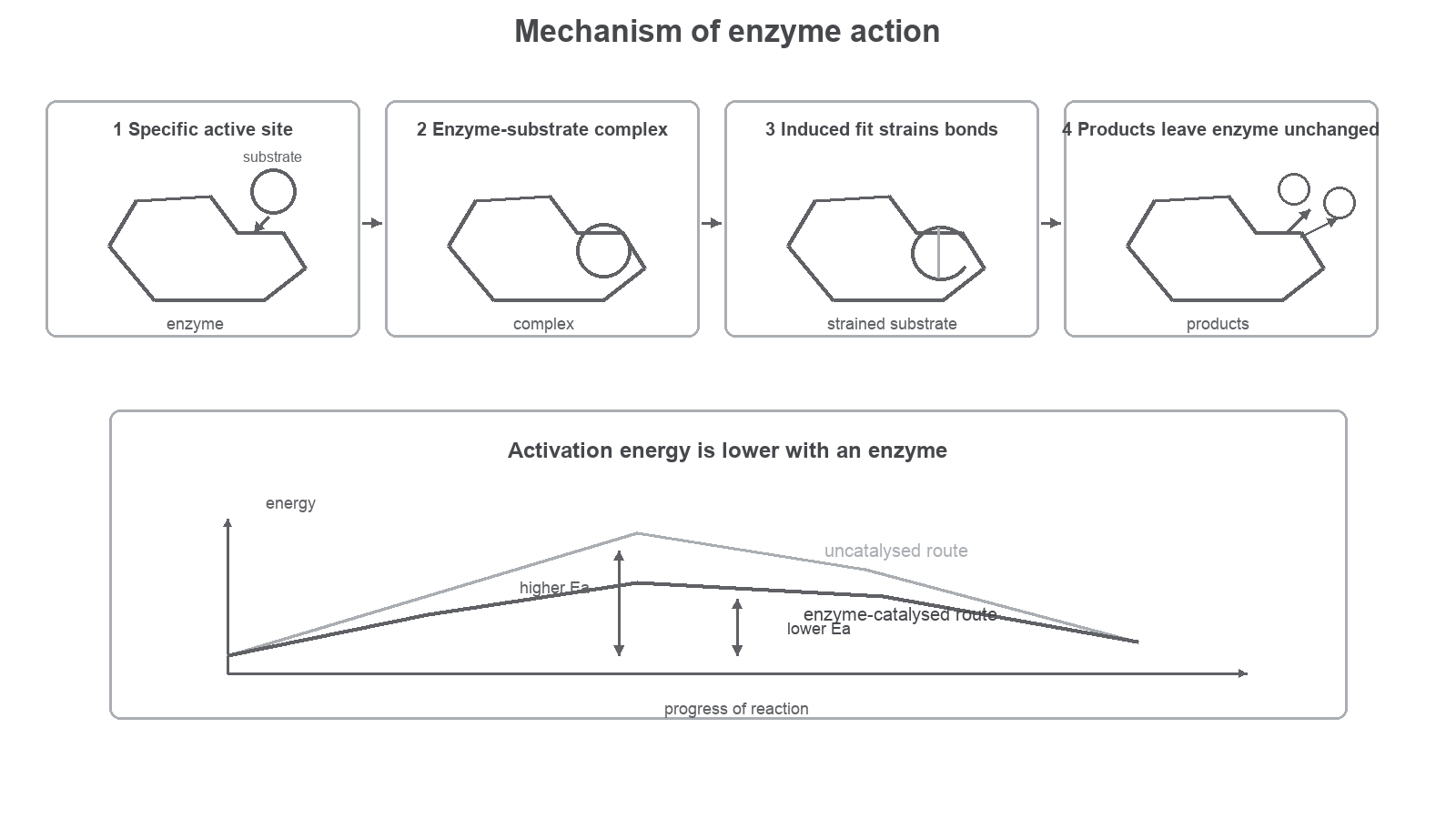
The substrate binds, the active site changes slightly, the reaction occurs, the products leave, and the enzyme is available again.
Lowering Activation Energy
Activation energy is the minimum energy needed for a reaction to start. Many metabolic reactions would happen too slowly at normal cell temperatures without enzymes. An enzyme lowers activation energy by providing a different route for the reaction.
Activation Energy
Activation energy is the minimum energy required for reactants to reach the transition state and start a reaction.
For OCR Biology, the important biological explanation is that enzyme-substrate complex formation helps the substrate react. The active site may bring reacting groups close together, hold the substrate in a suitable orientation, strain bonds in the substrate, or create a suitable local chemical environment. You do not need to describe detailed molecular mechanisms beyond the row boundary, but you do need to link enzyme action to lowering activation energy.
Lowering activation energy does not mean the enzyme gives energy to the substrate. It also does not mean the enzyme is used up. The enzyme provides a route that needs less energy, so more substrate molecules can be converted to products per unit time.
Choosing The Creditworthy Explanation
A student writes: "The enzyme breaks the substrate because it has the same shape as the substrate."
A stronger answer is: "The substrate binds to the complementary active site to form an enzyme-substrate complex. Induced fit changes the active site slightly, straining or positioning bonds in the substrate, which lowers activation energy. Products form and leave the active site."
The stronger answer is better because it uses the active site, the named complex, induced fit, product formation and activation energy. It also avoids saying the whole enzyme has the same shape as the substrate.
Models And OCR Precision
The lock and key and induced-fit hypotheses are both scientific models. A model is a simplified explanation that helps people understand a process. HSW1 matters here because models can be developed when evidence supports a better explanation. HSW8 matters because enzyme questions reward precise biological language.
Use this wording carefully.
| Say this | Avoid this |
|---|---|
| The active site is on the enzyme. | The active site is on the substrate. |
| The substrate binds to the active site. | The enzyme and substrate "join forever". |
| Products leave the active site. | The substrate leaves after it has reacted. |
| The enzyme is not used up. | The enzyme is consumed in the reaction. |
| Induced fit is a slight shape change in the active site. | Induced fit means the enzyme changes permanently. |
This lesson stops at the mechanism. The effects of temperature, pH, enzyme concentration, substrate concentration, cofactors and inhibitors are neighbouring OCR rows. You will use today's mechanism to explain those later, but they are not objectives here.