2.1.2(b)-(c) - Monomers, polymers, condensation, hydrolysis and biological elements
Living cells contain large biological molecules, but those molecules are built from a small set of recurring chemical ideas. In this lesson you learn how smaller units can join to form larger molecules, why condensation and hydrolysis reactions matter, and which chemical elements OCR expects you to associate with the main groups of biological molecules. The focus is the foundation idea; later lessons add the detailed structures and named bonds for carbohydrates, lipids, proteins and nucleic acids.
From Units To Larger Molecules
A monomer is a small molecular unit that can be joined to other units to make a larger molecule. A polymer is a large molecule made from many repeating monomer units joined together by covalent bonds. The word "polymer" is useful because it makes you look for repeating units, not just for a large molecule.
Monomer
A small molecular unit that can be joined to other similar units to form a larger molecule.
Carbohydrates, proteins and nucleic acids can be taught using a clear monomer-to-polymer idea. Some lipids are also large biological molecules, but lipids are not true polymers because their smaller components do not form a long repeating chain of the same type of monomer.
| Biological molecule group | Building-block idea at this point |
|---|---|
| Carbohydrates | Monosaccharides can join to form larger carbohydrates such as polysaccharides. |
| Proteins | Amino acids can join to form polypeptides and proteins. |
| Nucleic acids | Nucleotides can join to form polynucleotides such as DNA and RNA. |
| Lipids | Fatty acids and glycerol can join in lipid synthesis, but lipids are not polymers of repeating monomers. |
This distinction matters in questions about classification. A molecule can be large without being a polymer. A triglyceride is a macromolecule, but it is not a polymer. A polysaccharide is a polymer because it is made from many monosaccharide units.
If a question asks whether a molecule is a polymer, ask: "Is it made from many repeating monomer units?" Do not answer just from molecule size.
Use that idea in this classification check.
Condensation Builds
A condensation reaction joins two molecules together, forms a covalent bond, and releases a molecule of water. In biological molecules, condensation reactions are important because they build larger molecules from smaller units.
Condensation reaction
A reaction in which two molecules join together with the formation of a covalent bond and the release of water.
The simplest pattern is:
Condensation Pattern
The exact groups and bond names depend on the molecule type. For this lesson, track the direction of the reaction: two smaller units become one larger molecule, and water is released.
[DIAGRAM: condensation_hydrolysis_overview: Lesson 19: Condensation and hydrolysis direction - diagram 01; asset_slug: 019_m02_1_2_monomers_polymers_condensation_hydrolysis_and_biological_elements__diagram_01; recommended_method: drawn_biology; description: A clean 16:9 schematic showing condensation joining two monomer units with water released, and hydrolysis using water to split the covalent bond back into smaller units.]
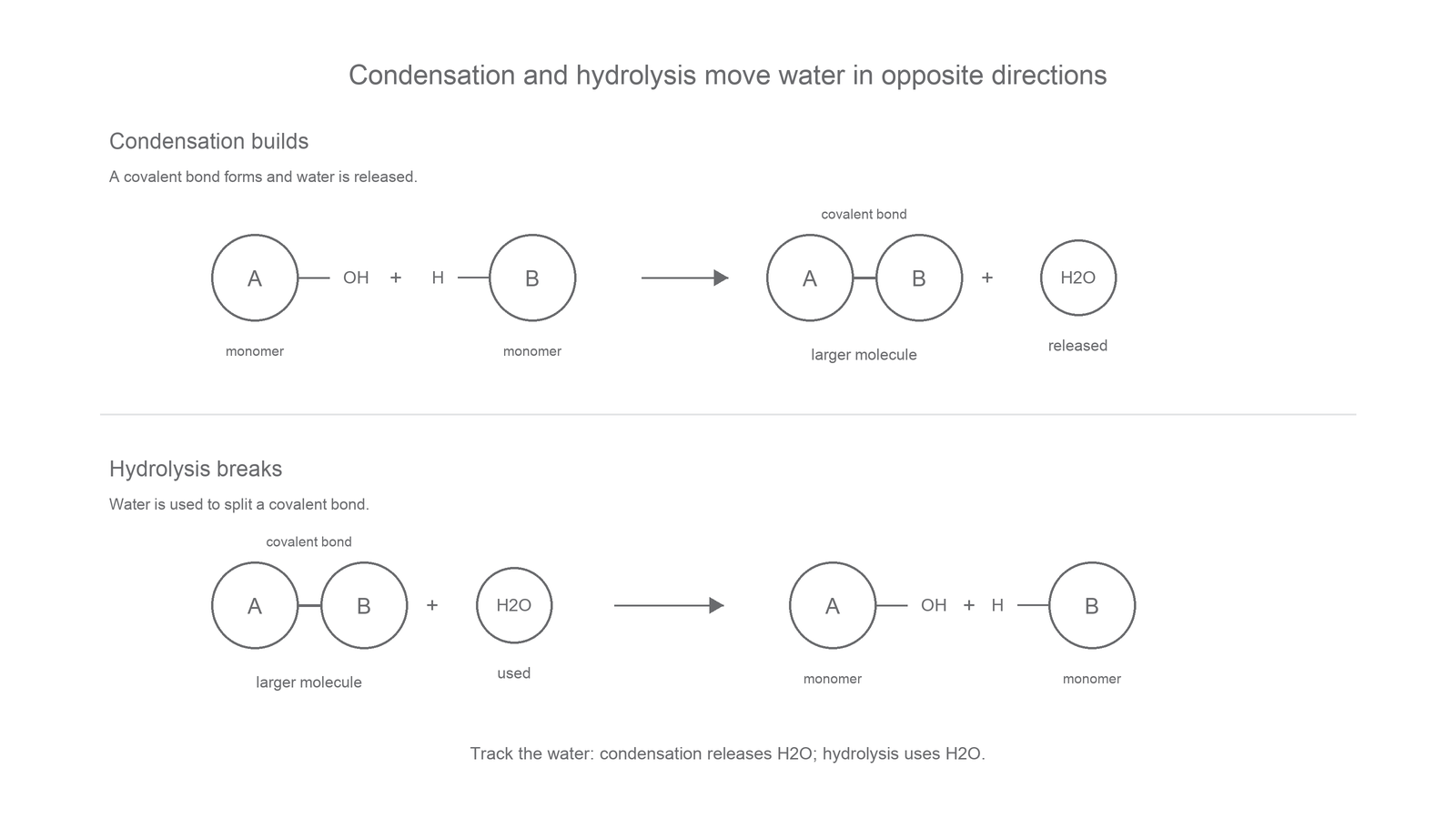
Condensation reactions are used in a range of biological molecules. Monosaccharides can be joined into larger carbohydrates, amino acids can be joined into polypeptides, and nucleotides can be joined into polynucleotides. Lipid synthesis also involves condensation reactions, even though lipids are not polymers.
Hydrolysis Breaks
Hydrolysis is the reverse type of reaction. A water molecule is used to break a covalent bond in a larger biological molecule, producing smaller molecules. The word helps: "hydro" refers to water and "lysis" refers to splitting.
Hydrolysis reaction
A reaction in which water is used to break a covalent bond, splitting a larger molecule into smaller molecules.
The simplest pattern is:
Hydrolysis Pattern
Hydrolysis is important because cells and organisms often need to break larger molecules into smaller units. Digestion hydrolyses food molecules into smaller molecules that can be absorbed. Cells also hydrolyse stored or assembled molecules when smaller units are needed for metabolism.
One useful rule is that each covalent bond broken by hydrolysis uses one water molecule. If a chain of three monosaccharides is completely hydrolysed into three separate monosaccharides, two bonds must be broken, so two water molecules are used.
Counting Water In Hydrolysis
A trisaccharide contains three monosaccharide units joined in a chain.
Number of links between the units = 2
Complete hydrolysis breaks both links.
Water molecules used = 2
The answer is 2 water molecules, not 3, because the water count follows the number of bonds broken rather than the number of monomer units.
Now apply the same bond-counting idea to a slightly longer chain.
Element Patterns
Biological molecules are made from chemical elements. In this row, the required element knowledge is deliberately concise. Use the element symbols accurately.
| Biological molecule group | Chemical elements to know |
|---|---|
| Carbohydrates | C, H and O |
| Lipids | C, H and O |
| Proteins | C, H, O, N and S |
| Nucleic acids | C, H, O, N and P |
Carbon and hydrogen appear in all four groups in this table. Oxygen also appears in all four. Nitrogen helps distinguish proteins and nucleic acids from carbohydrates and lipids. Sulfur is included with proteins, while phosphorus is included with nucleic acids.
Do not widen this list into inorganic ions. Elements such as calcium, sodium, potassium, magnesium and iron are biologically important, but they belong to a later inorganic-ion lesson rather than this one.
Exam Precision
This lesson is small, but the wording is easy to blur. The safest approach is to connect each term to the reaction direction or the molecule structure it describes.
Classifying A Biological Molecule
A molecule is described as a long chain made from many amino acid units. It contains C, H, O, N and S.
The repeating unit is the amino acid, so the molecule is built from monomers.
Many amino acids joined in a chain form a polymer, such as a polypeptide or protein.
The element set C, H, O, N and S supports the identification as a protein.
The molecule would be built by condensation reactions and broken into smaller units by hydrolysis reactions.
A common error is to use "condensation" and "hydrolysis" as if they are just opposite names for the same event. They are opposite directions. Condensation builds and releases water. Hydrolysis breaks and uses water.
Another common error is to call any carbohydrate made from more than one monosaccharide a polysaccharide. A disaccharide has two monosaccharide units and a trisaccharide has three; a polysaccharide has many. You do not need the detailed structures in this lesson, but the word ending can matter when classifying molecules.
For this lesson, the core pattern is: monomers can build polymers; condensation builds and releases water; hydrolysis breaks and uses water; molecule groups have fixed element sets.