2.1.2(d)-(e) - Monosaccharides, disaccharides and glycosidic bonds
This lesson teaches carbohydrate structure at the level needed for glucose, ribose, named disaccharides and glycosidic bonds. The aim is to connect molecular shape to bond formation without drifting into later starch, cellulose or biochemical test lessons.
Monosaccharide Carbon Count
A monosaccharide is a single sugar unit. Monosaccharides can be classified by their number of carbon atoms.
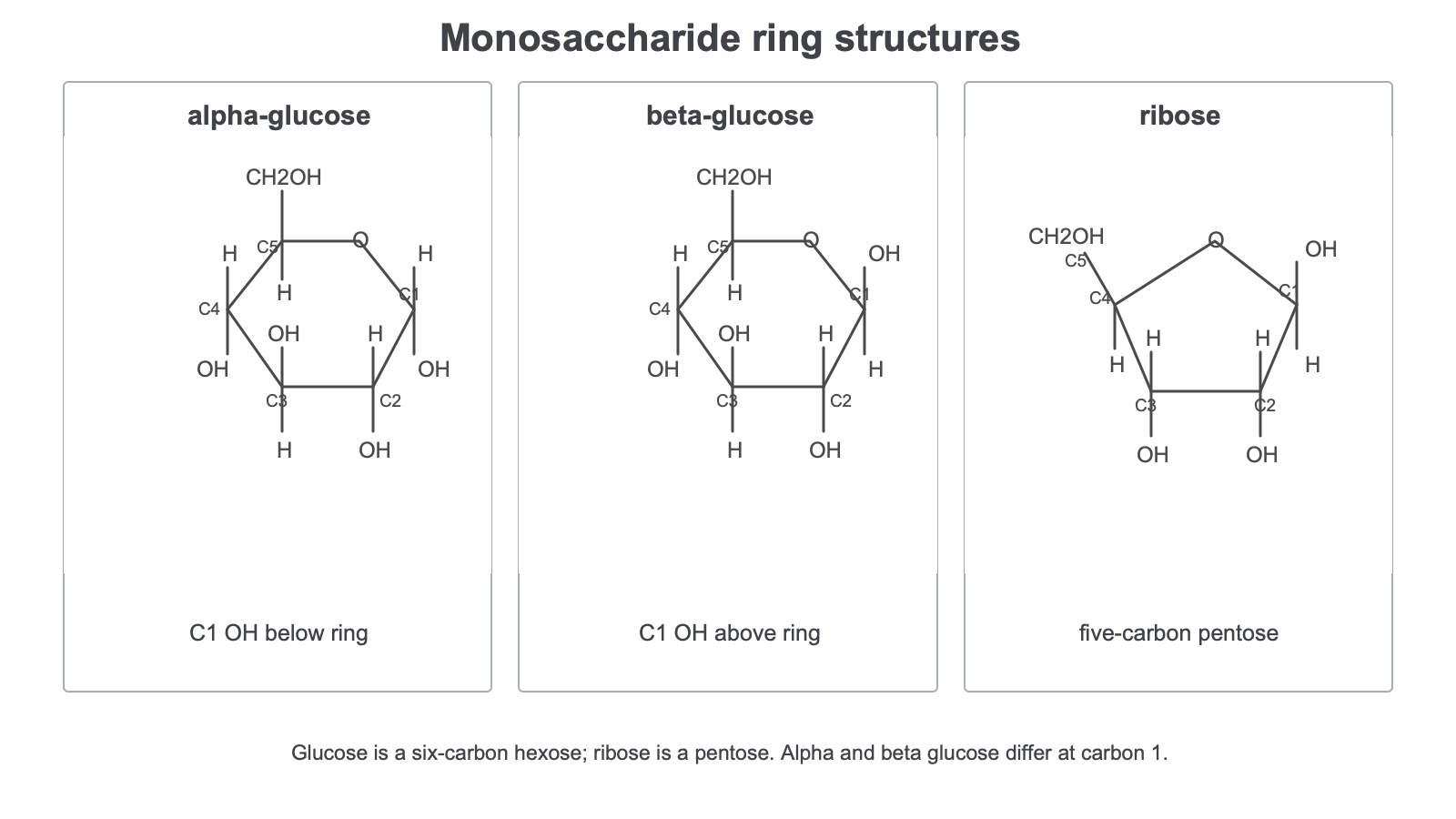
Glucose is a hexose monosaccharide, meaning it has six carbon atoms. Ribose is a pentose monosaccharide, meaning it has five carbon atoms. Ribose will matter later in nucleotides, but this lesson only needs its pentose sugar structure.
[DIAGRAM: monosaccharide_ring_structures: Lesson 020: Monosaccharide ring structures - diagram 01; asset_slug: 020_m02_1_2_monosaccharides_disaccharides_and_glycosidic_bonds__diagram_01; recommended_method: drawn_biology; description: Deterministic labelled comparison of alpha-glucose, beta-glucose and ribose ring structures.]
Glucose Structure And Properties
Glucose is a useful example of a hexose monosaccharide because it is small, soluble and can be used in respiration. Its many hydroxyl groups help it dissolve in water, so it can be transported in solution.
Glucose commonly forms a ring structure. The structural difference between alpha-glucose and beta-glucose is the orientation of the hydroxyl group on carbon 1. In a simplified OCR-safe ring diagram, alpha-glucose has the carbon 1 hydroxyl group below the ring; beta-glucose has it above the ring.
That small structural difference becomes important in later polysaccharides. Here, the required point is recognition of the alpha/beta difference, not full stereochemistry.
Forming Glycosidic Bonds
A glycosidic bond joins monosaccharides. It forms by condensation: two hydroxyl groups are involved, water is released, and a covalent bond links the sugar units.
[DIAGRAM: glycosidic_bond_formation_breakdown: Lesson 020: Glycosidic bond synthesis and breakdown - diagram 02; asset_slug: 020_m02_1_2_monosaccharides_disaccharides_and_glycosidic_bonds__diagram_02; recommended_method: drawn_biology; description: Deterministic diagram showing condensation forming maltose and hydrolysis breaking a glycosidic bond, with named disaccharide table.]
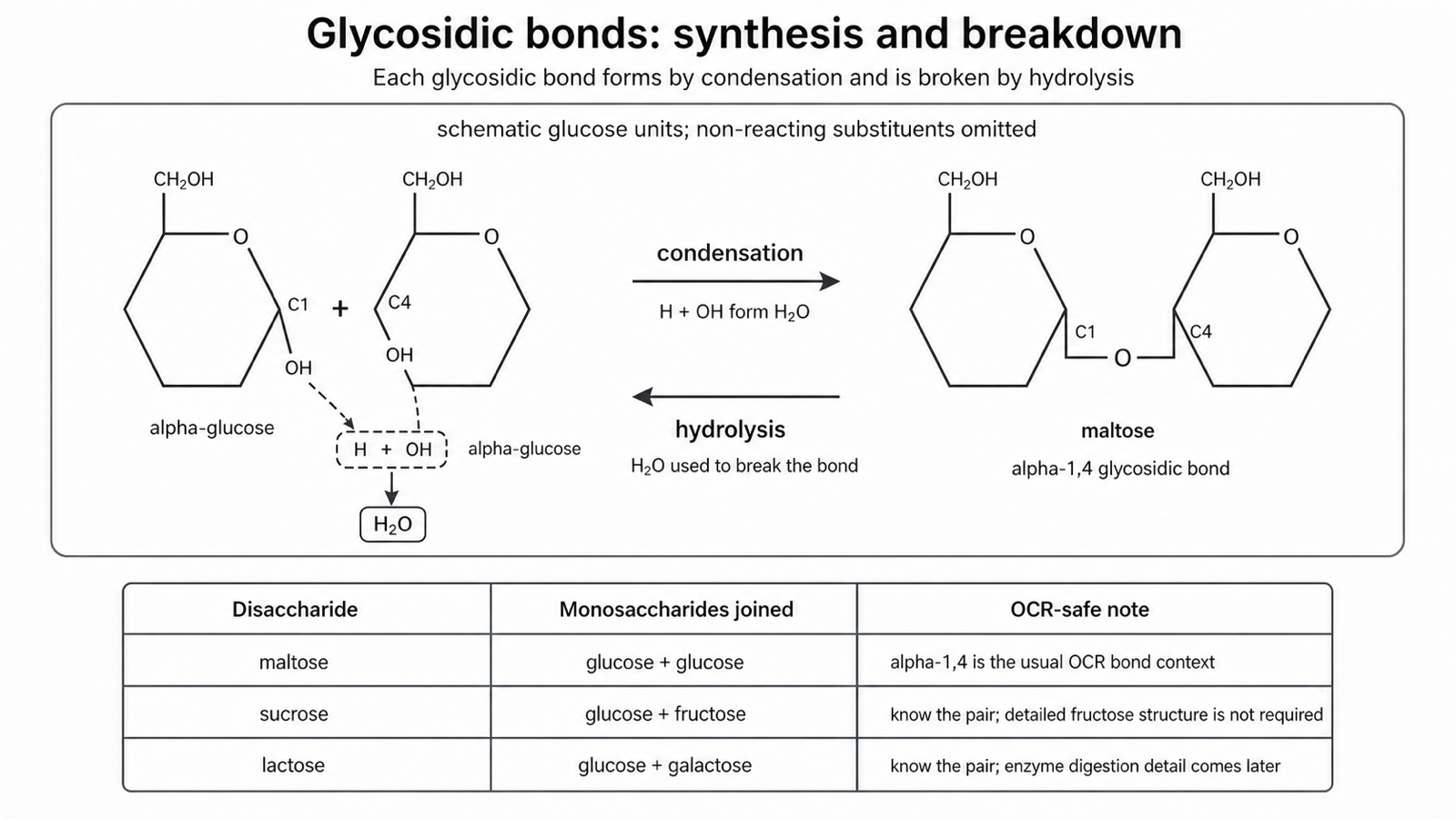
For maltose, two glucose molecules join. A common exam context is an alpha-1,4 glycosidic bond: carbon 1 of one alpha-glucose joins carbon 4 of another glucose.
Hydrolysis is the reverse process. Water is used to break a glycosidic bond.
Counting Water Molecules
A trisaccharide contains three monosaccharides joined in a chain.
Three monosaccharides in one chain are joined by two glycosidic bonds.
Complete hydrolysis breaks two bonds, so it uses two water molecules.
The count follows the number of bonds broken, not the number of monosaccharides produced.
Named Disaccharides
You need the three named disaccharides and the monosaccharides that form them.
| Disaccharide | Monosaccharides joined |
|---|---|
| Maltose | glucose + glucose |
| Sucrose | glucose + fructose |
| Lactose | glucose + galactose |
Do not turn this row into detailed fructose or galactose chemistry. The required learning is the named pair and the idea that a glycosidic bond links the monosaccharides.
Polysaccharides form when many monosaccharides join by glycosidic bonds. Their detailed structure-function differences are the next lesson, so this lesson treats polysaccharides only as many sugar units joined together.
Hydrolysis And Exam Precision
Hydrolysis breaks glycosidic bonds by adding water. Condensation forms glycosidic bonds by releasing water. These two reactions are opposite directions of the same bond logic.
Be precise with language:
| If asked about | Say |
|---|---|
| bond type in maltose | glycosidic bond, often alpha-1,4 in this context |
| synthesis | condensation and water released |
| breakdown | hydrolysis and water used |
| water count | count the glycosidic bonds made or broken |
Hydrolysis And Exam Precision Summary
Carbohydrate structure is built by carbon count, alpha/beta ring position and glycosidic bonds formed or broken by water-linked reactions.