4.2.3.2a - Plant Transport Organs And Transpiration
Roots, stems and leaves work together as a plant organ system for transport. This lesson follows the route of water and mineral ions from the soil to the leaves, then explains how water is lost by transpiration and how the plant controls that loss. The key exam habit is to link each structure to its function, not just name it.
Plant Transport Organs
An organ is a group of different tissues working together to carry out a function. In plants, the roots, stem and leaves form an organ system for transporting substances around the plant.
- roots absorb water and mineral ions from the soil
- stems hold the plant up and contain transport tissues
- leaves make sugars by photosynthesis, contain stomata for gas exchange, and supply dissolved sugars to phloem
[DIAGRAM: asset_name: plant_transport_routes - diagram 1; asset_slug: 028_4_2_3_2a_plant_transport_organs_and_transpiration_diagram1; file: diagram_assets/imagegen_regen_all/028_4_2_3_2a_plant_transport_organs_and_transpiration_diagram1_imagegen.png; recommended_method: codex_image_gen; description: Monochrome schematic of roots, stem and leaves, with xylem arrows showing water and mineral ions moving from roots to leaves, phloem arrows showing dissolved sugars moving from leaves to the rest of the plant, and a leaf stoma showing water vapour loss.]
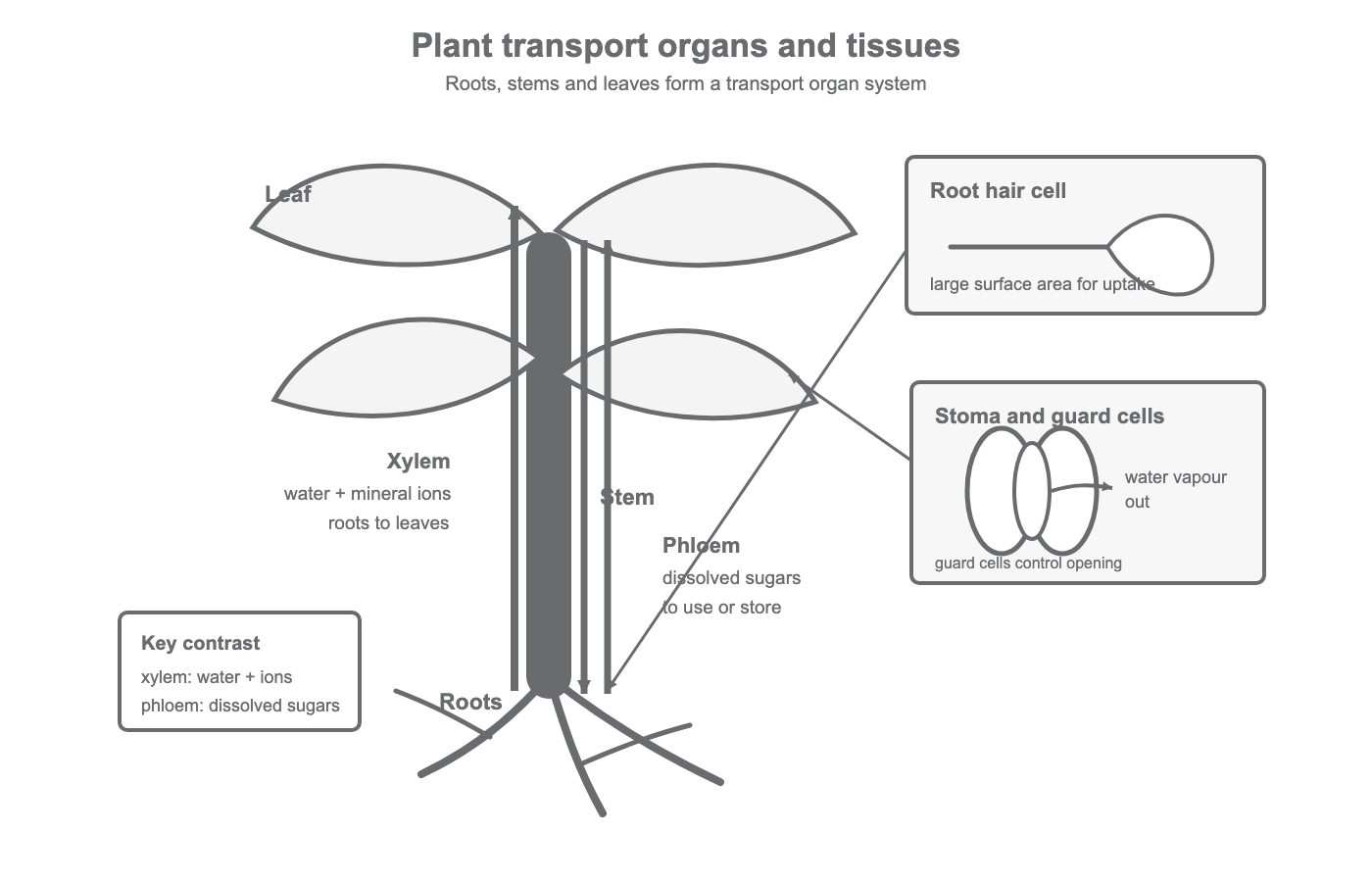
Plants have two main transport tissues here:
- xylem transports water and mineral ions from roots to stems and leaves
- phloem transports dissolved sugars from leaves to the rest of the plant for immediate use or storage
Xylem and phloem have different structures. Xylem forms hollow tubes strengthened with lignin. Phloem is made of tubes of elongated cells. Cell sap can move from one phloem cell to the next through pores in the end walls.
The movement of food molecules through phloem is called translocation. For this lesson, the important contrast is simple: xylem carries water and mineral ions; phloem carries dissolved sugars in cell sap. Detailed phloem structure and the mechanism of translocation are not required.
Root Uptake And Xylem
Root hair cells are specialised cells on the surface of roots. Their long, thin extensions give a large surface area, so more water and mineral ions can be absorbed from the soil.
Osmosis
Osmosis is the net movement of water from a dilute solution to a more concentrated solution through a partially permeable membrane.
Water enters root hair cells by osmosis because the soil water is usually more dilute than the cell contents. Mineral ions are often at a lower concentration in the soil than inside the root hair cell, so they are taken up by active transport. Active transport needs energy released by respiration, which is why root hair cells need mitochondria.
Xylem tissue then carries water and mineral ions from the roots to the stem and leaves. Xylem is adapted for this job because mature xylem vessels form hollow tubes. Their walls contain lignin, which strengthens the tubes and helps support the plant.
Stomata And Transpiration
Transpiration is the loss of water vapour from the leaves and other aerial parts of a plant. Most of this water vapour leaves through stomata, which are tiny pores in the leaf surface.
Transpiration Stream
The transpiration stream is the movement of water and mineral ions from the roots, through the xylem, to the leaves.
Inside a leaf, water evaporates from moist cell surfaces. The water vapour then diffuses through air spaces and out through stomata. This loss of water from the leaf helps pull more water up the xylem from the roots, forming the transpiration stream.
Stomata are surrounded by guard cells. Guard cells change shape to open or close the stomatal pore. Open stomata allow carbon dioxide to enter for photosynthesis and allow oxygen and water vapour to leave. Closing stomata reduces water loss, but it also reduces gas exchange.
When you describe transpiration, keep the sequence in order: evaporation inside the leaf, diffusion out through stomata, then replacement water moving up the xylem.
Factors Affecting Transpiration Rate
The rate of transpiration means how much water is lost by the plant per unit time. In school investigations, water uptake can be used as an estimate of transpiration rate because water lost from the leaves is replaced by water taken up through the roots.
Rate Of Transpiration
For example, if a shoot takes up 6.0 cm^3 of water in 30 minutes:
[DIAGRAM: asset_name: transpiration_rate_factors - diagram 2; asset_slug: 028_4_2_3_2a_plant_transport_organs_and_transpiration_diagram2; file: diagram_assets/imagegen_regen_all/028_4_2_3_2a_plant_transport_organs_and_transpiration_diagram2_imagegen.png; recommended_method: codex_image_gen; description: Monochrome factor map showing how higher temperature, higher humidity, more air movement and higher light intensity affect transpiration rate, with a note that low humidity has the opposite effect.]
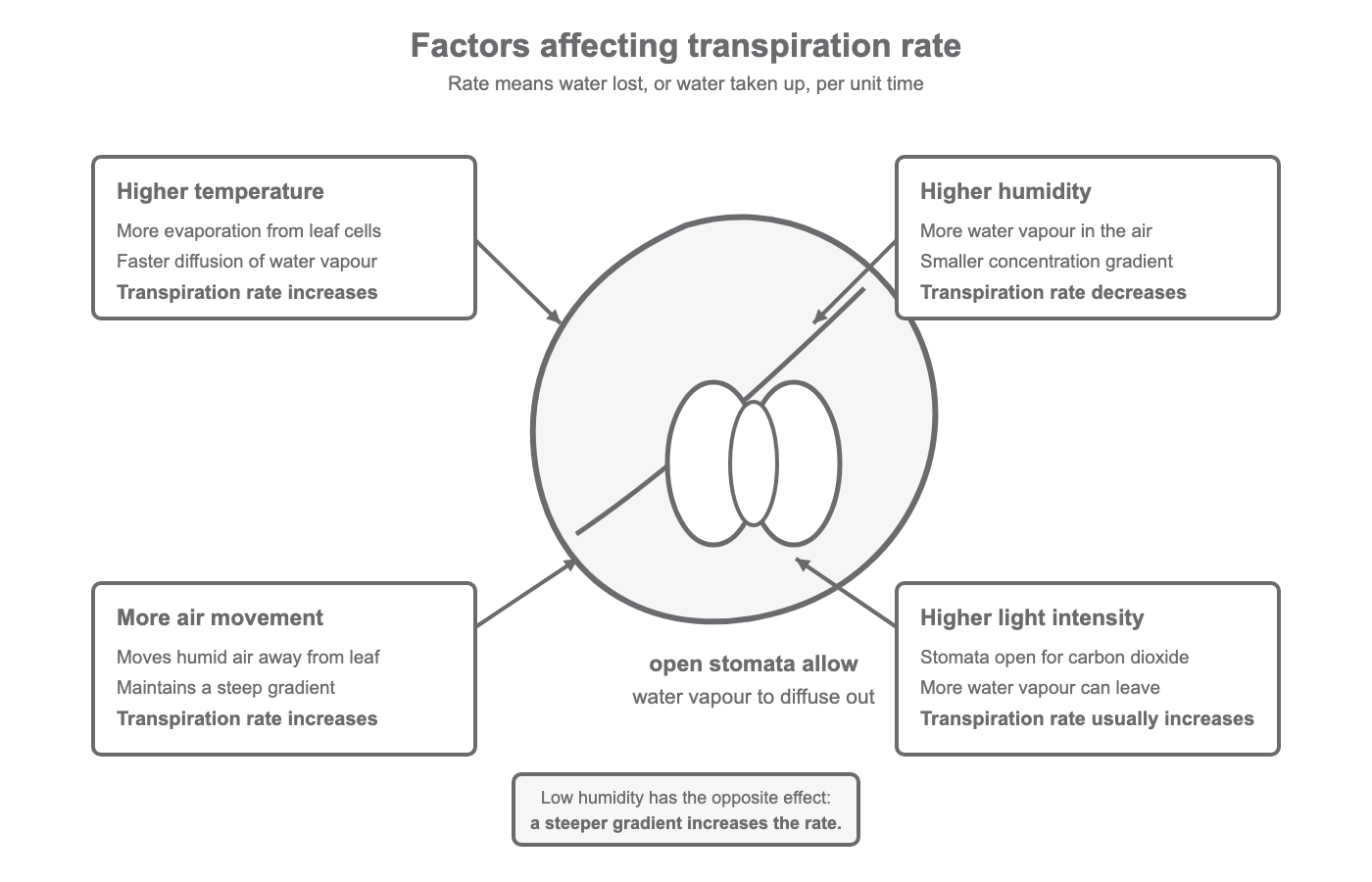
Four environmental factors affect transpiration rate:
- higher temperature usually increases transpiration because water evaporates faster and water vapour diffuses faster
- higher humidity decreases transpiration because the water vapour concentration gradient between the leaf and the air is smaller
- more air movement increases transpiration because moving air removes humid air from around the leaf
- higher light intensity usually increases transpiration because stomata open for carbon dioxide to enter for photosynthesis
Humidity is a common trap. High humidity means the air already contains a lot of water vapour, so water vapour diffuses out of the leaf more slowly. Low humidity means drier air, a steeper concentration gradient, and faster transpiration.
Exam Links And Misconceptions
Strong answers use precise transport words. Do not say that xylem and phloem both carry "food and water". Xylem carries water and mineral ions. Phloem carries dissolved sugars in cell sap.
For structure questions, keep the comparison short: xylem forms hollow tubes strengthened by lignin, while phloem forms tubes of elongated cells with pores in the end walls.
Do not confuse transpiration with translocation. Transpiration is about water loss and water movement in xylem. Translocation is movement of dissolved sugars in phloem.
Do not just list a factor and say "it affects transpiration". Explain the link. For humidity, compare water vapour in the leaf with water vapour in the air. For light intensity, link open stomata to carbon dioxide entering for photosynthesis and water vapour leaving.
The final check is to pair each transport process with the correct tissue and substance.
Plant transport answers work best when you link the substance, the tissue and the direction or process: water and mineral ions move up xylem in the transpiration stream, while dissolved sugars move in phloem.