4.2.2.1b - Required Practical - Food Tests
Food tests use chemical reagents to identify molecules in food samples. In this required practical, the tested molecules are sugars, starch, lipids and protein, using Benedict's solution, iodine solution, Sudan III stain and Biuret reagent. The results are qualitative: they tell you whether a substance is present or absent, not its exact mass or concentration.
Qualitative Tests
A qualitative reagent is a chemical used to identify whether a substance is present. The key evidence is an observation, usually a colour change. You must connect the colour change to the molecule being tested, not just name the reagent.
Qualitative Test
A test that shows whether a substance is present or absent, without measuring its exact amount.
For this practical, learn the pairings as a set:
| Molecule tested | Reagent | Heating needed? | Positive result |
|---|---|---|---|
| Sugars such as glucose | Benedict's solution | Yes, in a hot water bath | Blue changes to green, yellow, orange or brick-red |
| Starch | Iodine solution | No | Orange-brown changes to blue-black |
| Lipids | Sudan III stain | No | A red-stained oil layer separates and floats on the surface |
| Protein | Biuret reagent | No | Blue changes to lilac or purple |
The required practical is described as testing a range of carbohydrates, lipids and proteins. The named tests in the specification are Benedict's test for sugars, iodine test for starch and Biuret reagent for protein. The AQA practical guidance also uses Sudan III stain solution for lipids.
The colour names matter because they are the evidence. If iodine stays orange-brown, starch was not detected. If Sudan III does not form a red-stained oil layer, lipids were not detected. If Biuret reagent stays blue, protein was not detected. If Benedict's solution stays blue after heating, sugar was not detected.
Preparing Food Samples
Many foods are solids or mixtures, so the first job is to make a testable food extract. Use a small sample, grind it with a pestle and mortar, add distilled water, stir, then filter the mixture. The filtrate is the liquid food extract that can be divided between clean test tubes.
Use separate clean test tubes for each test. This prevents one reagent from contaminating another test and causing a misleading colour change. Label the tubes clearly so the observation is matched to the correct reagent.
[DIAGRAM: asset_name: food-test-setup - diagram 1; asset_slug: 019_4_2_2_1b_required_practical_4_food_tests_diagram1; file: diagram_assets/imagegen_regen_all/019_4_2_2_1b_required_practical_4_food_tests_diagram1_imagegen.png; recommended_method: codex_image_gen; description: Monochrome flow diagram showing a ground food sample mixed with distilled water and filtered, then split into four labelled tests: Benedict's test heated in a hot water bath for sugars, iodine test for starch, Sudan III test for lipids, and Biuret test for protein, with positive and negative result wording.]
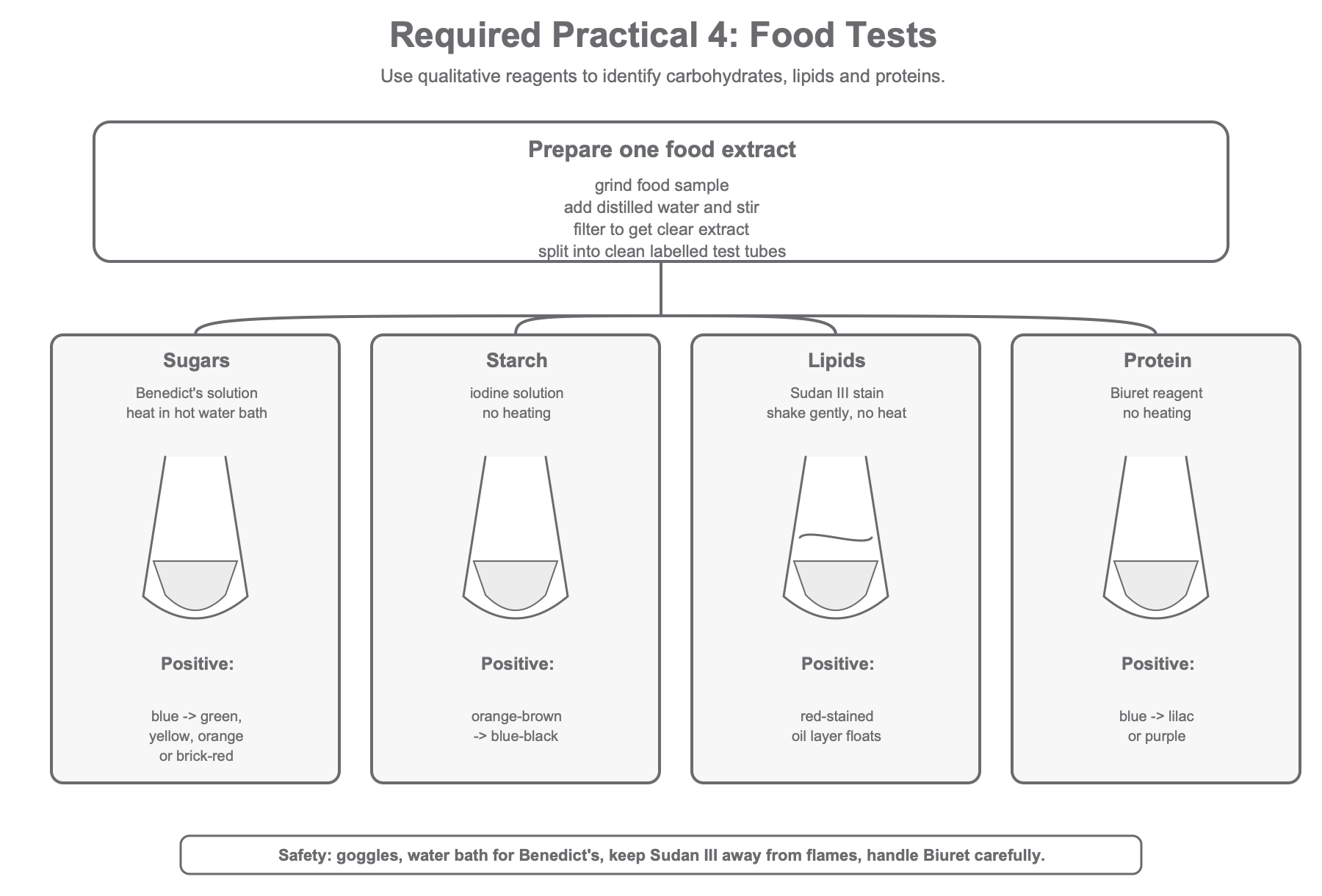
A fair comparison uses the same preparation method for each food being tested. If one food is filtered but another is not, or one sample uses much more food extract, the results are harder to compare.
Benedict's Test For Sugars
Benedict's solution is used to test for sugars such as glucose. In GCSE practical work this is often described as the test for reducing sugars, but the key course point is the method and result.
Method:
- Put food extract into a test tube.
- Add Benedict's solution and mix gently.
- Place the test tube in a hot or boiling water bath for a few minutes.
- Record the final colour.
The water bath is part of AT 2. A Bunsen burner may be used to heat the water in a beaker on a tripod and gauze, but the test tube is heated by the water, not directly in the flame. Wear eye protection, keep the tube opening pointed away from people, and handle hot glassware carefully.
A positive Benedict's test is a colour change from blue towards green, yellow, orange or brick-red. A brick-red result is often described as a strong positive result. For this required practical, the safest conclusion is qualitative: sugar was detected.
Iodine, Sudan III And Biuret Tests
Iodine solution tests for starch. Add a few drops of iodine solution to the food extract and mix. A positive result is a change from orange-brown to blue-black. No heating is needed.
Sudan III stain tests for lipids. Add a few drops of Sudan III stain to the food extract and shake gently to mix. If fat is present, a red-stained oil layer separates out and floats on the water surface. No heating is needed. Sudan III stain contains ethanol, so keep it away from naked flames.
Biuret reagent tests for protein. Add Biuret reagent to the food extract and mix gently. A positive result is a change from blue to lilac or purple. Some practical instructions use sodium hydroxide followed by copper(II) sulfate instead of a pre-mixed Biuret reagent; both are forms of the Biuret test, but the specification wording you need here is Biuret reagent.
Do not swap the tests. A common error is to say iodine tests for sugar, Sudan III tests for protein, or Benedict's tests for starch. The reagent-molecule-result chain is the mark-scoring unit.
Iodine detects starch by turning blue-black; Sudan III detects lipids by forming a red-stained oil layer; Biuret detects protein by turning lilac or purple.
Valid And Safe Results
The independent variable is usually the food sample being tested. The dependent variable is the observed colour change for each reagent. Control variables include the volume of food extract, volume and concentration of reagent, heating time and water-bath temperature for Benedict's test, and the way the sample is prepared and filtered.
To improve reliability, repeat the test on the same food extract or test more than one sample of the same food. If one repeat gives a different result from the others, treat it as an anomalous result and repeat it before making a conclusion. A mean is not normally useful for simple colour categories, but it could be used if the method converted observations into numerical data, such as a colour score.
For validity, include controls where possible. A positive control contains the molecule and should give the expected positive result, such as starch solution with iodine. A negative control lacks the molecule and should give a negative result, such as distilled water with the reagent. Controls show that the reagents and method are working.
Risk reduction must match the hazard:
- Wear safety goggles when using reagents.
- Use a water bath rather than heating test tubes directly in a flame.
- Keep hot water and hot glassware away from skin.
- Keep Sudan III stain away from naked flames because it contains ethanol and is flammable.
- Handle Biuret reagent carefully because it can contain sodium hydroxide and copper sulfate.
- Clean spills and use clean equipment to avoid contamination.
Exam Precision
In exam answers, keep the order clear: sample, reagent, condition, observation, conclusion. For Benedict's test, the condition is heating in a hot water bath. For iodine, Sudan III and Biuret tests, no heating is needed.
Use observation words before conclusion words. "The iodine changed to blue-black" is the observation. "Starch is present" is the conclusion. If the result is negative, say what did not change and which molecule was not detected.
Be careful with the word contains. A positive food test supports the conclusion that a molecule is present in the tested extract. It does not prove the exact amount in the original food. For a more precise amount, a different quantitative method would be needed.