4.1.3.2a - Osmosis and Water Movement
Water can move into and out of cells through the cell membrane. The AQA word for this movement is osmosis, and the definition is exact: it is about water, a partially permeable membrane, and movement from a dilute solution to a concentrated solution. In this lesson you will learn how to follow the direction of water movement and how to calculate percentage gain, percentage loss and simple rates of water uptake.
What osmosis means
Osmosis is a special case of diffusion. In diffusion, particles spread out because of their random movement. In osmosis, the moving particles are water molecules, and the movement happens through a partially permeable membrane.
Osmosis
The diffusion of water from a dilute solution to a concentrated solution through a partially permeable membrane.
A dilute solution has a lower concentration of dissolved solute and a higher concentration of water. A concentrated solution has a higher concentration of dissolved solute and a lower concentration of water.
A partially permeable membrane lets some particles pass through but not others. In cells, the cell membrane is partially permeable. For this lesson, the key model is simple: water molecules can pass through the membrane, but larger dissolved solute particles may not.
Following water movement
When two solutions are separated by a partially permeable membrane, water molecules move in both directions. However, if one side is more dilute and the other side is more concentrated, more water moves from the dilute side to the concentrated side than the other way round. This is the net movement of water.
[DIAGRAM: asset_name: osmosis-membrane-model - diagram 1; asset_slug: 014_4_1_3_2a_osmosis_and_water_movement_diagram1; file: diagram_assets/imagegen_regen_all/014_4_1_3_2a_osmosis_and_water_movement_diagram1_imagegen.png; recommended_method: codex_image_gen; description: Monochrome labelled model with a central partially permeable membrane. The left side is a dilute solution with many small water particles and few solute particles; the right side is a concentrated solution with fewer water particles and many larger solute particles. Small arrows show water can move both ways and a larger net arrow points from dilute to concentrated. Solute particles are shown not crossing the membrane.]
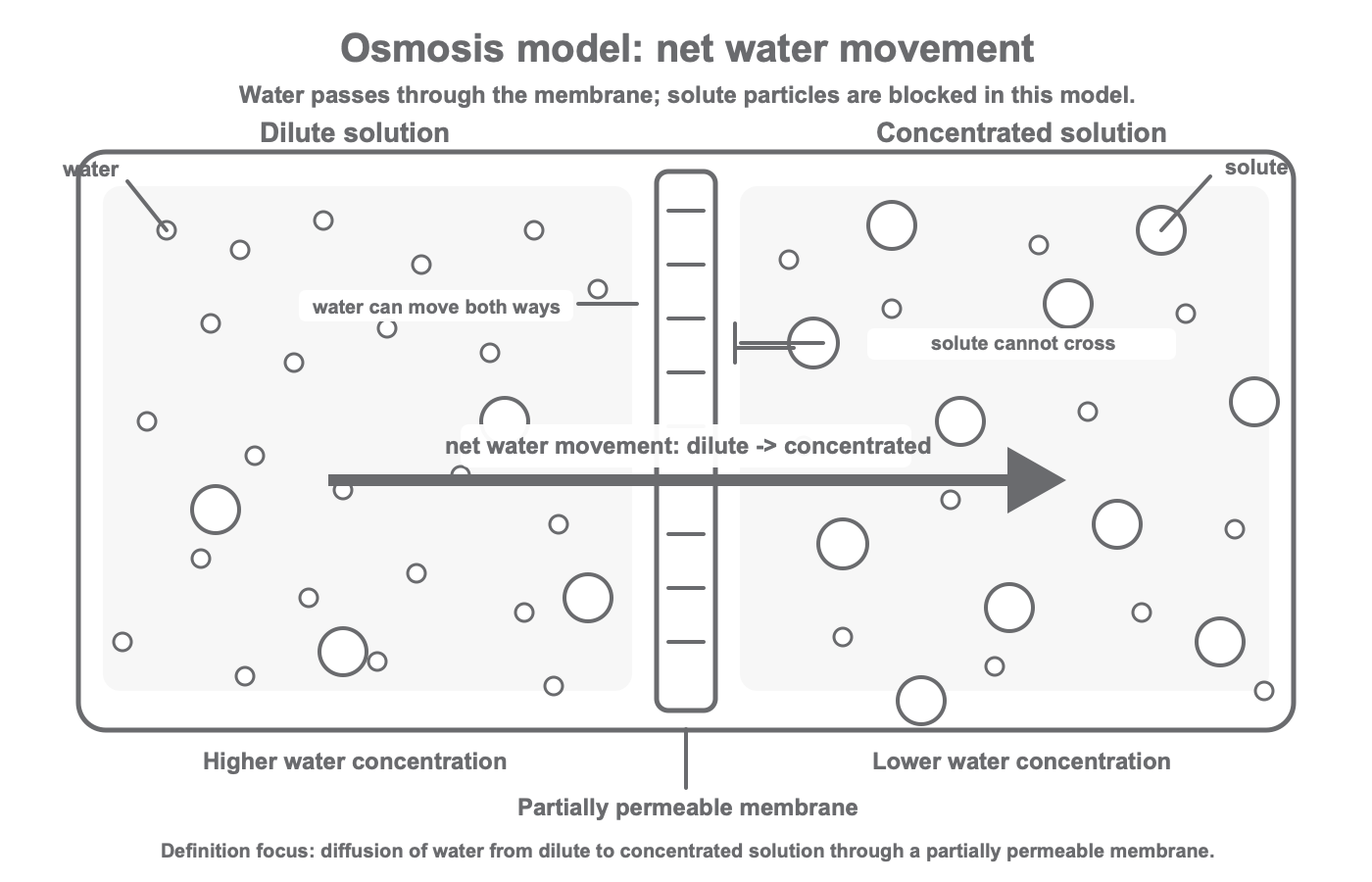
To interpret an osmosis diagram, ask three questions:
- Which side is more dilute?
- Which side is more concentrated?
- Does the membrane allow water through?
If water can cross the membrane, the net movement is from the more dilute solution to the more concentrated solution. Do not say the solute moves by osmosis. Osmosis is the movement of water.
This is the key exam idea: name water, name the partially permeable membrane, and give the direction from dilute to concentrated.
Plant tissue mass changes
Plant tissue contains cells with partially permeable cell membranes. If plant tissue is placed in a solution that is more dilute than the cell contents, water moves into the cells by osmosis. The tissue gains mass because more water enters than leaves.
If plant tissue is placed in a solution that is more concentrated than the cell contents, water moves out of the cells by osmosis. The tissue loses mass because more water leaves than enters.
If there is no overall difference in concentration, there is no net movement of water. Water still moves both ways through the membranes, but the amounts moving in each direction are balanced, so the mass stays about the same.
This lesson uses plant tissue as a calculation context. The full required practical method with potato cylinders, variables and controls belongs to the linked practical scaffold, not this split point.
Mass gain means net water movement into the tissue; mass loss means net water movement out of the tissue.
When you explain a mass change, link the result to whether water entered or left the plant cells overall.
Percentage gain and loss
AQA expects you to calculate percentage gain and percentage loss of mass for plant tissue. First calculate the change in mass:
change in mass = final mass - initial mass
Then compare that change with the initial mass.
Percentage change in mass
Worked example 1: percentage gain
A potato cylinder has an initial mass of 2.50 g and a final mass of 2.75 g.
- Change in mass:
2.75 - 2.50 = 0.25 g - Percentage change:
(0.25 / 2.50) x 100 = 10.0% - The answer is positive, so this is a
10.0% gain in mass.
Worked example 2: percentage loss
A different potato cylinder has an initial mass of 3.20 g and a final mass of 2.88 g.
- Change in mass:
2.88 - 3.20 = -0.32 g - Percentage change:
(-0.32 / 3.20) x 100 = -10.0% - The answer is negative, so this is a
10.0% loss in mass.
Rate of water uptake
A rate compares a change with the time taken. For osmosis questions, a simple rate of water uptake can be calculated from the change in mass divided by the time.
Rate of water uptake
The unit is a compound unit because it combines mass and time, for example g/min.
Worked example:
Plant tissue gains 0.18 g in 30 minutes.
- Rate of water uptake:
0.18 / 30 - Rate:
0.006 g/min
If the tissue loses mass, the same calculation can describe the rate of water loss. For example, a loss of 0.24 g in 40 minutes gives 0.24 / 40 = 0.006 g/min as the rate of water loss.
Exam precision
Osmosis answers lose marks when they become too vague. The safest definition contains all three ideas: water, dilute to concentrated, and partially permeable membrane.
Use water rather than particles if the question is about osmosis. Use partially permeable membrane rather than just membrane when the definition is being assessed. If a question asks about mass change, connect the mass change to net water movement: gaining mass means water entered overall; losing mass means water left overall.
For calculations, keep the sign clear. A positive percentage change means gain. A negative percentage change means loss. If the question asks for percentage loss, you can give the size of the loss as a positive percentage, but your working should show that the final mass was lower than the initial mass.