4.2.3.1 - Plant Tissues
Plants are organised: cells with similar jobs form tissues, and different tissues work together in organs. In this lesson, the main organ is the leaf. The exam focus is not just naming leaf tissues, but explaining how each tissue's structure helps it carry out its function.
Tissues and organs
A plant tissue is a group of cells that work together to do a particular job. A tissue is more than a single cell, but less than a whole organ.
Tissue
A group of cells with similar structures working together to perform a particular function.
Different tissues can then work together as an organ. A leaf is a plant organ because it contains several tissues that cooperate for photosynthesis, gas exchange, transport and protection.
Organ
A group of different tissues working together to perform a particular function.
For this specification point, the plant tissues to know are epidermal tissues, palisade mesophyll, spongy mesophyll, xylem and phloem, and meristem tissue at the growing tips of shoots and roots.
Leaf cross-section
A transverse section is a thin slice cut across a leaf. Under a microscope, this view shows the upper surface, the lower surface, and the tissues between them.
[DIAGRAM: asset_name: Leaf transverse section - diagram 1; asset_slug: 027_4_2_3_1_plant_tissues_diagram1; file: diagram_assets/imagegen_regen_all/027_4_2_3_1_plant_tissues_diagram1_imagegen.png; recommended_method: codex_image_gen; description: Monochrome labelled transverse section of a leaf showing upper epidermis, palisade mesophyll, spongy mesophyll with air spaces, lower epidermis with guard cells around a stoma, and a vascular bundle labelled xylem and phloem.]
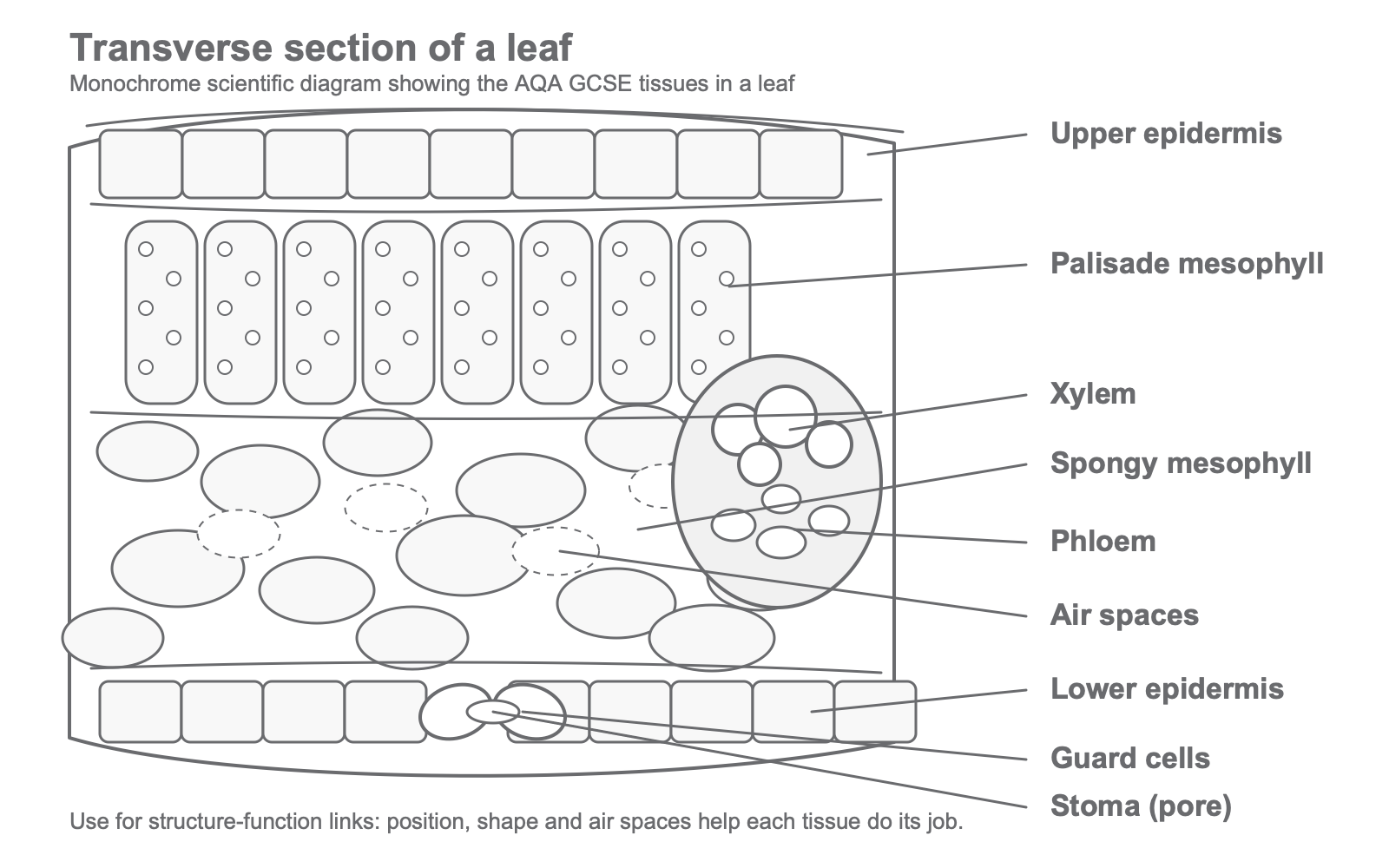
The top and bottom surfaces are epidermal tissues. Inside the leaf are palisade mesophyll and spongy mesophyll. Veins contain xylem and phloem, and the lower epidermis can include stomata surrounded by guard cells.
The important exam habit is to use the tissue name and the job it is adapted for. For example, "palisade mesophyll has many chloroplasts" is a structure statement; "so it absorbs light for photosynthesis" is the function link.
Mesophyll tissues
Mesophyll means the tissue in the middle of the leaf. The two mesophyll tissues are not arranged in the same way because they have different main jobs.
Palisade mesophyll is near the upper surface of the leaf. Its cells are long, closely packed and contain many chloroplasts. This arrangement helps the tissue absorb light for photosynthesis.
Spongy mesophyll lies below the palisade layer. Its cells are more loosely arranged, with air spaces between them. These air spaces allow gases, especially carbon dioxide and oxygen, to diffuse through the leaf.
A common mistake is to say that the spongy mesophyll "does photosynthesis better" than the palisade mesophyll. Spongy mesophyll cells can contain chloroplasts, but its looser arrangement and air spaces make gas diffusion its key structure-function link.
Epidermis, guard cells and stomata
The epidermis is the surface tissue of the leaf. It helps protect the leaf and forms a boundary between the inside of the leaf and the air outside. The upper epidermis is thin and transparent enough for light to reach the palisade mesophyll below.
Stomata are tiny pores, usually in the epidermis. Guard cells are the pair of cells around each stoma. The guard cells change shape to control the size of the pore, so they help control gas exchange through the leaf surface.
Be precise with the words: the stoma is the pore, while the guard cells are the cells around the pore. In an exam, mixing those up can lose an otherwise easy mark.
Transport tissues and meristems
Xylem and phloem are transport tissues. In a leaf, they are found together in veins, also called vascular bundles. The leaf's photosynthesising cells need a supply of water, and the sugars made in the leaf need to be moved to other parts of the plant.
Xylem carries water and mineral ions towards the leaf. Phloem carries dissolved sugars from the leaf to other parts of the plant for use or storage. This lesson only needs the broad tissue roles and where they appear in the leaf; the detailed tube adaptations are the next specification point.
Meristem tissue is found at the growing tips of shoots and roots. These are the places where plants make new cells for growth. The new cells can then become specialised into different plant tissues.
Drawing and exam precision
AQA links this section to AT7: observing and drawing a transverse section of a leaf. A scientific drawing should be clear, large enough to see, drawn with clean outlines, and labelled using tissue names such as epidermis, palisade mesophyll, spongy mesophyll, xylem, phloem, guard cells and stoma.
When the question asks you to explain a structure-function relationship, use a three-step answer:
- Name the tissue.
- State the structure clearly.
- Link that structure to the function.
For example: "Spongy mesophyll has air spaces between its cells, so gases can diffuse through the leaf." That answer earns credit because the structure and function are connected.
The core idea is structure linked to function: each plant tissue has features that help it do a particular job in the leaf or at the growing tips.