4.1.1.3 - Cell Specialisation
Different cells can have different shapes and subcellular structures because they do different jobs. In this lesson, the key skill is to explain a structure-function link: name a feature, state what it does, then connect it to the cell's role in a tissue, organ, organ system or whole organism.
What Specialised Means
A specialised cell is a cell with structures that help it carry out a particular function. The word "function" means the job the cell does. The structure may be the cell's shape, its internal parts, the materials in its walls, or how it joins to other cells.
Specialised Cell
A specialised cell is a cell with features that help it carry out a specific function.
The AQA skill is not just naming the feature. You need to make a link:
- feature: "The cell has a long extension."
- function: "This gives a large surface area."
- explanation: "So more water and mineral ions can be absorbed from the soil."
Cells do not work in isolation. A muscle cell helps muscle tissue contract; muscle tissue helps an organ move; organ systems use those movements to help the whole organism survive. In plants, xylem and phloem cells work together in vascular tissue to move substances through organs such as roots, stems and leaves.
Animal Specialised Cells
Sperm cells, nerve cells and muscle cells are the animal examples named in the specification. You should be able to use information about their structures to explain their functions.
[DIAGRAM: asset_name: animal_specialised_cells - diagram 1; asset_slug: 004_4_1_1_3_cell_specialisation_diagram1; file: diagram_assets/imagegen_regen_all/004_4_1_1_3_cell_specialisation_diagram1_imagegen.png; recommended_method: codex_image_gen; description: Monochrome labelled schematics of a sperm cell, nerve cell and muscle cell, with arrows connecting visible structural features to their functions.]
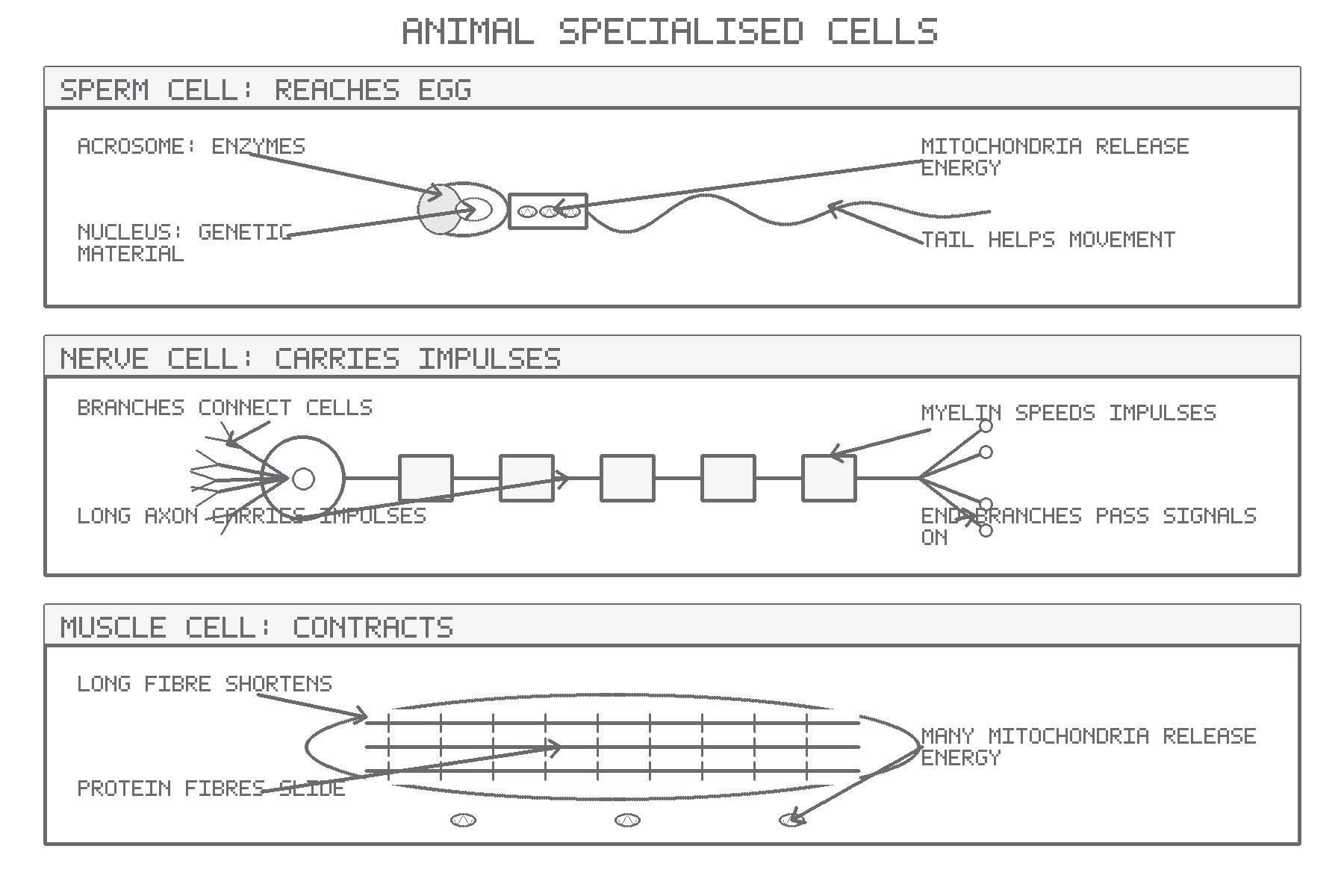
A sperm cell is specialised to deliver male genetic material to an egg cell. The head contains the nucleus with genetic material. The acrosome contains enzymes that help the sperm cell enter the egg. The middle section contains many mitochondria, which release energy by respiration. The tail helps the sperm cell move.
A nerve cell, also called a neurone, is specialised to carry electrical impulses. It has a long axon so impulses can travel over long distances in the body. Branches at the ends allow it to connect with other cells, such as other neurones or muscle cells. Some axons have a myelin sheath, which helps impulses travel faster.
A muscle cell is specialised to contract. Muscle cells contain protein fibres that can slide past each other, shortening the cell. They often contain many mitochondria because contraction needs energy released by respiration.
Plant Specialised Cells
Root hair cells, xylem cells and phloem cells are the plant examples named in the specification. Each one shows a different way structure can support transport.
[DIAGRAM: asset_name: plant_specialised_cells - diagram 2; asset_slug: 004_4_1_1_3_cell_specialisation_diagram2; file: diagram_assets/imagegen_regen_all/004_4_1_1_3_cell_specialisation_diagram2_imagegen.png; recommended_method: codex_image_gen; description: Monochrome labelled schematics of a root hair cell, xylem vessel cells and phloem sieve tube cells, with structure-function labels.]
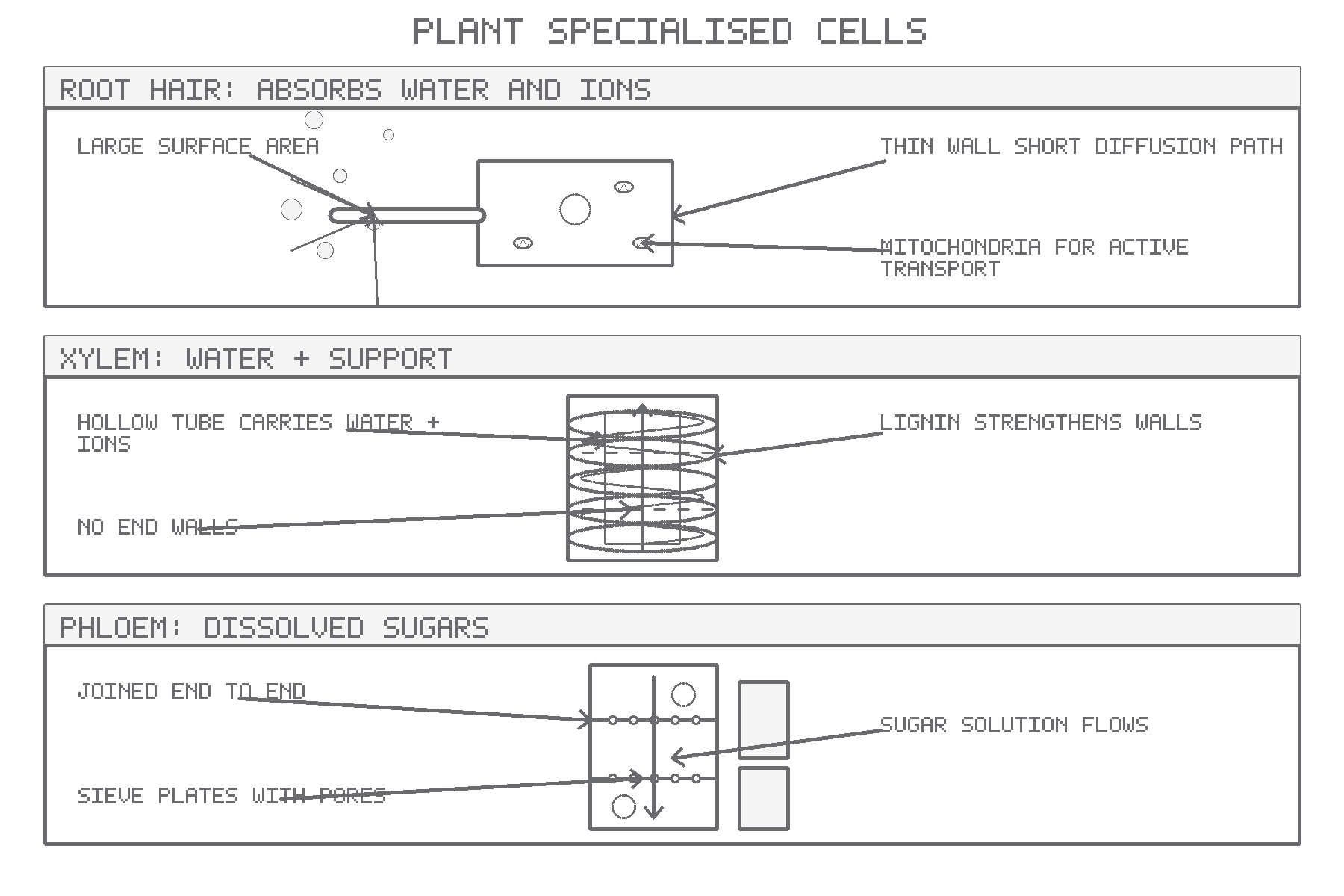
A root hair cell absorbs water and mineral ions from the soil. Its long, thin extension gives a large surface area, so more of the cell surface is in contact with soil water. A thin cell wall gives a short diffusion distance for water. Mitochondria provide energy needed for active transport of mineral ions.
Xylem cells are specialised for transporting water and mineral ions and for supporting the plant. Mature xylem vessel cells are hollow and dead, so water can move through the tube. Their end walls break down, making a continuous pathway. Their walls contain lignin, which strengthens the vessel and helps support stems and leaves.
Phloem cells are specialised for transporting dissolved sugars made in photosynthesis. Sieve tube cells are joined end-to-end. Their end walls have pores called sieve plates, so dissolved substances can move through. They have few subcellular structures, leaving more space for flow.
Explaining Structure And Function
In exams, AQA may give you information about a familiar or unfamiliar cell. A strong answer links structure to function using clear biological reasoning.
Use this three-step pattern:
- Name the structure or feature.
- State the effect of the feature.
- Link the effect to the cell's function.
For example: "The nerve cell has a long axon, which allows electrical impulses to travel long distances, so messages can pass between the spinal cord and muscles."
Avoid vague answers such as "it helps the cell work" or "it is adapted". Those phrases do not explain the link. Use "because", "so", "therefore" or "which allows" to show the reasoning.
Common Misconceptions
Do not say that a cell is specialised only because it is "important". The mark comes from the specific structure-function link.
Do not mix up xylem and phloem. Xylem carries water and mineral ions and has lignified walls for support. Phloem carries dissolved sugars and has sieve plates for flow.
Do not say mitochondria "make energy". In GCSE Biology, mitochondria release energy by respiration. That released energy can then be used for movement, contraction or active transport.
Do not overcomplicate the scale. A sperm cell helps fertilisation in the whole organism, a nerve cell helps communication in the nervous system, a muscle cell helps muscle tissue contract, and root hair, xylem and phloem cells help plant organs absorb or transport substances.
To explain cell specialisation, connect a named structure to the job it helps the cell do.