4.1.1.4 - Cell Differentiation
One cell is not enough to build a complex organism. As an organism develops, cells change so that different cells can do different jobs. This change is called cell differentiation, and it is how ordinary developing cells become specialised cells.
What differentiation means
Cell differentiation is the process in which a cell changes to become specialised for a particular function.
Cell differentiation
The process by which a cell changes and becomes specialised to carry out a particular function.
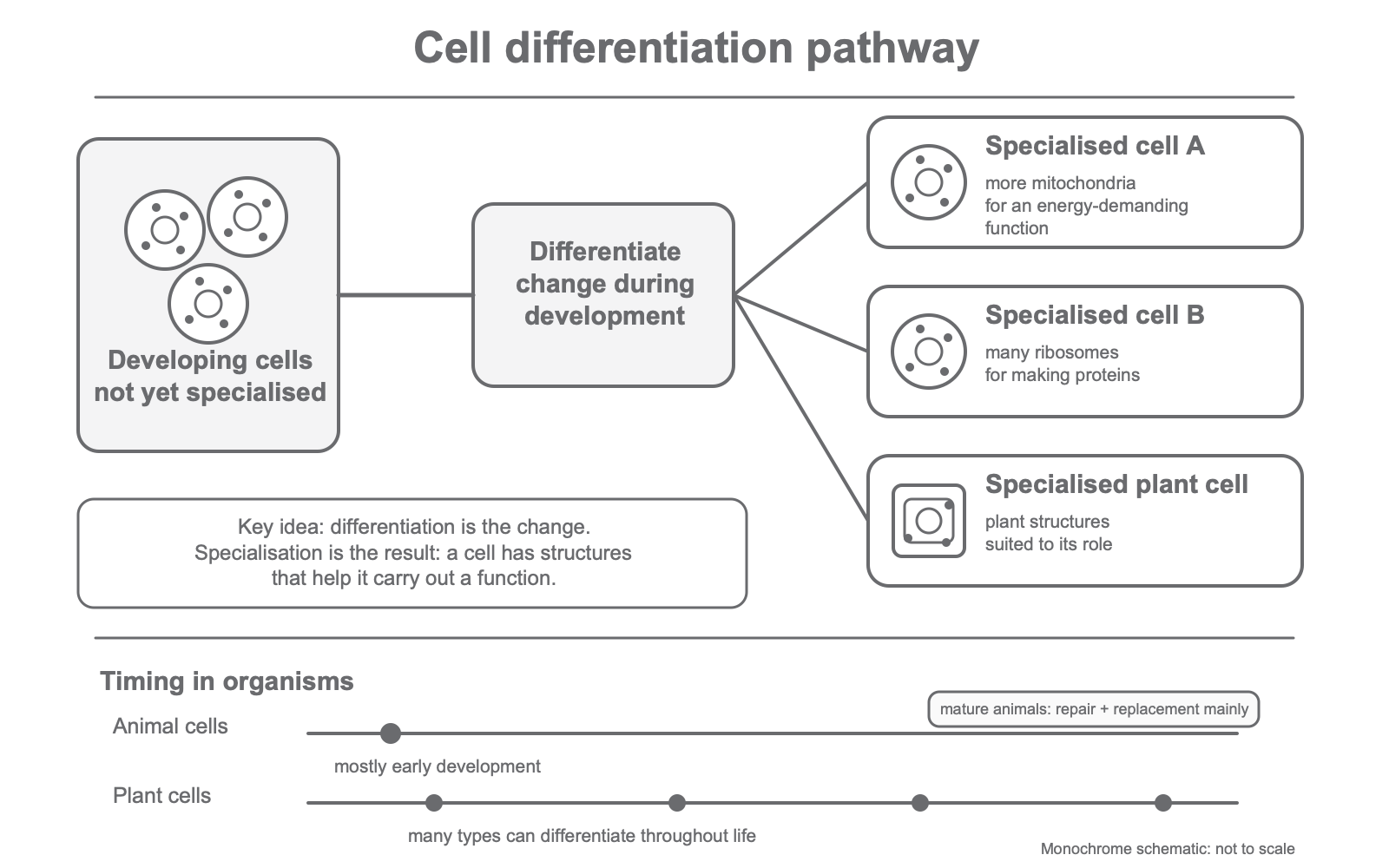
Before differentiation, a developing cell has the basic features needed to live and divide. During differentiation, the cell changes. It may make more of some sub-cellular structures, develop structures suited to its job, or develop a shape that helps it do a specific job.
A differentiated cell is a specialised cell. The two ideas are linked:
- differentiation is the process of changing
- specialisation is the result of that change
[DIAGRAM: asset_name: cell differentiation pathway - diagram 1; asset_slug: 005_4_1_1_4_cell_differentiation_diagram1; file: diagram_assets/imagegen_regen_all/005_4_1_1_4_cell_differentiation_diagram1_imagegen.png; recommended_method: codex_image_gen; description: Monochrome flowchart showing developing cells differentiating into specialised cells with different sub-cellular structures, plus a comparison timeline for animal cells and plant cells.]
Why differentiation matters
Cell differentiation is important because multicellular organisms need many different jobs to happen at the same time. A muscle cell, a nerve cell and a root hair cell do not all need the same shape or the same balance of sub-cellular structures.
If every cell stayed the same, the organism could only carry out a limited set of simple tasks. Differentiation allows cells to form tissues, organs and organ systems because groups of specialised cells can work together.
For example, some cells need many mitochondria because their function needs lots of energy to be transferred by respiration. Other cells may need many ribosomes because they make large amounts of protein. The important exam idea is not to memorise every example here; it is to link the cell's structures to the function it carries out.
Differentiation lets a multicellular organism develop many types of specialised cell, so different functions can be carried out efficiently.
Structures make function possible
As a cell differentiates, it acquires different sub-cellular structures. "Acquires" means it develops or gains the structures it needs for its role. These structures enable the cell to carry out a certain function.
This is the chain of reasoning to use:
- The organism develops.
- Cells differentiate to form different types of cell.
- Each type of cell becomes specialised.
- Its sub-cellular structures help it carry out its function.
A strong answer links the process to the outcome. For example, do not just say "cells become different". Say that cells become specialised, with structures suited to their functions, so the organism can carry out many different life processes.
Animals and plants differ
The timing of differentiation is different in animals and plants.
Most types of animal cell differentiate at an early stage as the animal develops. In mature animals, cell division is mainly restricted to repair and replacement. This means adult animal cells usually do not keep producing lots of completely new cell types as part of normal growth.
Many types of plant cell retain the ability to differentiate throughout life. This matters because plants can keep forming new tissues as they grow.
Answering exam questions
For this topic, the most important command word is Explain. That means you need a reasoned link, not only a definition.
If the question asks for the importance of differentiation, include:
- different types of cell are formed
- the cells become specialised
- specialised cells have sub-cellular structures suited to their functions
- this allows the organism to carry out different functions efficiently
Keep the boundary clear. Stem-cell treatments, cloning, mitosis stages and detailed mechanisms of how genes are switched on or off are not needed for this specification point. The assessable idea here is the link between development, differentiation, specialised cells and function.