4.1.3.1a - Diffusion and Factors Affecting Its Rate
Cells constantly exchange substances with their surroundings. Diffusion is one way particles move into and out of cells across cell membranes, and it matters because cells need useful substances while removing waste. This lesson focuses on what diffusion means, examples named in the specification, and the three factors that change its rate.
What diffusion means
Diffusion is the spreading out of particles in a gas or in a solution. The particles move randomly, but if there are more particles in one area than another, there is an overall movement from the area of higher concentration to the area of lower concentration.
Diffusion
Diffusion is the spreading out of particles of a substance in solution, or particles of a gas, resulting in a net movement from an area of higher concentration to an area of lower concentration.
The word net is important. Individual particles can move in any direction, including back towards the higher-concentration side. However, because there are more particles on the higher-concentration side, more particles move away from that side overall.
Concentration gradient
A concentration gradient is the difference in concentration between two areas.
Diffusion does not require energy from respiration. It depends on the random movement of particles and the concentration gradient for that particular substance.
Modelling diffusion across a membrane
Cell membranes form a boundary between the inside of a cell and its surroundings. Some small substances can move across the membrane by diffusion if there is a concentration gradient for that substance.
[DIAGRAM: asset_name: Net diffusion across a cell membrane - diagram 1; asset_slug: 012_4_1_3_1a_diffusion_and_factors_affecting_rate_diagram1; file: diagram_assets/imagegen_regen_all/012_4_1_3_1a_diffusion_and_factors_affecting_rate_diagram1_imagegen.png; recommended_method: codex_image_gen; description: A labelled monochrome model showing more particles on one side of a cell membrane, fewer particles on the other side, small random movement arrows in both directions, and a larger net movement arrow from higher concentration to lower concentration.]
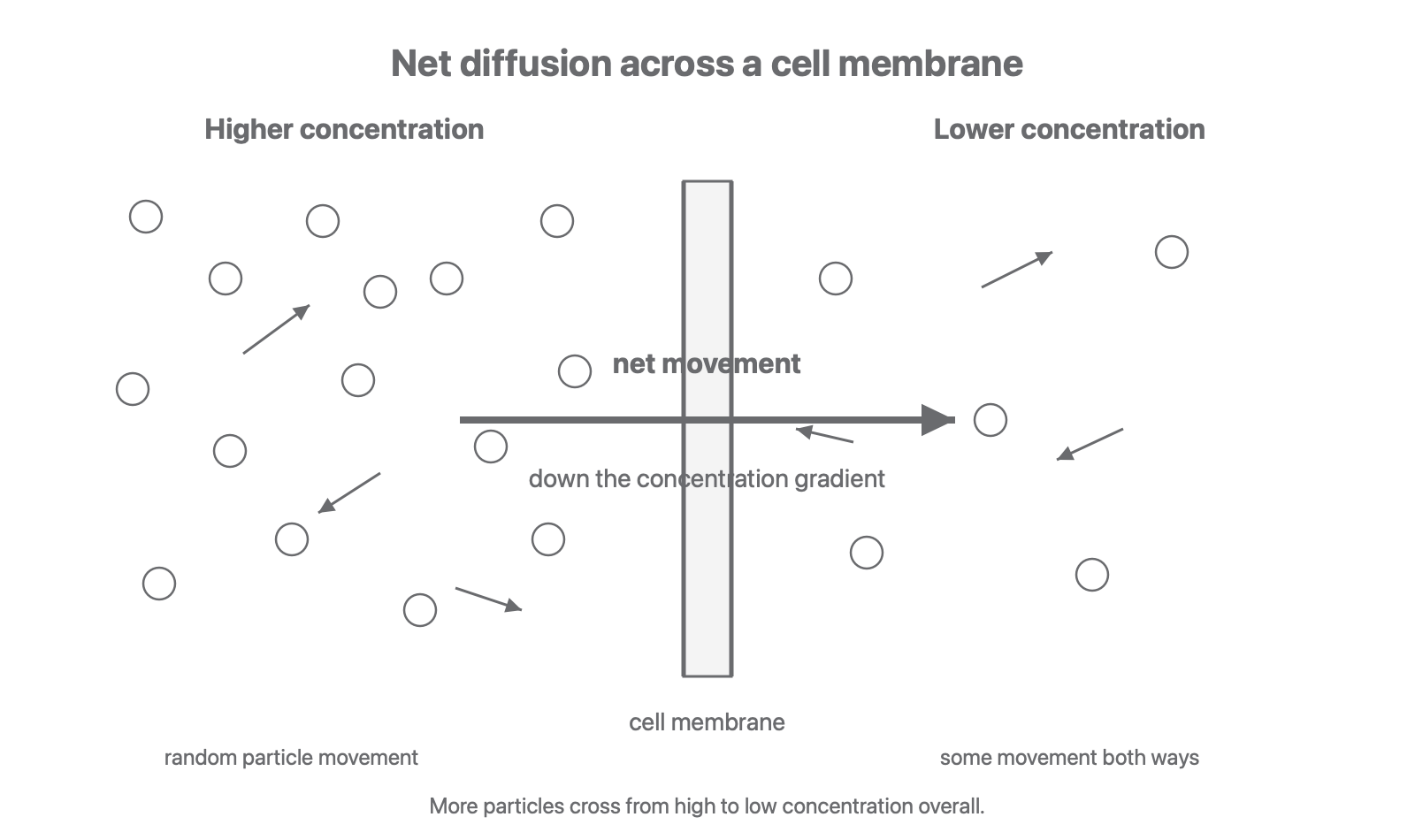
When you interpret a diffusion model, first identify where the substance is more concentrated. Then identify the lower-concentration area. The net movement is down the concentration gradient, from higher to lower concentration.
The model should not be read as saying that every particle moves in the same direction. It shows the overall result of many randomly moving particles.
In diffusion diagrams, the side with more particles of the named substance is the higher-concentration side, and the net movement is away from it.
Diffusion in cells
Substances may move into and out of cells across cell membranes by diffusion. The direction depends on the concentration gradient for that substance, not on whether the substance is useful or waste.
Oxygen can diffuse into cells because cells use oxygen in aerobic respiration. Carbon dioxide can diffuse out of respiring cells because carbon dioxide is a waste product of aerobic respiration. In gas exchange, oxygen and carbon dioxide move by diffusion down their own concentration gradients.
Urea is another named example. Urea is a waste product made in cells and can diffuse from cells into the blood plasma. It is then carried in the blood for excretion by the kidney.
Concentration gradient and rate
The rate of diffusion means how quickly particles spread out or cross a membrane. A larger difference in concentration gives a steeper concentration gradient, so diffusion is faster.
For example, if there is a high concentration of oxygen outside a cell and a low concentration of oxygen inside the cell, oxygen diffuses into the cell more quickly than it would if the concentrations were almost the same. As the difference in concentration gets smaller, the rate of net diffusion decreases.
Good exam explanations link the factor to particle movement. A larger concentration gradient means more particles are available on the high-concentration side, so more particles cross per second from high to low concentration.
Temperature and membrane surface area
Temperature affects diffusion because particles move faster when they have more kinetic energy. Over the normal range considered in this topic, a higher temperature increases the rate of diffusion because particles move more quickly and spread out faster.
Membrane surface area also affects diffusion. A larger surface area means more membrane is available for particles to cross at the same time, so the rate of diffusion increases.
[DIAGRAM: asset_name: Factors that increase diffusion rate - diagram 2; asset_slug: 012_4_1_3_1a_diffusion_and_factors_affecting_rate_diagram2; file: diagram_assets/imagegen_regen_all/012_4_1_3_1a_diffusion_and_factors_affecting_rate_diagram2_imagegen.png; recommended_method: codex_image_gen; description: Three labelled monochrome panels showing the in-scope factors that increase diffusion rate: larger concentration gradient, higher temperature causing faster random movement, and larger membrane surface area allowing more crossings per second.]
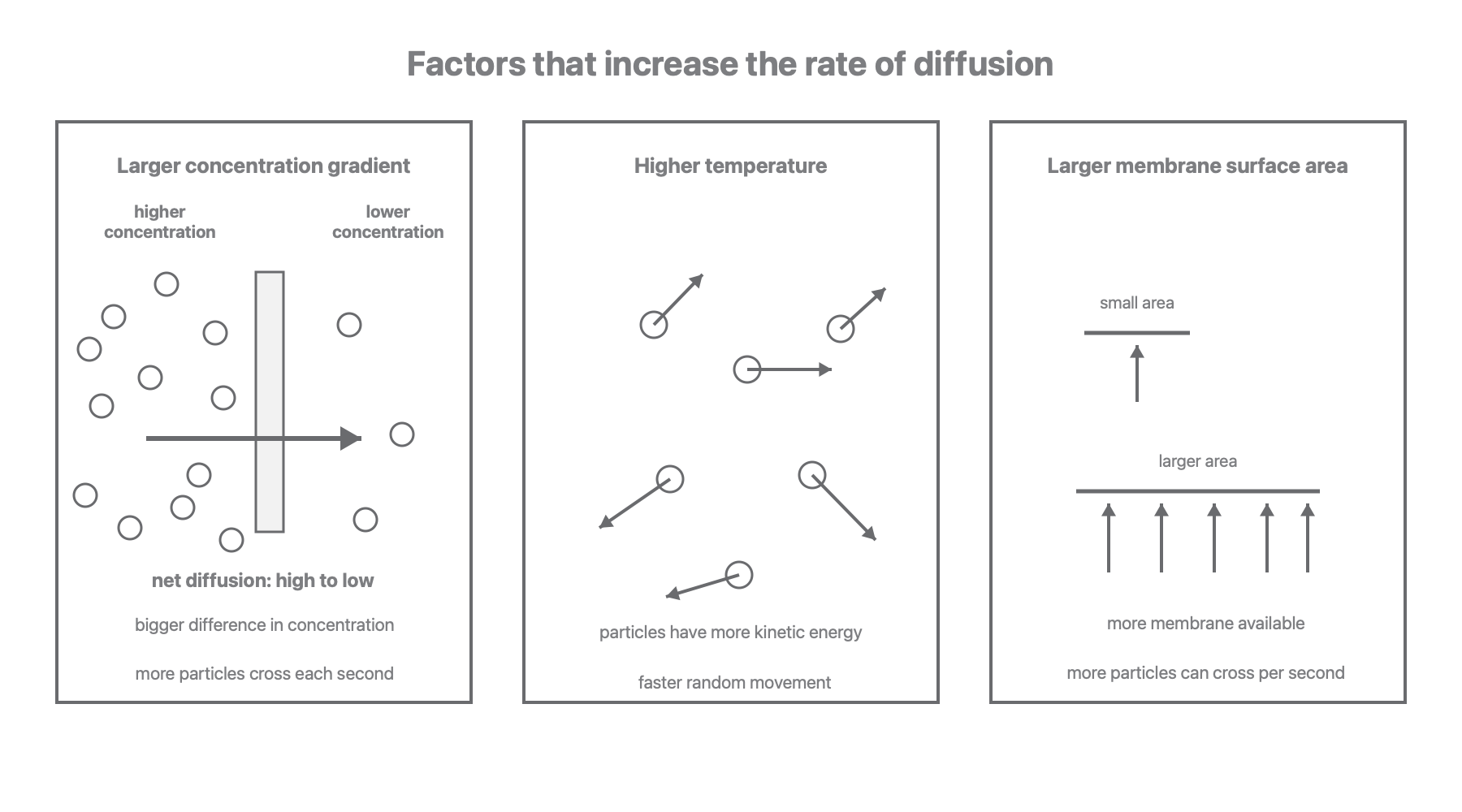
This lesson only requires the surface area of the membrane as a factor affecting diffusion rate.
Answering diffusion questions
Most diffusion answers need a cause-and-effect chain. Name the factor, describe how it changes, then link it to particle movement down the concentration gradient.
For concentration gradient questions, use comparative language such as larger, steeper, smaller or less steep. For temperature questions, mention kinetic energy or faster particle movement. For surface area questions, mention that more particles can cross the membrane at the same time.
A strong answer avoids three common mistakes: saying diffusion moves all particles in one direction, saying diffusion needs energy from respiration, or naming a different transport process when the question only asks about diffusion.