4.2.2.7 - Cancer
Cancer starts when changes in cells disrupt the normal control of growth and division. The key idea is not to memorise many named cancers, but to describe how abnormal cells can form tumours, why benign and malignant tumours are different, and why risk factors affect the chance of developing cancer.
Uncontrolled growth
Body cells normally divide in a controlled way for growth, repair and replacement. Cancer is different: changes in cells can make them grow and divide uncontrollably. This produces a mass of abnormal cells called a tumour.
Cancer
Cancer is the result of changes in cells that lead to uncontrolled growth and division.
The exam wording matters. Do not just write "cells grow" because normal cells grow too. The cancer idea is that the growth and division are uncontrolled after changes in the cells.
Benign tumours
A benign tumour is a growth of abnormal cells, but the cells are contained in one area. In the AQA description, benign tumours are usually contained within a membrane and do not invade other parts of the body.
Benign tumour
A growth of abnormal cells that is contained in one area, usually within a membrane, and does not invade other parts of the body.
The trap is thinking benign means "normal". It does not. A benign tumour is still made of abnormal cells; the important difference is that it stays contained rather than invading or spreading.
Malignant tumours
Malignant tumour cells are cancers. Unlike benign tumours, malignant tumour cells can invade neighbouring tissues. They can also spread to different parts of the body in the blood, where they form secondary tumours.
Malignant tumour
A cancerous tumour whose cells can invade neighbouring tissues, spread in the blood and form secondary tumours.
[DIAGRAM: asset_name: benign-malignant-tumours - diagram 1; asset_slug: 026_4_2_2_7_cancer_diagram1; file: diagram_assets/imagegen_regen_all/026_4_2_2_7_cancer_diagram1_imagegen.png; recommended_method: codex_image_gen; description: Monochrome side-by-side schematic comparing a benign tumour contained by a membrane with a malignant tumour invading neighbouring tissue, entering a blood vessel and forming a secondary tumour.]
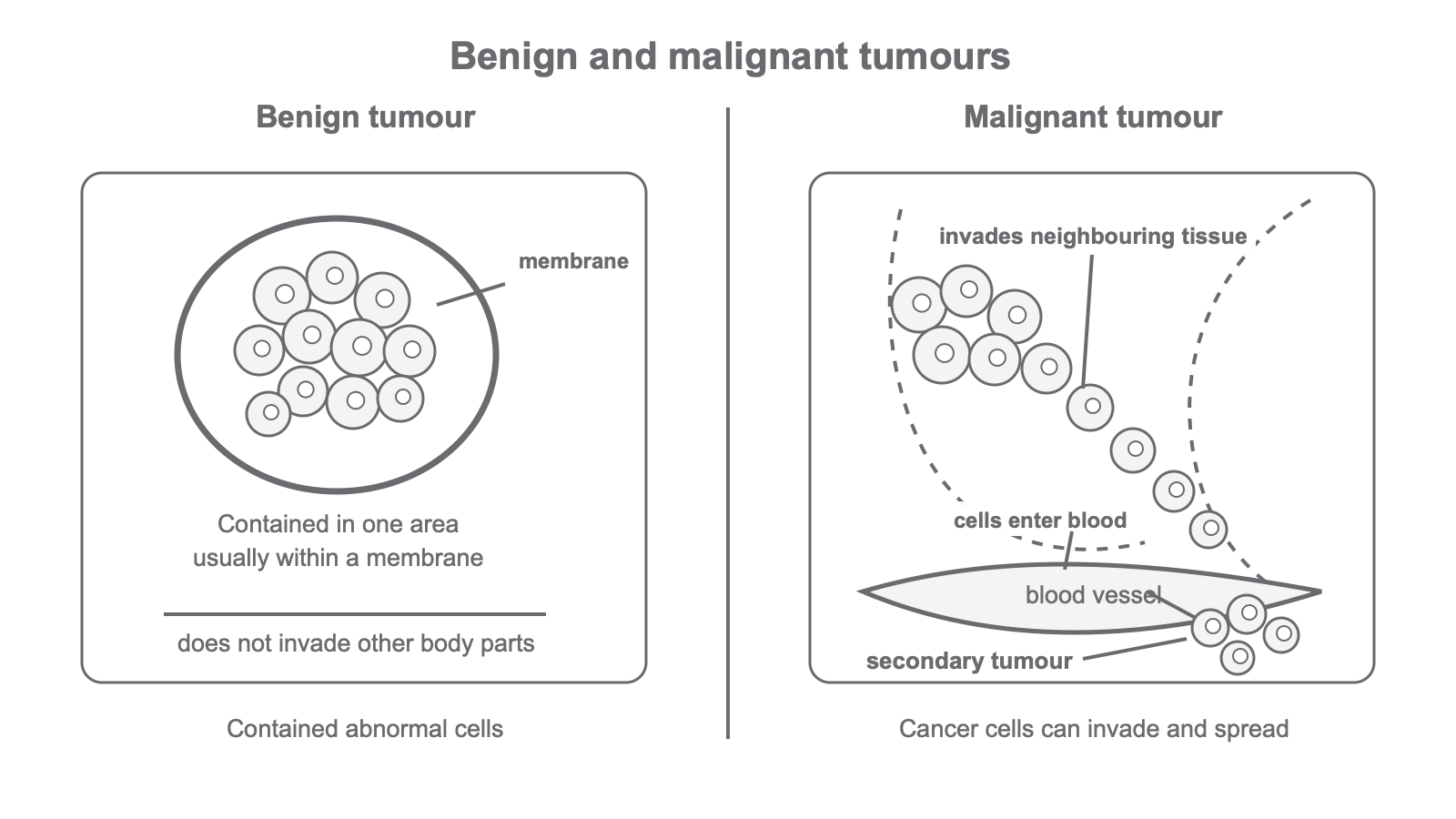
The word secondary means that the new tumour formed after malignant cells spread from the original tumour. For this lesson, keep the spread route precise: malignant tumour cells spread in the blood.
A comparison answer should make both sides explicit. Say what benign tumours do not do, then say what malignant tumour cells can do.
Risk factors
A risk factor is something that increases the chance of developing a disease. A risk factor does not guarantee that cancer will develop, and not having a particular risk factor does not guarantee that cancer will never develop. It changes probability, not certainty.
Risk factor
Something that increases the chance of developing a disease.
Scientists have identified lifestyle risk factors for various types of cancer. Examples include smoking or tobacco use, alcohol, excess body mass, low physical activity, unhealthy diet and exposure to ultraviolet radiation from sunlight or sunbeds. Different cancers have different risk factors, so a good answer should say various types of cancer rather than implying that every risk factor affects every cancer in the same way.
There are also genetic risk factors for some cancers. These are inherited factors, such as faulty genes passed through families, that can increase a person's risk. Genetic risk factors are not lifestyle choices, and they still do not mean that cancer is certain.
Exam precision
Cancer answers need careful contrasts. A strong answer names the tumour type, then links it to containment, invasion or spread.
| Feature | Benign tumour | Malignant tumour |
|---|---|---|
| Cell type | Abnormal cells | Cancer cells |
| Position | Contained in one area, usually within a membrane | Can invade neighbouring tissues |
| Spread | Does not invade other parts of the body | Can spread in the blood |
| Result of spread | No secondary tumours | Can form secondary tumours |
Avoid these common weak answers:
- "Benign tumours are harmless." This misses the required idea of being contained and not invading.
- "Malignant tumours are bigger." Size is not the key GCSE distinction.
- "Risk factors cause cancer." More precise: risk factors increase the chance of developing cancer.
The core cancer sequence is: changes in cells -> uncontrolled growth and division -> tumour; malignant tumour cells can invade, spread in the blood and form secondary tumours.
When a context describes tissue invasion or blood spread, use that evidence to identify a malignant tumour and explain why.