4.2.1 - Principles of Organisation
Biology often moves between very small structures and whole living organisms. In this section, the important skill is using the correct order and vocabulary: cells, tissues, organs, organ systems and organisms. The words sound simple, but AQA can test whether you know exactly what each level is made from and how the levels fit together.
Cells as basic building blocks
Cells are the basic building blocks of all living organisms. A living thing may be made from one cell or from many cells, but cell structure is the starting point for the organisation of life.
Cell
A cell is the basic building block of all living organisms.
In a multicellular organism, one cell is not usually enough to carry out every job for the whole organism. Many cells work together, and cells with particular structures can carry out particular functions. This idea prepares you for the next levels of organisation, where cells are grouped into larger structures.
The key scale idea is that cells are smaller than tissues, organs, organ systems and whole organisms. When an exam asks for the order of organisation, start with the cell.
Tissues are similar cells working together
A tissue is the next level up from a cell. A tissue is not just any group of cells; the cells have a similar structure and a similar function.
Tissue
A tissue is a group of cells with a similar structure and function.
For example, muscle tissue contains cells that are suited to contraction. The exact tissue examples can vary, but the definition stays the same: similar cells, doing a similar job, form a tissue.
A common mistake is to say that a tissue is made from organs. That reverses the order. Tissues are made from cells; organs are made from tissues.
Organs and organ systems
An organ is a bigger level of organisation than a tissue. It is made from different tissues working together to perform a specific function.
Organ
An organ is an aggregation of tissues performing a specific function.
The word aggregation means a collection or grouping. In exam answers, it is usually clearer to write that an organ is made from different tissues that work together for a particular function.
An organ system is bigger again. It is made from organs that work together, so that a larger function can happen in the organism.
Organ System
An organ system is a group of organs that work together to carry out a function in an organism.
This lesson does not require the details of particular organ systems. Those come later. Here, the important relationship is the hierarchy: tissues build organs, organs build organ systems, and organ systems work together in the organism.
Scale and exam language
The full AQA order is:
cell -> tissue -> organ -> organ system -> organism
[DIAGRAM: asset_name: Cells to organisms hierarchy - diagram 1; asset_slug: 017_4_2_1_principles_of_organisation_diagram1; file: diagram_assets/imagegen_regen_all/017_4_2_1_principles_of_organisation_diagram1_imagegen.png; recommended_method: codex_image_gen; description: A monochrome flow diagram showing cell, tissue, organ, organ system and organism in increasing scale, with arrows and brief definition notes.]
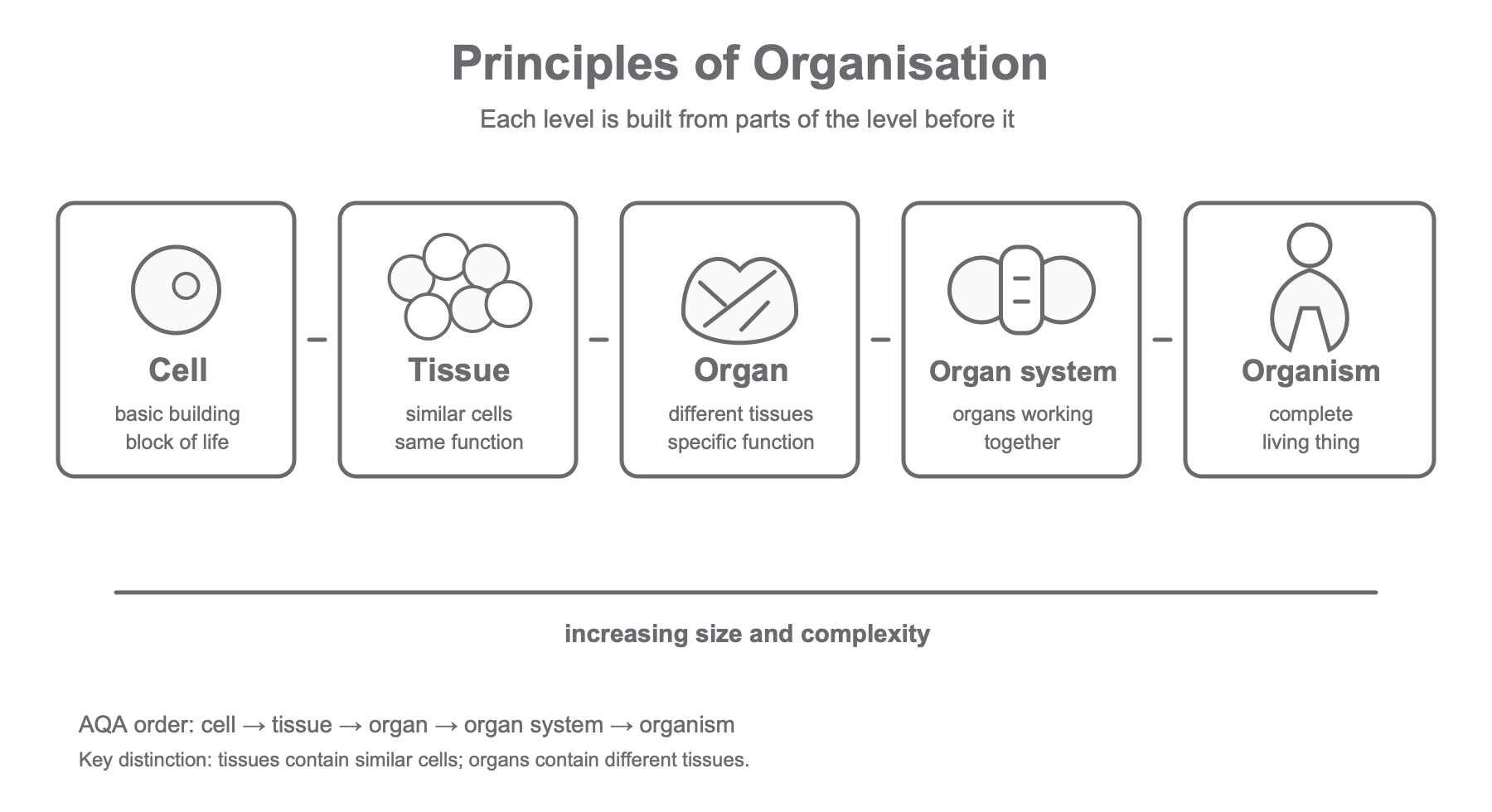
Read the order from left to right when thinking about increasing size and complexity. Each level is built from parts of the level before it: tissues contain cells, organs contain tissues, organ systems contain organs, and the organism contains organ systems working together.
AQA questions may ask you to state a definition, describe the order, or explain why a named structure fits one level of the hierarchy. For a definition question, use the exact relationship. For an explain question, link what the structure is made from to the function it carries out.
Avoid vague answers such as "a bigger part of the body" or "things that work together". They may be partly true, but they do not show the precise level. The best answers use the correct building blocks: cells for tissues, tissues for organs, and organs for organ systems.
Use that order as a final check on any answer about biological scale.
The hierarchy is cell -> tissue -> organ -> organ system -> organism; do not swap tissues and organs.