4.1.3.3 - Active Transport
Cells sometimes need useful substances even when those substances are already more concentrated inside the cell or in the blood. Diffusion cannot do that job, because diffusion only gives a net movement down a concentration gradient. Active transport is the process that moves substances against a concentration gradient using energy from respiration.
What active transport means
A concentration gradient is a difference in concentration between two places. If a substance moves from a more concentrated solution to a more dilute solution, it is moving down its concentration gradient. Active transport is different because the substance is moved from a more dilute solution to a more concentrated solution.
Active Transport
The movement of substances from a more dilute solution to a more concentrated solution, against a concentration gradient, using energy from respiration.
The phrase "against a concentration gradient" is the key idea. It means the movement would not happen by ordinary diffusion. The cell must use energy released by respiration to move the substance across the cell membrane.
[DIAGRAM: asset_name: Active transport across a cell membrane - diagram 1; asset_slug: 016_4_1_3_3_active_transport_diagram1; file: diagram_assets/imagegen_regen_all/016_4_1_3_3_active_transport_diagram1_imagegen.png; recommended_method: codex_image_gen; description: Monochrome schematic showing a cell membrane, a lower concentration of particles outside the cell, a higher concentration inside the cell, and an arrow through the membrane labelled as movement against the concentration gradient using energy from respiration.]
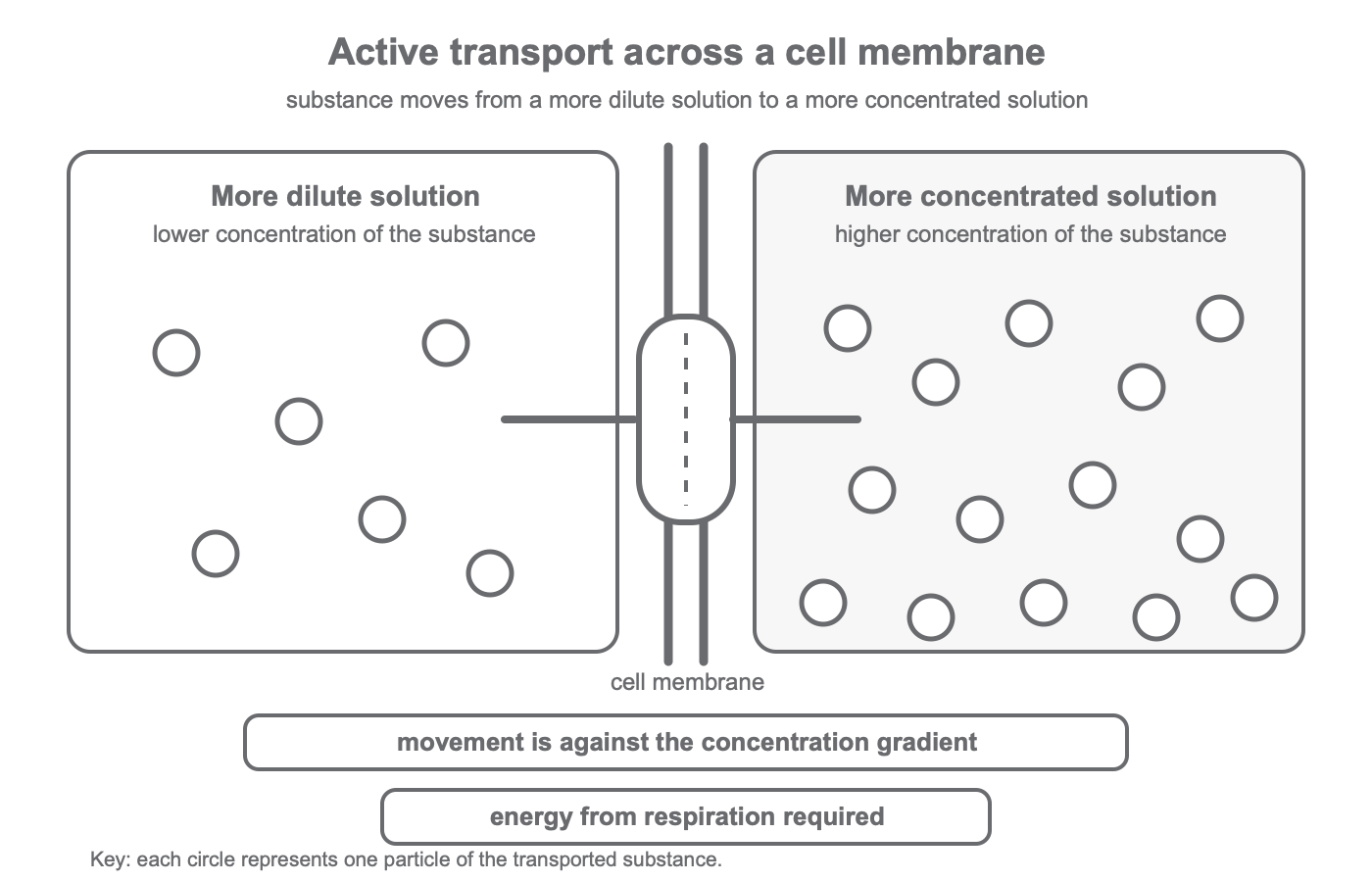
Do not describe active transport as "moving from high to low". That describes diffusion. For active transport, a good GCSE answer normally needs both ideas: movement against the gradient and energy from respiration.
Mineral ions in root hair cells
Plant roots are surrounded by soil water that usually contains a very dilute solution of mineral ions. A root hair cell may already have a higher concentration of those ions than the soil solution. If the plant relied only on diffusion, mineral ions would not move into the root hair cell in that situation.
Active transport solves this problem. It allows mineral ions to be absorbed into root hair cells from very dilute solutions in the soil. The plant can then use those ions for healthy growth.
Root hair cells link this topic to cell specialisation. Their long, thin extension gives a large surface area in contact with the soil, and the cell needs a supply of energy from respiration to keep active transport happening.
Sugar absorption from the gut
Active transport also happens in animals. Sugar molecules can be absorbed from the gut into the blood even when the sugar concentration is lower in the gut than in the blood.
This matters because sugar molecules, such as glucose, are used for cell respiration. If a sugar molecule is in the gut after digestion, the body should absorb it rather than leave it behind simply because diffusion is no longer possible.
A careful answer should name the direction and the gradient. The sugar moves from the gut, where its concentration is lower, into the blood, where its concentration is higher. That is movement against the concentration gradient, so energy from respiration is required.
Comparing the three transport processes
AQA can ask you to describe how substances move into and out of cells by diffusion, osmosis and active transport. The safest way to compare them is to ask four questions: what moves, which way does it move, is a membrane involved, and is energy from respiration needed?
| Process | What moves? | Direction of net movement | Energy from respiration? | Key membrane detail |
|---|---|---|---|---|
| Diffusion | Particles of a substance in a gas or solution | From higher concentration to lower concentration | No | May happen across a cell membrane |
| Osmosis | Water molecules | From a dilute solution to a more concentrated solution | No | Through a partially permeable membrane |
| Active transport | Substances such as mineral ions or sugar molecules | From a more dilute solution to a more concentrated solution | Yes | Across a cell membrane |
Notice the wording trap. In osmosis, the particles that move are water molecules; in active transport, the named substance itself moves from lower concentration to higher concentration.
The most common mistake is to mix up active transport and osmosis. Osmosis is only about water. Active transport is about substances such as mineral ions in plant roots and sugar molecules moving from the gut into the blood.
After your explanation, check whether you used the word "energy". If you did not, your active transport explanation is probably incomplete.
Using active transport in explanations
In exam questions, active transport is often hidden inside a situation. Look for these clues:
- the substance moves from lower concentration to higher concentration
- diffusion would not move the substance in the required direction
- the question mentions respiration, energy supply, mitochondria, root hair cells, mineral ions, the gut, blood or sugar molecules
Here is a model chain of reasoning:
- The useful substance is at a lower concentration outside the cell or in the gut.
- It still needs to enter the cell or blood.
- This is movement against the concentration gradient.
- Therefore active transport is used.
- Energy from respiration is required.
Worked example: a plant has roots in soil where the mineral ion concentration is lower than the concentration inside the root hair cells. Explain how the plant can still absorb mineral ions.
Full-credit answer: the mineral ions move from the soil into the root hair cells against their concentration gradient. This is active transport, so it requires energy from respiration.
Active transport is identified by three linked ideas: lower to higher concentration, against the concentration gradient, and energy from respiration.
A strong answer does not need to add unrelated detail about xylem, transpiration or photosynthesis. For this specification point, stay focused on transport across cell membranes, root hair mineral ion uptake, gut sugar absorption, and the comparison with diffusion and osmosis.