4.1.2.2 - Mitosis and the Cell Cycle
Multicellular organisms become larger because their cells divide as well as grow. In this topic, the important idea is that the cell cycle copies the genetic material and then divides it so two identical cells are made. You need the overall order of events, not the named phases inside mitosis.
The cell cycle in one idea
The cell cycle is the series of stages a cell goes through when it divides. During the cycle, the genetic material is doubled and then divided into two cells that are genetically identical to each other and to the original cell.
Cell cycle
The cell cycle is the series of stages in which a cell grows, copies its DNA, and divides to form new cells.
Mitosis is one part of the cell cycle. It is the stage where copied chromosomes are separated so each new nucleus receives one complete set of genetic material. The final result is two identical cells, which is why mitosis is useful for growth and development in multicellular organisms.
Stage 1: cell growth
Before a cell can divide, it has to prepare. It grows larger and increases the number of sub-cellular structures such as ribosomes and mitochondria. This matters because each new cell needs enough cell contents to function after division.
Ribosomes are needed for making proteins. Mitochondria are needed for aerobic respiration, which releases energy for cell activities. The key GCSE point is not the detailed structure of these organelles, but that the cell makes more of its internal structures before it splits.
Stage 2: DNA replication
After the cell has grown, the DNA replicates. This means the DNA is copied to form two copies of each chromosome. At this point the cell has doubled its genetic material, but it has not yet made two cells.
The copy step is essential. If the DNA was not copied before division, the new cells would not each receive the full set of genetic instructions. Mitosis can only produce identical cells if the chromosome copies are made first and then separated accurately.
DNA replication happens before mitosis so each new cell can receive a complete set of chromosomes.
Stage 3: mitosis and cell division
In mitosis, one set of chromosomes is pulled to each end of the cell. The nucleus then divides so the copied genetic material is shared into two new nuclei. For this specification point, you do not need to name the different phases within mitosis.
[DIAGRAM: asset_name: three-stage-cell-cycle-overview: Three overall stages of the cell cycle - diagram 1; asset_slug: 010_4_1_2_2_mitosis_and_the_cell_cycle_diagram1; file: diagram_assets/imagegen_regen_all/010_4_1_2_2_mitosis_and_the_cell_cycle_diagram1_imagegen.png; recommended_method: codex_image_gen; description: Monochrome flow diagram showing stage 1 growth and increase in ribosomes/mitochondria, stage 2 DNA replication to make two copies of each chromosome, and stage 3 mitosis plus cytoplasm/cell membrane division to produce two identical daughter cells. It deliberately avoids named mitosis phases.]
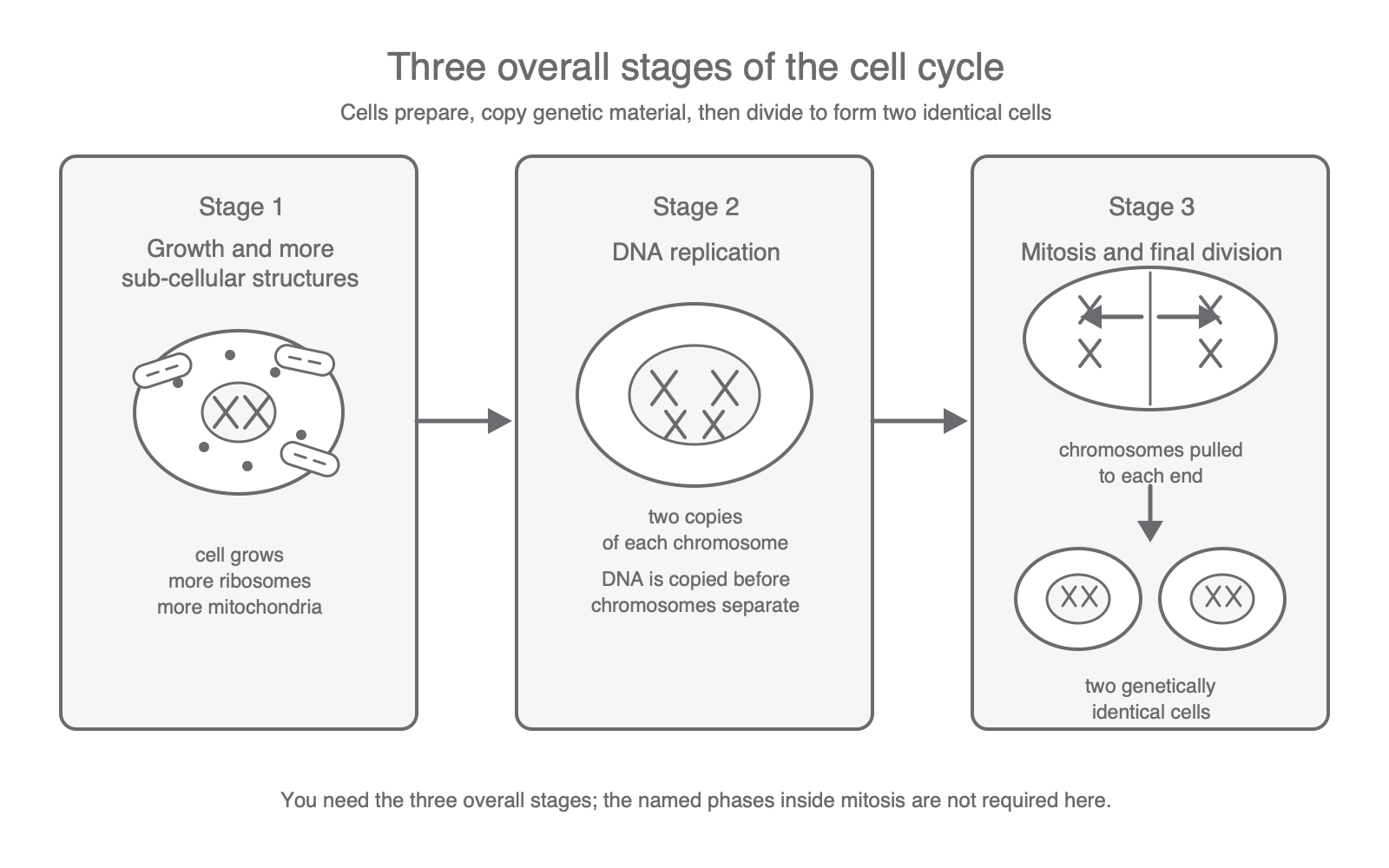
Finally, the cytoplasm and cell membrane divide. This produces two separate daughter cells. Because the chromosomes were copied and then separated, the daughter cells are genetically identical.
Use the sequence as a check: copy the DNA first, separate the chromosomes during mitosis, then split the cell contents.
Recognising mitosis in contexts
A context is likely to involve mitosis when a multicellular organism needs to make more identical cells. Examples include an embryo developing into a multicellular organism, a child growing, a plant root tip growing, or damaged skin being repaired. In each case, the useful outcome is more cells with the same genetic information.
When you answer a context question, do not just write "cells divide". Add what the division achieves. A strong answer usually links mitosis to growth, development, or repair and says that genetically identical cells are produced.
The common mistake is to describe mitosis as any cell division. For this lesson, look for division that makes identical cells for growth and development in multicellular organisms.