4.2.2.3 - Blood
Blood is a tissue: it contains different components that work together to transport substances, defend the body and reduce blood loss after injury. The liquid part is plasma, and suspended in it are red blood cells, white blood cells and platelets. AQA expects you to know the function of each component, recognise the blood cells in photographs or diagrams, and explain how their structures fit their functions.
Blood as a tissue
A tissue is a group of cells with a similar structure and function. Blood is unusual because it is a liquid tissue, but it still fits the idea: its components work together in the circulatory system.
Blood
A tissue consisting of plasma, in which red blood cells, white blood cells and platelets are suspended.
The word suspended means carried in the liquid rather than dissolved like a soluble chemical. Red blood cells, white blood cells and platelets are not all the same size or shape, so they can be separated and recognised under a microscope.
| Blood component | What it is | Main GCSE function |
|---|---|---|
| Plasma | Liquid part of blood | Transports blood cells and dissolved substances |
| Red blood cells | Cells packed with haemoglobin | Transport oxygen |
| White blood cells | Defence cells | Help defend the body against pathogens |
| Platelets | Small cell fragments | Help blood to clot |
This table is the backbone of the whole specification point. In exam answers, try to name the exact component and the exact function instead of writing broad phrases such as "blood carries things".
Plasma transport
Plasma is mostly water, so it is a good transport medium. It carries the blood cells and platelets around the body, but it also carries dissolved substances between organs.
The main GCSE examples are:
| Substance or material carried in plasma | Usual route |
|---|---|
| Carbon dioxide | From organs to the lungs |
| Urea | From the liver to the kidneys |
| Soluble products of digestion, such as glucose and amino acids | From the small intestine to other organs |
| Hormones | From glands to target organs |
| Heat energy | From warmer parts of the body to cooler parts |
Oxygen is the important contrast: most oxygen is carried by red blood cells because it binds to haemoglobin. Plasma is therefore not just "watery blood"; it is the transport fluid for many dissolved materials and for the suspended blood components.
Plasma transports blood components and dissolved substances, while red blood cells are specialised for oxygen transport.
When a question asks for the function of plasma, choose examples that actually travel in plasma. A common mistake is to write only "carries oxygen"; that loses the difference between plasma and red blood cells.
Red blood cells
Red blood cells transport oxygen from the lungs to body cells. They contain haemoglobin, a protein that binds oxygen. When oxygen binds to haemoglobin, the cell can carry oxygen through the blood and release it where cells need oxygen for respiration.
Haemoglobin
A protein in red blood cells that binds oxygen so oxygen can be transported in the blood.
Their structure is adapted to this function. A red blood cell has a biconcave disc shape, meaning it is thinner in the middle than at the edge. This gives a large surface area for oxygen to diffuse in and out. Mature red blood cells have no nucleus, which leaves more space for haemoglobin. They are also small and flexible enough to pass through narrow capillaries.
In photographs and diagrams, red blood cells are usually the most numerous blood cells. They look like small discs and do not have a visible nucleus. If a diagram shows many similar pale discs with a thinner centre, those are red blood cells.
White blood cells and platelets
White blood cells help defend the body against pathogens. Different types of white blood cell do this in different ways. For this specification point, the key functions are that some white blood cells engulf pathogens and some produce antibodies.
White blood cells are adapted for defence because they can change shape, move towards infected areas and carry out specific defence functions. In microscope images, a white blood cell is usually larger than a red blood cell and has a visible nucleus. It is also much less common than red blood cells in a typical blood sample.
Platelets are tiny fragments of cells. Their function is to help blood clot when a blood vessel is damaged. A clot reduces blood loss and helps stop pathogens entering through the wound.
Platelet
A small cell fragment in blood that helps blood clot.
In microscope images, platelets are much smaller than red and white blood cells. They often look like tiny dots or irregular fragments. Do not describe them as oxygen carriers or defence cells; their assessed function is clotting.
After the explanation, check that every structure has been linked to a function. AQA often gives the mark for the link, not just the named feature.
Recognising blood cells
AQA can ask you to recognise blood cells in a photograph or diagram. Start with size, number and nucleus. Red blood cells are numerous biconcave discs with no nucleus. White blood cells are larger, much less numerous and have a visible nucleus. Platelets are the smallest fragments.
[DIAGRAM: asset_name: blood-cell-recognition - diagram 1; asset_slug: 022_4_2_2_3_blood_diagram1; file: diagram_assets/imagegen_regen_all/022_4_2_2_3_blood_diagram1_imagegen.png; recommended_method: codex_image_gen; description: Monochrome microscope-field style schematic showing many red blood cells as biconcave discs with no nucleus, one larger white blood cell with a visible nucleus, and tiny platelets as cell fragments, with label arrows and concise recognition cues.]
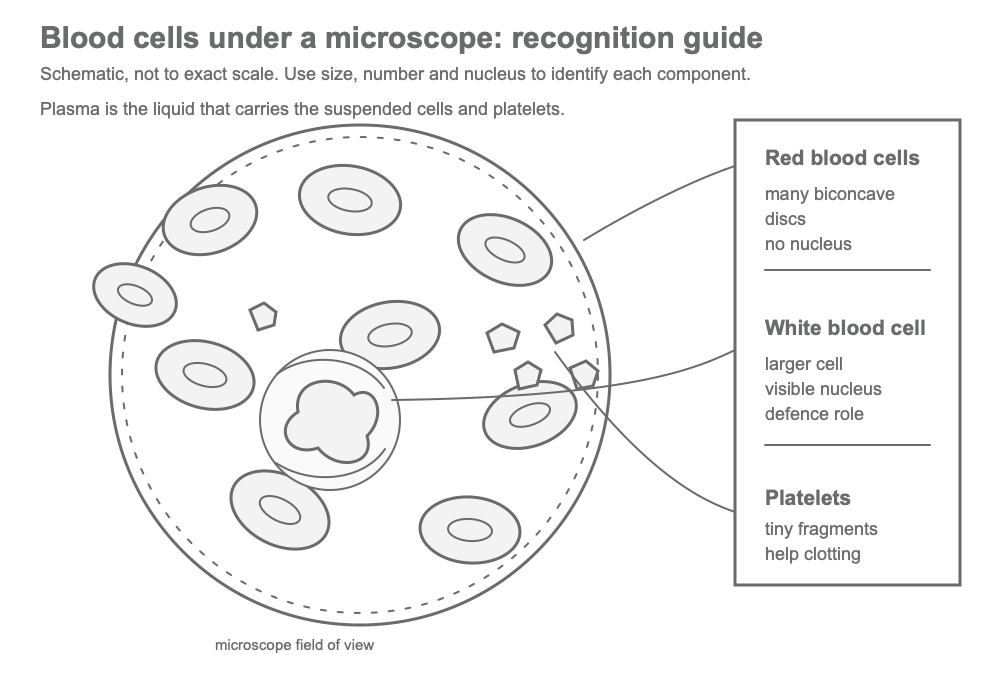
For microscope drawing, the assessed skill is observation and clear biological drawing. Use a sharp pencil, draw clear outlines, avoid sketchy shading, make the drawing large enough to show the observed features, and label only features you can actually see. If you are comparing cells, keep the relative sizes sensible: platelets tiny, red blood cells small discs, white blood cells larger with a nucleus.
Blood products and risk
Blood can be separated into useful products such as red cells, platelets and plasma. Giving a patient only the component they need is called component therapy. For example, red cells can help replace oxygen-carrying capacity after heavy blood loss, platelets can help with clotting, and plasma can help where clotting factors are needed.
Risk evaluation means weighing benefits against possible harms and the ways those harms are reduced. Blood products can be life-saving, but there are risks such as allergic reactions, infection transmission, and problems if an incompatible product is given. Repeated transfusions can also cause too much iron in the blood.
Hospitals reduce these risks by checking the patient's blood, matching donated blood carefully, testing donor blood for infections, monitoring the patient during and after the transfusion, and using alternatives when those are better for the patient. A good evaluation should include both sides: the benefit may be large in severe blood loss, while the remaining risks are usually reduced by screening, matching and monitoring.