4.1.1.6a - Culturing Microorganisms and Bacterial Growth
Microorganisms are tiny living organisms. In this biology-only section, the focus is bacteria: how they multiply, how they can be grown in nutrient media, and how to do the calculations that come from bacterial growth on agar plates. The key pattern is doubling, so a small starting population can become a very large number quickly when conditions are suitable.
Culture media
A culture is microorganisms grown under controlled conditions. Bacteria need a source of nutrients and a suitable temperature so they can grow and divide.
Bacteria can be grown in a liquid nutrient broth solution or on a solid agar gel plate. Both are culture media, which means they provide substances bacteria need for growth. A broth is useful when bacteria are mixed through a liquid. An agar plate is useful when bacterial cells grow in fixed places on the surface, forming visible colonies.
Colony
A colony is a visible group of microorganisms that has grown from one or more cells on a solid medium such as agar.
On an agar plate, a colony is evidence that bacteria have reproduced. If the plate is used in a context involving disinfectants or antibiotics, a clear zone is an area where bacterial growth has been prevented. This lesson uses agar plates and clear zones as measurement contexts; the full practical method for preparing uncontaminated cultures is a separate focus.
Binary fission
Bacteria reproduce by binary fission. This is simple cell division: one bacterial cell divides to produce two bacterial cells. It is not mitosis, and you do not need the stages of mitosis for this topic.
Before division, the bacterial cell copies its genetic material. The cell then grows, separates the copied genetic material, and divides into two cells. Each of those cells can then divide again, so the number of bacteria doubles each time the mean division time passes.
[DIAGRAM: asset_name: binary_fission_doubling_sequence; title: Binary fission as repeated doubling - diagram 1; asset_slug: 007_4_1_1_6a_culturing_microorganisms_and_bacterial_growth_diagram1; file: diagram_assets/007_4_1_1_6a_culturing_microorganisms_and_bacterial_growth_diagram1.png; recommended_method: deterministic_drawn; description: Monochrome sequence showing one rod-shaped bacterium becoming 2, 4, then 8 cells over three mean division times, with arrows labelled one doubling and no mitosis-stage labels.]
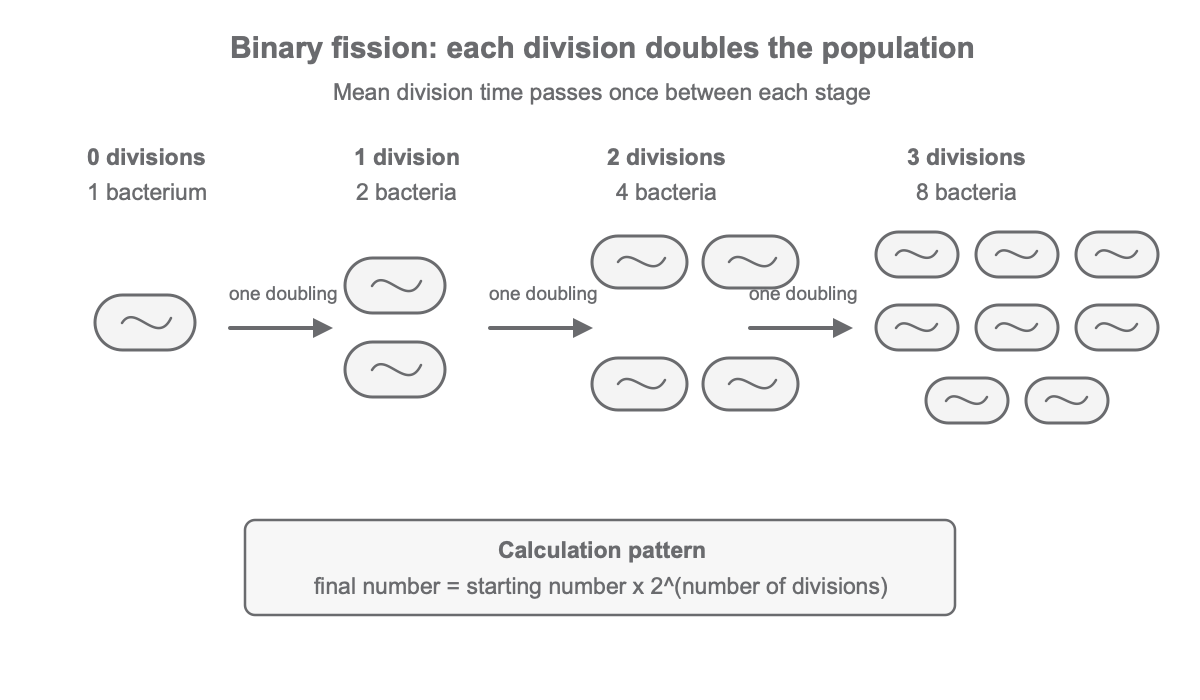
Under suitable conditions, some bacteria can divide as often as once every 20 minutes. The phrase "as often as" matters: this fastest rate needs enough nutrients and a suitable temperature. If nutrients run out, temperature is unsuitable, or waste products build up, the population will not keep doubling at that fastest rate.
One mean division time means one population doubling.
That is the idea to keep in mind when a question gives you a mean division time.
Population calculations
Bacterial growth calculations normally give you three things: the starting number of bacteria, the total time, and the mean division time. First calculate how many divisions happen. Then multiply the starting number by 2 for each division.
Bacterial population after repeated doubling
Use the same time units before you divide. For example, 2 hours is 120 minutes.
Worked example: a culture starts with 50 bacteria. The mean division time is 20 minutes. Calculate the number of bacteria after 2 hours.
- Convert the time: 2 hours = 120 minutes.
- Number of divisions = 120 / 20 = 6.
- Final number = 50 x 2^6 = 50 x 64 = 3200 bacteria.
For Higher tier, answers may need to be written in standard form. The same answer is:
Standard form means a number from 1 up to, but not including, 10 multiplied by a power of 10.
Now use that doubling pattern in a calculation.
Colony and clear-zone area
Colonies and clear zones on agar plates are often treated as circles in GCSE calculations. To calculate a circular cross-sectional area, use:
Area of a circle
The radius is the distance from the centre of the circle to its edge. If you are given a diameter, halve it first. The diameter is the full distance across the circle through the centre.
[DIAGRAM: asset_name: clear_zone_area_measurement; title: Measuring a clear zone on an agar plate - diagram 2; asset_slug: 007_4_1_1_6a_culturing_microorganisms_and_bacterial_growth_diagram2; file: diagram_assets/007_4_1_1_6a_culturing_microorganisms_and_bacterial_growth_diagram2.png; recommended_method: deterministic_drawn; description: Monochrome Petri dish schematic with bacterial lawn, circular clear zone around a central disc, radius labelled from centre to edge, diameter labelled across the clear zone, and area equals pi r squared.]
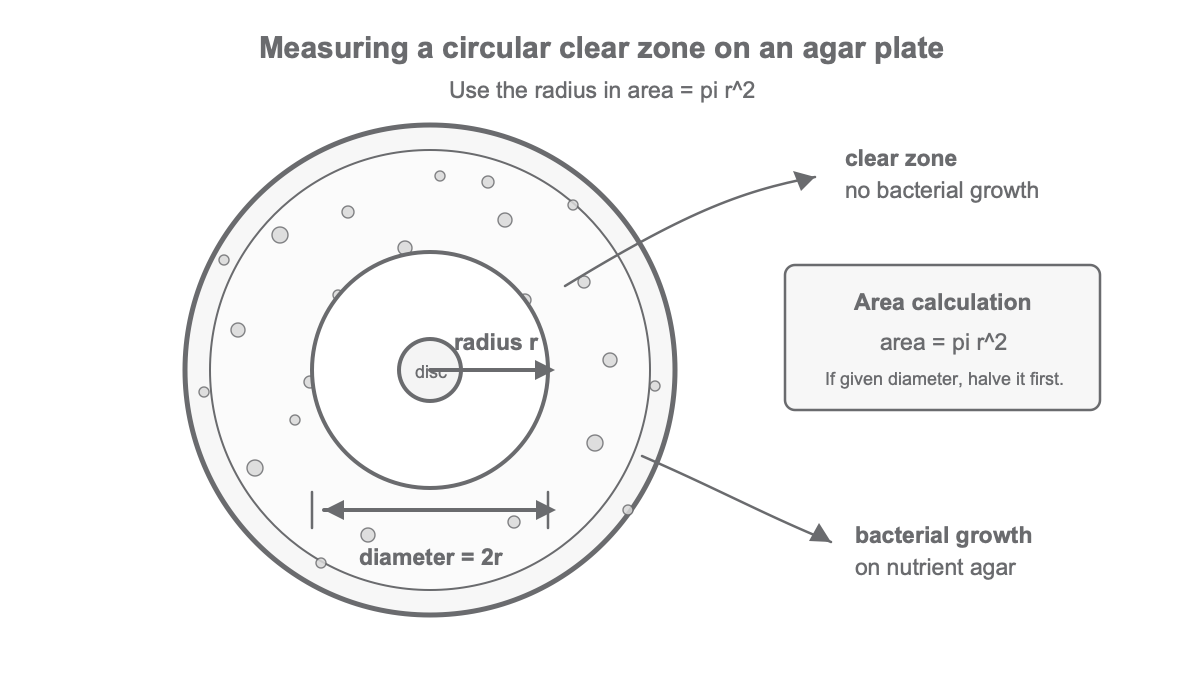
Worked example: a clear zone has a diameter of 18 mm. Calculate its area using pi = 3.14.
- Radius = 18 / 2 = 9 mm.
- Area = 3.14 x 9^2.
- Area = 3.14 x 81 = 254.34 mm^2.
A sensible rounded answer is 254 mm^2. Notice that the unit is squared because area is being measured.
Do not subtract the area of a disc or colony unless the question specifically asks you to. Most GCSE questions at this point ask for the cross-sectional area of the circular colony or clear zone shown by the measurement.
Exam habits
The common calculation mistake is treating binary fission as repeated addition. If 10 bacteria divide once, there are 20. After a second division, all 20 can divide, so there are 40. The population doubles; it does not add 10 each time.
The common area mistake is using the diameter as if it were the radius. If the question gives a diameter of 12 mm, the radius is 6 mm, so the area is pi x 6^2, not pi x 12^2.
For written answers, keep the conditions linked to growth. Bacteria can divide rapidly only when they have enough nutrients and a suitable temperature. On agar plates, larger colonies or clear zones are measurement evidence, but your calculation still depends on the numbers given in the question.