4.1.3.2b - Required Practical - Osmosis in Plant Tissue
In this required practical, you investigate how the concentration of a salt or sugar solution affects the mass of plant tissue. The biology is osmosis, but the exam marks often come from practical detail: variables, accurate mass measurements, percentage change, graph interpretation and evaluation. A good answer links the method to the movement of water through partially permeable cell membranes.
Aim and Osmosis
The aim is to investigate the effect of a range of concentrations of salt or sugar solutions on the mass of plant tissue. Potato is often used because it is easy to cut into similar cylinders, but the specification says plant tissue, so the important idea is the tissue, not the potato itself.
Osmosis
Osmosis is the diffusion of water from a dilute solution to a concentrated solution through a partially permeable membrane.
Plant cells are surrounded by cell membranes that are partially permeable. Water molecules can move through these membranes. If the solution around the tissue is more dilute than the solution inside the cells, water moves into the cells and the tissue gains mass. If the solution around the tissue is more concentrated than the solution inside the cells, water moves out of the cells and the tissue loses mass.
In this practical, concentration is the independent variable. The dependent variable is the change in mass of the plant tissue, usually processed as percentage change in mass so cylinders with slightly different starting masses can still be compared fairly.
Method and Apparatus
[DIAGRAM: asset_name: Required practical osmosis apparatus - diagram 1; asset_slug: 015_4_1_3_2b_required_practical_3_osmosis_in_plant_tissue_diagram1; file: diagram_assets/imagegen_regen_all/015_4_1_3_2b_required_practical_3_osmosis_in_plant_tissue_diagram1_imagegen.png; recommended_method: codex_image_gen; description: Monochrome apparatus layout showing labelled boiling tubes in a rack with equal volumes of different sugar or salt concentrations, equal potato cylinders, balance, ruler, timer, paper towel and safety note for scalpel/cork borer.]
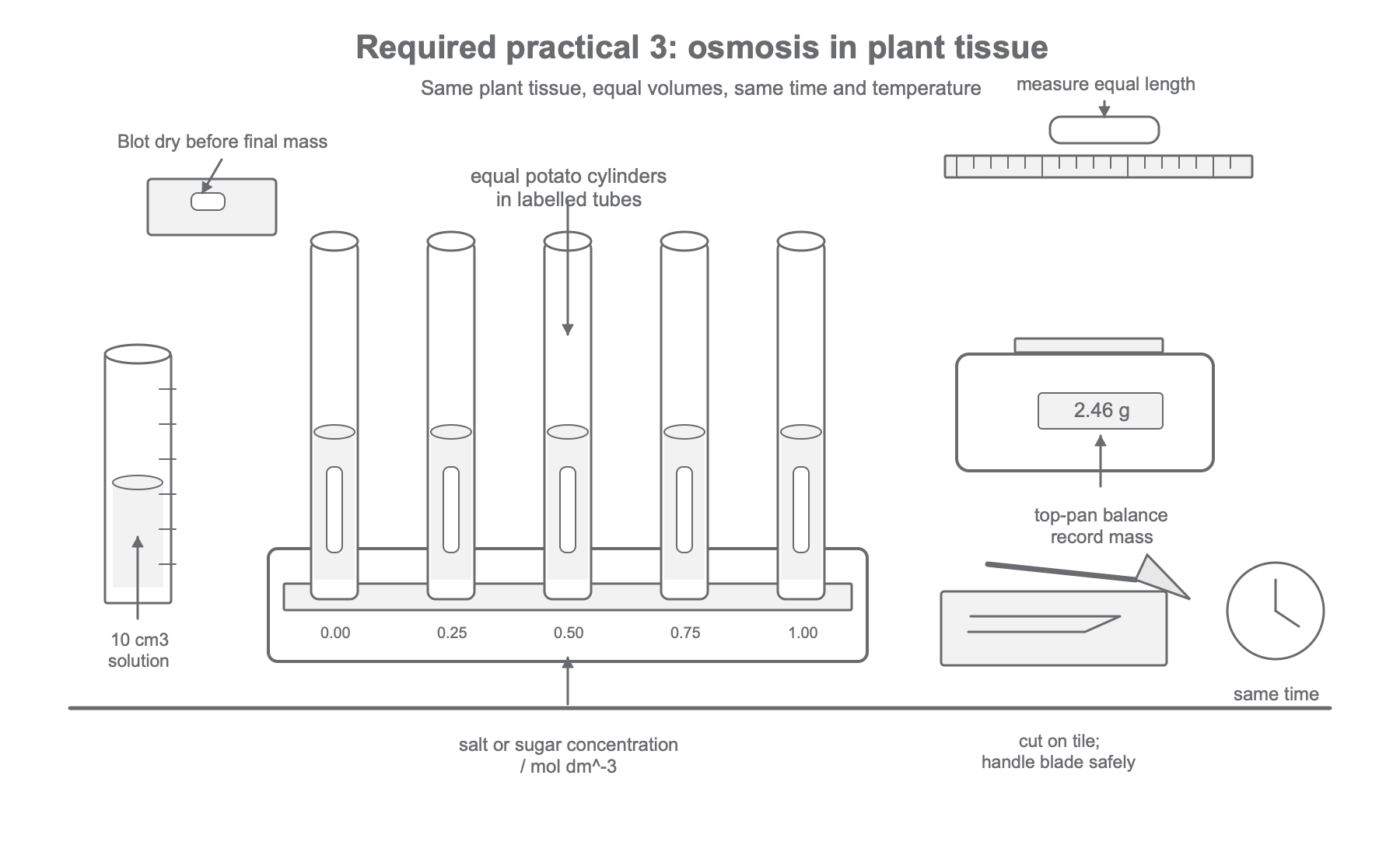
A valid method has to make the concentration of the solution the only planned change. A strong GCSE method would use these stages:
- Use a cork borer to cut cylinders of plant tissue with the same diameter.
- Trim the cylinders to the same length and remove any skin, because skin can affect water movement.
- Blot the cylinders gently and record each initial mass using a balance, for example to 0.01 g.
- Label tubes or beakers with at least five salt or sugar concentrations, including distilled water as 0.00 mol dm^-3 if used.
- Add the same volume of solution to each tube, for example 10 cm^3.
- Put one or more plant tissue cylinders into each concentration and leave them for the same time at the same temperature.
- Remove the cylinders, blot them dry in the same way each time, then record the final mass.
- Calculate change in mass, percentage change in mass and a mean for repeat samples.
The key apparatus can include a cork borer, scalpel or sharp knife, white tile, ruler, labelled tubes or beakers, measuring cylinder, paper towels, top-pan balance, plant tissue, distilled water and a range of salt or sugar solutions. AT 1 is covered by measuring mass and time, AT 3 by observing and measuring osmosis, and AT 5 by measuring water uptake from the change in mass over time.
The main hazards are cuts from the cork borer or scalpel and water near an electrical balance. Reduce risk by cutting on a white tile, keeping fingers away from the blade, carrying sharp tools carefully, drying the outside of containers before using the balance, and clearing spills.
Collecting Valid Data
Validity means the investigation really tests the effect of solution concentration on mass change. The easiest way to protect validity is to control the variables that would also affect osmosis.
Keep the plant tissue pieces as similar as possible. Same diameter and length help keep surface area similar. Same plant tissue source helps because different potatoes or different parts of a potato may have different cell contents. Same solution volume makes sure the tissue is fully covered. Same time and temperature keep the opportunity and rate for osmosis comparable.
Reliability improves when each concentration has repeats. Repeat samples let you spot an anomaly: a result that does not fit the pattern. If there is a valid reason, such as a cylinder not being blotted dry or a mass being recorded incorrectly, you may exclude the anomaly and calculate a mean from the remaining repeats.
Accuracy depends on careful measurement. Use a balance that reads to at least 0.01 g if available, use labelled tubes to avoid swapping concentrations, blot each sample the same way, and read volumes with the measuring cylinder at eye level.
The fair test is not just "put potato in sugar solution"; it is "change only the solution concentration and measure mass change accurately enough to compare the effect."
If the question asks for an improvement, do not just say "repeat it". Say what the improvement does. For example, "use three cylinders at each concentration and calculate a mean" improves reliability and helps identify anomalies.
Percentage Change and Rate
The raw change in mass is useful, but percentage change is fairer when starting masses are not exactly the same. A small cylinder and a large cylinder could gain different masses even if the same osmosis pattern is happening.
Change in Mass
A positive answer means the tissue gained mass. A negative answer means it lost mass.
Percentage Change in Mass
For example, a plant tissue cylinder has an initial mass of 2.40 g and a final mass of 2.64 g after 30 minutes.
Change in mass:
Percentage change in mass:
Simple rate of water uptake can be found by dividing the mass gain by the time:
If the mass decreases, the negative sign shows water has been lost from the tissue overall. In an exam, keep the sign in your answer unless the question asks only for the size of the change.
Graphs and Interpretation
[DIAGRAM: asset_name: Percentage mass change graph - diagram 2; asset_slug: 015_4_1_3_2b_required_practical_3_osmosis_in_plant_tissue_diagram2; file: diagram_assets/015_4_1_3_2b_required_practical_3_osmosis_in_plant_tissue_diagram2.png; recommended_method: deterministic_drawn; description: Monochrome example graph of mean percentage change in mass against sugar or salt solution concentration, with the zero-change line and estimated equal concentration labelled.]
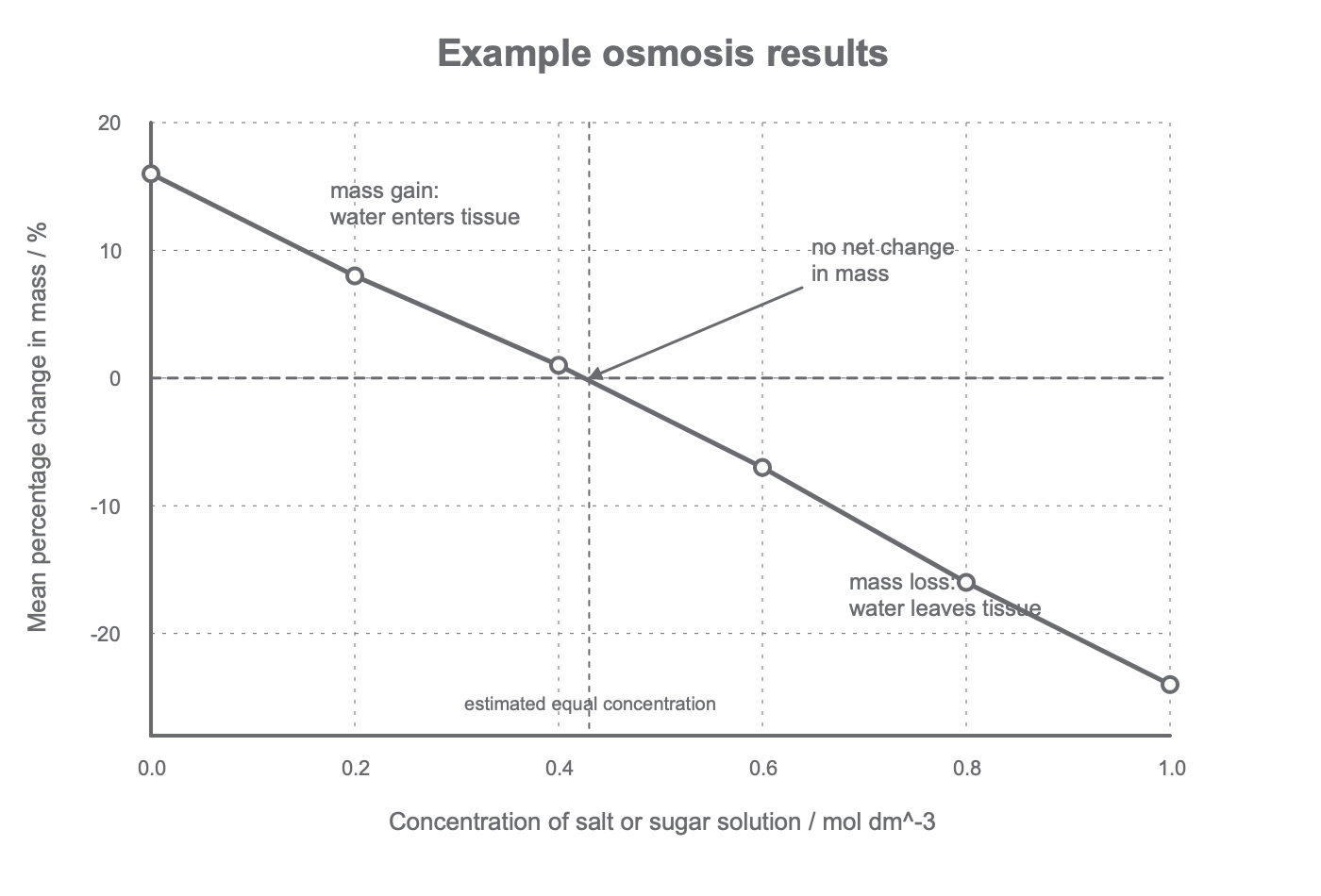
For this practical, the concentration of the salt or sugar solution goes on the x-axis because it is the independent variable. The percentage change in mass goes on the y-axis because it is the dependent variable.
Points above 0% show mass gain: water has moved into the plant tissue by osmosis. Points below 0% show mass loss: water has moved out of the plant tissue by osmosis. Where the graph crosses 0%, there is no net change in mass; the solution is about the same concentration as the solution inside the plant cells, so there is no overall movement of water in or out.
When interpreting a graph, use the trend and the biology together. A good conclusion might say: "As the sugar solution concentration increases, the percentage change in mass decreases because water moves out of the plant tissue by osmosis into the more concentrated solution."
The best way to check your understanding is to explain both halves of the graph: why the tissue gains mass in dilute solutions, and why it loses mass in more concentrated solutions.
Evaluation and Exam Answers
Evaluation questions ask how good the method or evidence is. The strongest answers link a weakness to its effect on the results and then give a practical improvement.
Common weaknesses include unequal tissue size, tissue from different potatoes, not removing skin, not blotting consistently, leaving samples for different times, temperature changes, too few concentrations, no repeats, or using a balance that is not sensitive enough. Each one can reduce validity, reliability or accuracy.
Useful improvements include using a cork borer and ruler for equal cylinders, removing skin, using the same volume of solution, controlling temperature with a water bath if available, using at least five concentrations, repeating each concentration, calculating a mean, excluding justified anomalies, and using a balance that reads to 0.01 g.
Further investigations stay close to the same idea. For example, a student could test a narrower range of concentrations around the 0% crossing to estimate the concentration inside the plant cells more precisely, or test whether temperature affects the rate of osmosis while keeping concentration constant.
For command words, be disciplined. Describe a method needs ordered practical steps. Calculate needs working, answer and unit. Explain needs the movement of water linked to concentration difference and a partially permeable membrane. Evaluate needs a judgement about method quality, supported by specific limitations and improvements.