4.2.2.1a - Digestive System, Enzymes and Digestion
The digestive system is an organ system: several organs work together to digest food and absorb the useful small molecules into the bloodstream. Digestion matters because large food molecules are often insoluble and too large to be absorbed. Enzymes speed up the chemical breakdown of these food molecules, while bile helps lipase digest fats faster.
A digestive organ system
An organ system is a group of organs that work together to carry out a function. The digestive system is an organ system because organs such as the mouth, stomach, pancreas, liver, gall bladder and small intestine work together to digest food and absorb the products.
Digestion has two useful meanings in this lesson. Mechanical digestion physically breaks food into smaller pieces, for example by chewing or churning. Chemical digestion uses enzymes to break large molecules into smaller soluble molecules.
Digestion
The breakdown of large insoluble food molecules into small soluble molecules that can be absorbed into the bloodstream.
Food does not pass through every organ that helps digestion. For example, food passes through the stomach and small intestine, but not through the pancreas or liver. The pancreas releases digestive enzymes into the small intestine, and the liver makes bile which is stored in the gall bladder.
Enzymes and active sites
An enzyme is a biological catalyst. It speeds up a reaction in a living organism without being used up. In this course, enzymes are protein molecules with a specific shape, and each enzyme has an active site where the reacting molecule, called the substrate, fits.
Active site
The part of an enzyme where the substrate binds and the reaction is catalysed.
Enzymes catalyse specific reactions because the shape of the active site is complementary to the shape of the substrate. If the substrate does not fit the active site, the enzyme cannot catalyse that reaction.
The lock-and-key model is a simplified model for enzyme action:
- The substrate fits into the enzyme's active site.
- An enzyme-substrate complex forms.
- The reaction happens and products are released.
- The enzyme is unchanged and can be used again.
[DIAGRAM: asset_name: lock-and-key-enzyme-action - diagram 1; asset_slug: 018_4_2_2_1a_digestive_system_enzymes_and_digestion_diagram1; file: diagram_assets/imagegen_regen_all/018_4_2_2_1a_digestive_system_enzymes_and_digestion_diagram1_imagegen.png; recommended_method: codex_image_gen; description: Monochrome three-stage lock-and-key enzyme action model showing a substrate fitting a complementary active site, an enzyme-substrate complex forming, and products leaving while the enzyme remains unchanged. Labels must include enzyme, active site, substrate, enzyme-substrate complex and products.]
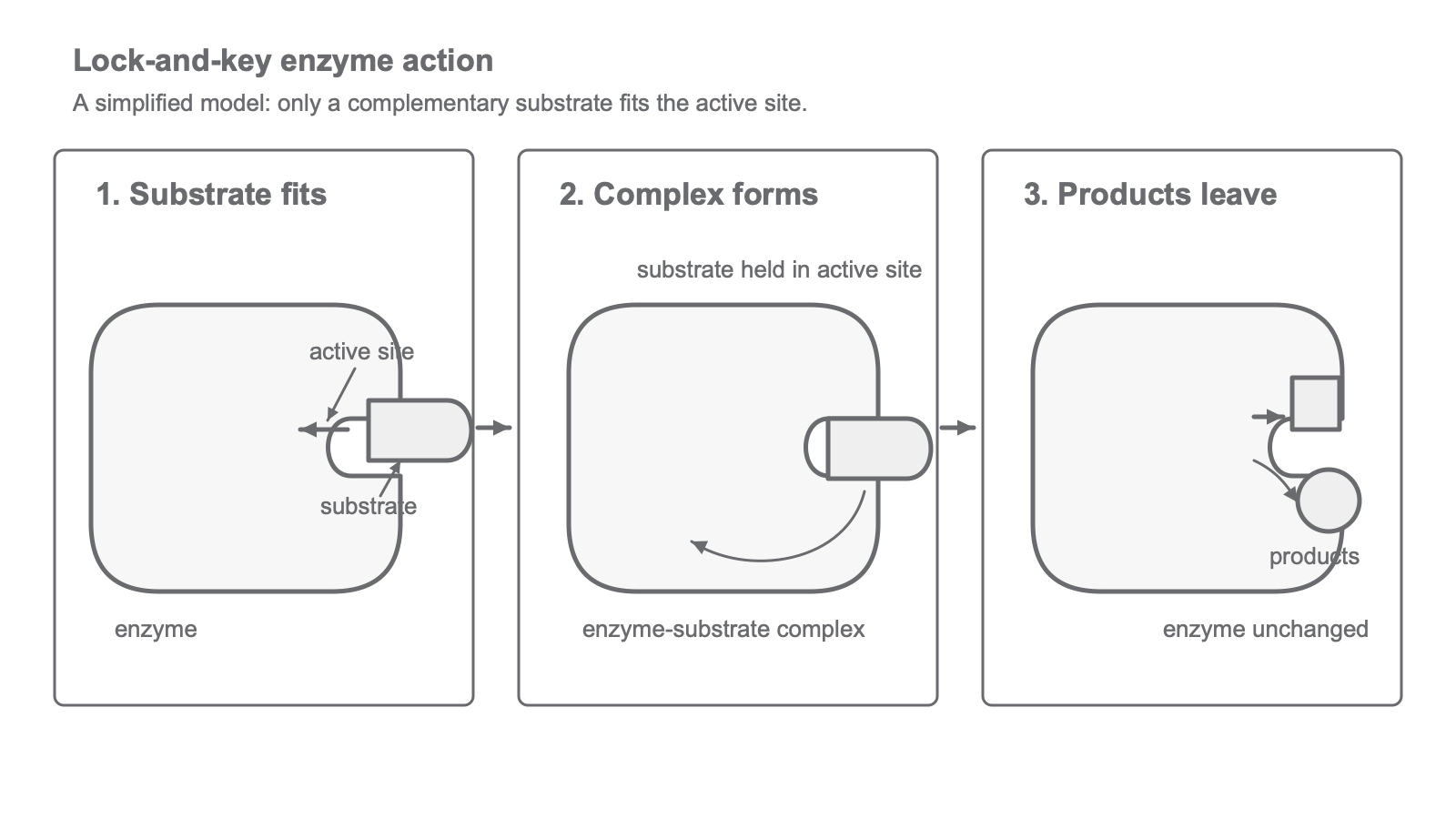
The model is useful because it explains specificity clearly. It is still a model, so it is simplified: real enzyme molecules are more flexible than a rigid lock.
Temperature, pH and rate
Enzyme activity is affected by temperature. At low temperatures, enzyme and substrate particles have less kinetic energy, so there are fewer successful collisions and the rate is low. As temperature increases, the rate usually increases because collisions happen more often.
Above the enzyme's optimum temperature, bonds holding the enzyme in shape can break. The active site changes shape, so the substrate no longer fits. The enzyme is denatured, and the rate falls sharply.
Denatured
An enzyme is denatured when its active site changes shape so the substrate no longer fits.
pH also affects enzymes. Each enzyme has an optimum pH. If the pH is too acidic or too alkaline for that enzyme, the active site can change shape and fewer enzyme-substrate complexes form. Extreme pH values can denature enzymes.
You may also need to calculate reaction rate. The most general relationship is:
Rate of reaction
If the same amount of substrate is digested each time, a simple relative rate can be calculated as:
relative rate = 1 / time taken
Worked example:
A sample of starch is completely digested in 125 s. Calculate the relative rate.
relative rate = 1 / 125 = 0.0080 s^-1
The unit is s^-1 because the calculation is one divided by time in seconds.
Digestive enzymes
Digestive enzymes convert food into small soluble molecules that can be absorbed into the bloodstream. You need the enzyme type, the substance it breaks down, the products, and where it is produced and acts.
| Enzyme | Substrate | Products | Sites of production | Sites of action |
|---|---|---|---|---|
| Amylase, a carbohydrase | Starch | Simple sugars | Salivary glands, pancreas, small intestine | Mouth, small intestine |
| Proteases | Proteins | Amino acids | Stomach, pancreas, small intestine | Stomach, small intestine |
| Lipases | Lipids (fats) | Glycerol and fatty acids | Pancreas, small intestine | Small intestine |
The specification expects simple word equations, not chemical symbol equations:
starch --amylase--> simple sugars
proteins --proteases--> amino acids
lipids --lipases--> glycerol + fatty acids
Two exam traps are worth catching early. First, amylase is a carbohydrase, but not all carbohydrases are amylase. Second, the pancreas produces enzymes but food does not pass through the pancreas; the enzymes are released into the small intestine.
Bile and lipase
Bile is not an enzyme. It is made in the liver and stored in the gall bladder before being released into the small intestine.
Bile helps fat digestion in two ways. First, bile is alkaline, so it neutralises hydrochloric acid from the stomach. This creates alkaline conditions in the small intestine, where lipase works more effectively. Second, bile emulsifies fat: it breaks large fat droplets into many small droplets.
[DIAGRAM: asset_name: bile-emulsification-and-lipase - diagram 2; asset_slug: 018_4_2_2_1a_digestive_system_enzymes_and_digestion_diagram2; file: diagram_assets/imagegen_regen_all/018_4_2_2_1a_digestive_system_enzymes_and_digestion_diagram2_imagegen.png; recommended_method: codex_image_gen; description: Monochrome schematic showing one large fat droplet before bile, many smaller fat droplets after bile emulsification, and lipase arrows acting on the increased surface area. Labels must state bile emulsifies fat, bile is not an enzyme, increased surface area and faster lipase action.]
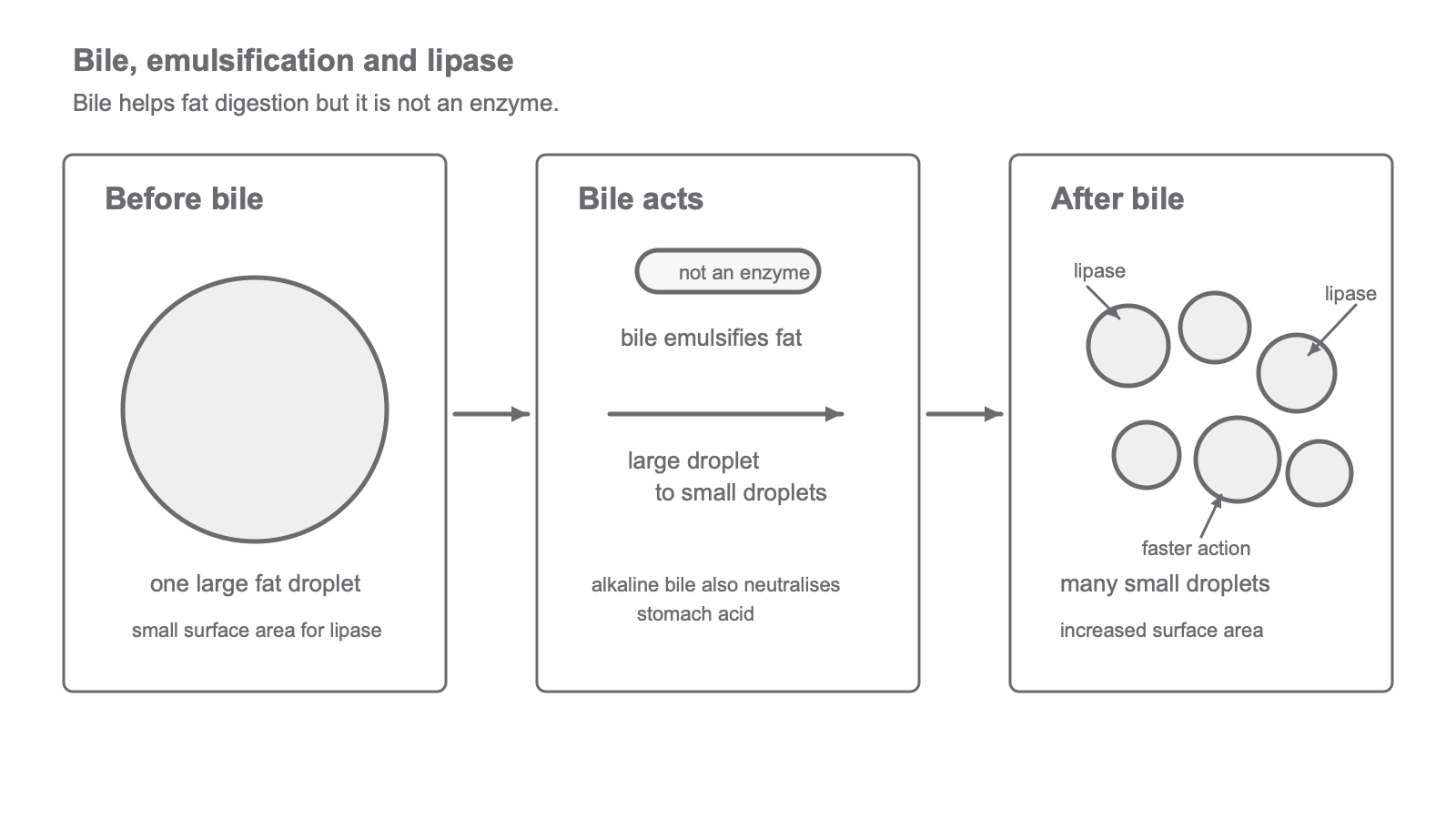
Emulsification increases the surface area of fat available for lipase. More lipase molecules can collide with fat at the same time, so the rate of fat breakdown increases. Lipase then chemically digests lipids into glycerol and fatty acids.
Products of digestion
The products of digestion are useful because they are small enough to be absorbed into the bloodstream. They are then used by cells to build new biological molecules.
Simple sugars from carbohydrate digestion can be used to build new carbohydrates. Some glucose is used in respiration. Amino acids from protein digestion are used to build new proteins. Glycerol and fatty acids from lipid digestion are used to build new lipids.
Strong answers keep the chain complete:
large insoluble food molecule -> enzyme digestion -> small soluble molecule -> absorption into bloodstream -> used by cells
Digestive enzymes make large food molecules small and soluble; bile helps lipase by neutralising acid and increasing fat surface area.