4.2.2.1c - Required Practical - Amylase and pH
This required practical investigates how pH affects the rate at which amylase digests starch. You use iodine reagent to test whether starch is still present, and you control temperature so that pH is the factor being tested. AQA can assess the method, variables, safety, observations, rate calculations and how the results would be shown on a graph.
Amylase, starch and iodine
Amylase is an enzyme that breaks down starch into smaller sugars. In this investigation the substrate is starch, the enzyme is amylase, and the reaction is followed using iodine reagent.
Substrate
The molecule that an enzyme acts on.
Iodine reagent is useful because it tests for starch. It is orange-brown when starch is absent, but turns blue-black when starch is present. If a sample from the reaction mixture still turns iodine blue-black, starch has not been completely digested. If the iodine stays orange-brown, the starch has been completely digested in that sample.
pH matters because enzymes have active sites with specific shapes. At the optimum pH the active site is most suitable for the substrate, so successful enzyme-substrate collisions happen more often. At pH values that are too acidic or too alkaline, the active site can change shape, so starch fits less well and the reaction rate decreases.
The endpoint is the first sample where iodine stays orange-brown, showing that starch is no longer present.
That colour change is the observation you use to decide when to stop timing.
Required practical method
The independent variable is pH. You change it using buffer solutions with different pH values. The dependent variable is the time taken for starch to be completely digested, which you then use to calculate a rate.
[DIAGRAM: asset_name: amylase-ph-apparatus - diagram 1; asset_slug: 020_4_2_2_1c_required_practical_5_amylase_and_ph_diagram1; file: diagram_assets/imagegen_regen_all/020_4_2_2_1c_required_practical_5_amylase_and_ph_diagram1_imagegen.png; recommended_method: codex_image_gen; description: Monochrome labelled apparatus layout for Required Practical 5 showing a thermostatically controlled water bath or electric heater, labelled tubes for starch plus pH buffer plus amylase, thermometer, stopwatch, spotting tile wells containing iodine, and a sampling arrow marked every 30 s.]
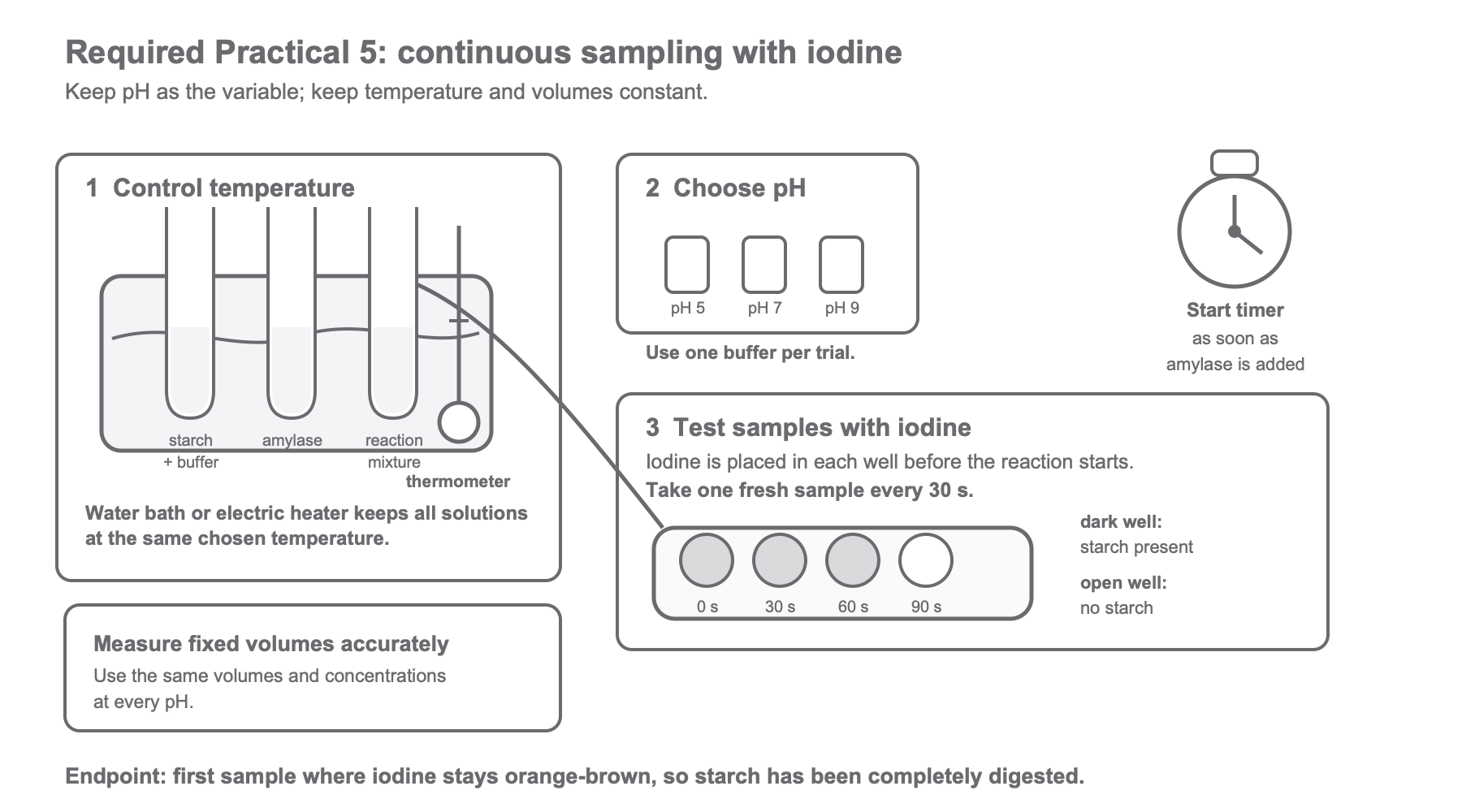
A valid school method is:
- Add one drop of iodine reagent to each well of a spotting tile.
- Label test tubes with the pH values of the buffer solutions being tested.
- Measure fixed volumes of starch solution, amylase solution and the first pH buffer solution using suitable apparatus such as a measuring cylinder, syringe or pipette.
- Place the starch, buffer and amylase solutions in a water bath or use an electric heater so they reach the same chosen temperature.
- Mix the starch solution with the buffer solution.
- Add amylase solution, start the stop clock immediately and mix.
- Every 30 seconds, take a small sample from the reaction mixture and add it to a fresh iodine well.
- Record the first time when iodine no longer turns blue-black.
- Repeat the method for each pH value.
The sampling is called continuous sampling because repeated samples are taken from the same reaction mixture as the reaction proceeds. Each sample is tested separately with iodine, so the reaction tube is not contaminated with iodine.
Variables, validity and safety
To make the investigation valid, only pH should change between trials. Keep the temperature constant with a water bath or electric heater, because temperature also affects enzyme activity. Keep the volume and concentration of starch, volume and concentration of amylase, volume of buffer, sampling interval, sample size and mixing method the same.
Repeats improve reliability. For each pH, repeat the measurement, identify any anomalous results, and calculate a mean time from the repeat values that are consistent. If the first orange-brown sample appears at 120 seconds, the true endpoint may have occurred between 90 seconds and 120 seconds, so using the same 30-second interval each time makes comparisons fair.
Accuracy depends on careful apparatus use. Record pH values, volumes and times clearly. Mix before sampling, take the same size sample each time, and use a fresh iodine well for every sample. If a glass rod is used to transfer samples, rinse it between samples so old starch is not carried into the next iodine well.
Wear eye protection because iodine solution can irritate eyes. Take care with hot water baths or electric heaters, and keep water away from electrical equipment. Handle glassware carefully and clean up spills promptly.
That same logic applies to other control variables: they must stay fixed so the pH comparison is meaningful.
Processing results
The raw result is the time taken for starch to be completely digested at each pH. A shorter time means a faster reaction. To compare activity more clearly, calculate a relative rate using:
Relative rate
Worked example:
At pH 7, starch is completely digested after 120 seconds.
relative rate = 1 / 120 = 0.0083 s^-1
At pH 4, starch is completely digested after 300 seconds.
relative rate = 1 / 300 = 0.0033 s^-1
The reaction at pH 7 is faster because its time is shorter and its relative rate is larger.
[DIAGRAM: asset_name: amylase-ph-rate-graph - diagram 2; asset_slug: 020_4_2_2_1c_required_practical_5_amylase_and_ph_diagram2; file: diagram_assets/020_4_2_2_1c_required_practical_5_amylase_and_ph_diagram2.png; recommended_method: deterministic_drawn; description: Monochrome graph of relative amylase activity against pH, with pH on the x-axis, relative rate from 1/time on the y-axis, low activity at acidic and alkaline extremes, a highest point labelled optimum pH, and a note that the optimum is read from the results.]
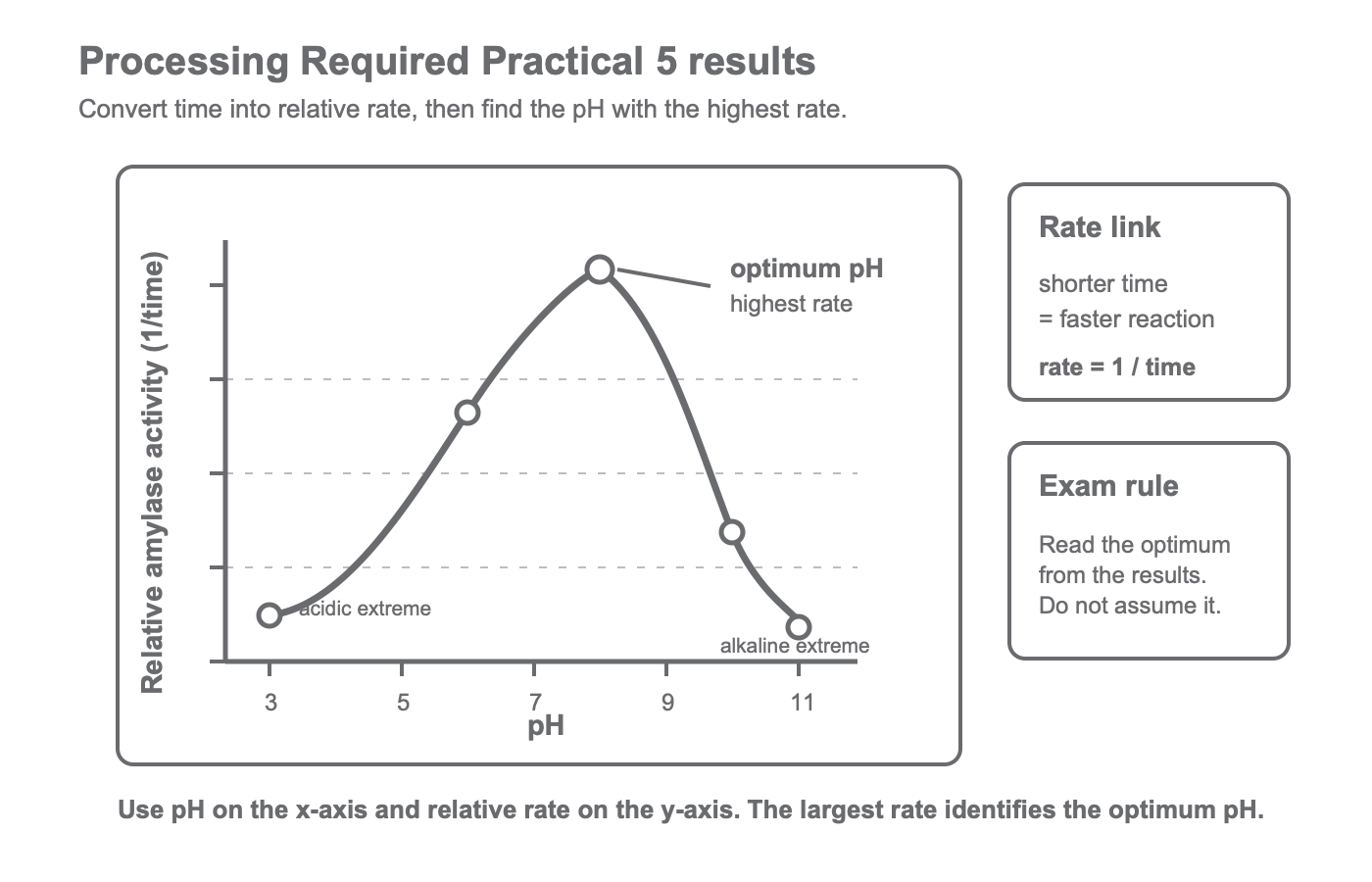
A graph should put pH on the x-axis and amylase activity or relative rate on the y-axis. The optimum pH is the pH with the highest rate. Do not assume the optimum in an exam unless the question gives data; identify it from the shortest time or the largest calculated rate.
Exam precision
In a method question, name the apparatus and connect each step to the variable it controls or the measurement it produces. Strong answers mention pH buffers, fixed volumes, a water bath or electric heater, iodine in a spotting tile, sampling every 30 seconds, repeated readings and calculating a mean.
In an explanation question, do not just say "pH affects enzymes". Link pH to the active site and then to the rate: an unsuitable pH changes the shape of the active site, fewer enzyme-substrate complexes form, so starch is digested more slowly.
In a data question, remember that time and rate move in opposite directions. The largest time is the slowest reaction. The shortest time is the fastest reaction. If rates are calculated using 1 / time, the largest rate is the optimum pH.