4.1.2.1 - Chromosomes, DNA and Genes
Chromosomes are one of the key links between cell biology and inheritance, but this lesson keeps to the first GCSE idea: where chromosomes are, what they are made of, what they carry, and how they are normally arranged in body cells. The important exam skill is to describe the relationship between nucleus, chromosome, DNA and gene without swapping the order around.
Chromosomes in the nucleus
In a cell with a nucleus, the nucleus contains chromosomes. A chromosome is made of a DNA molecule. At this level, the useful picture is not a complicated chemical structure; it is a stored set of genetic information inside the nucleus.
Chromosome
A chromosome is a structure in the nucleus made of a DNA molecule.
The exam wording matters. If a question asks where chromosomes are found, the creditworthy answer is the nucleus. If it asks what chromosomes are made of, the creditworthy answer is DNA. Do not reverse this and say that DNA is made of chromosomes.
Genes on chromosomes
Each chromosome carries a large number of genes. A gene is a section of DNA that carries genetic information, so a chromosome can be thought of as a long DNA molecule with many gene sections along it.
[DIAGRAM: asset_name: chromosome-dna-gene-model: Chromosomes, DNA, genes and pairs - diagram 1; asset_slug: 009_4_1_2_1_chromosomes_diagram1; file: diagram_assets/imagegen_regen_all/009_4_1_2_1_chromosomes_diagram1_imagegen.png; recommended_method: codex_image_gen; description: Monochrome model showing a cell nucleus containing chromosomes, a magnified chromosome as a DNA molecule carrying labelled gene sections, and a body-cell nucleus with matching chromosome pairs. It supports the relationships: nucleus contains chromosomes; chromosomes are made of DNA; chromosomes carry many genes; body-cell chromosomes are normally in pairs.]
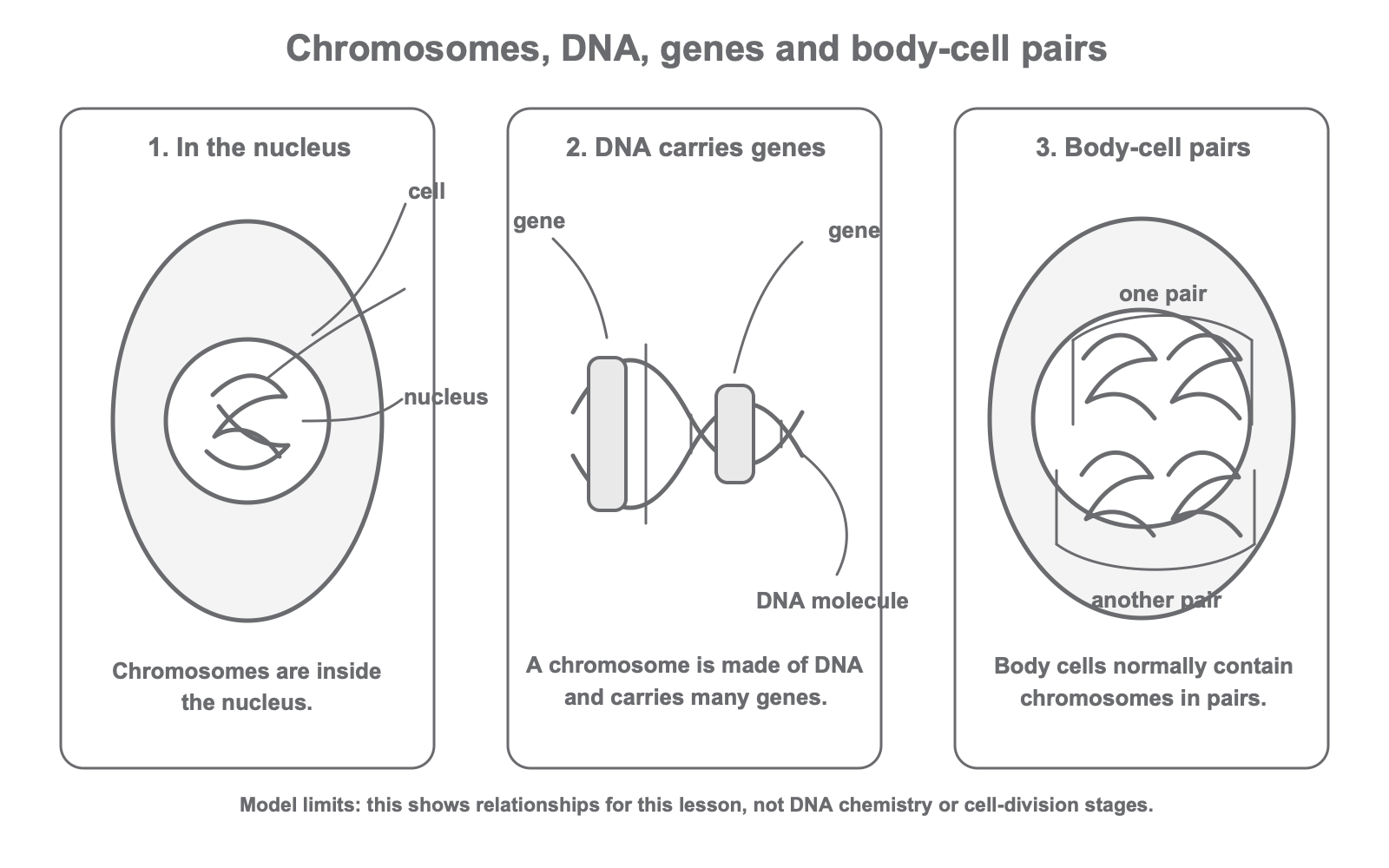
The order is:
- the nucleus contains chromosomes
- chromosomes are made of DNA molecules
- chromosomes carry many genes
That order is a small thing, but it prevents most wrong answers in this topic.
Pairs in body cells
In body cells, chromosomes are normally found in pairs. A body cell is a cell of the body rather than a sex cell. For this lesson, the key point is the arrangement: the chromosomes in body cells are paired, so the cell normally has matching pairs of chromosomes rather than just single chromosomes.
This does not mean that every drawing of a chromosome should look like an X. Many models draw chromosomes as X-shaped because that is easy to see, but the assessed idea here is the pair arrangement in body cells, not a specific drawing style.
Body cells normally contain chromosomes in pairs, and each chromosome is made of DNA and carries many genes.
Use the pair arrangement, rather than the X-shape used in some drawings, when answering the next check.
Using models carefully
A model can help you keep the scale and order straight. One useful analogy is a storage system: the nucleus is like a storage room, chromosomes are like long instruction books made from DNA, and genes are like individual instructions within each book.
Used carefully, this model also supports one cell-division idea: because genetic information is carried on chromosomes in the nucleus, any new body cell needs the correct chromosome set. The detailed stages of cell division are taught in the next specification point.
Every model has limits. The storage-room analogy helps with the idea that chromosomes carry many genes, but it does not show the real shape of DNA, the chemistry of DNA, or the detailed events of cell division. For this specification point, use the model to explain the relationships, then stop before adding extra inheritance or division detail.
Exam answer patterns
Good answers in this topic are short and precise. If the question is worth two or three marks, it is usually rewarding separate facts: location, material, genes carried, or pairs in body cells.
Common errors are:
- saying chromosomes are made of genes instead of DNA
- saying genes contain chromosomes instead of chromosomes carrying genes
- forgetting the nucleus
- saying body cells normally contain single chromosomes instead of pairs
- drifting into mitosis, meiosis or inheritance when the question only asks about chromosomes
When you see the word Describe, give the relationship directly. When you see Explain, add a because-link only if the question asks for a reason. For this lesson, the safest explanation is that chromosomes are DNA structures in the nucleus that carry many genes, and in body cells they are normally paired.