4.2.2.4 - Coronary Heart Disease and Treatments
Coronary heart disease is a non-communicable disease that affects the blood supply to the heart muscle itself. The key GCSE idea is simple but important: narrowed coronary arteries carry less blood, so the heart muscle receives less oxygen. Treatments can improve blood flow, reduce further fatty deposits, replace faulty parts, or support a failing heart, but each treatment has benefits and risks.
Coronary heart disease
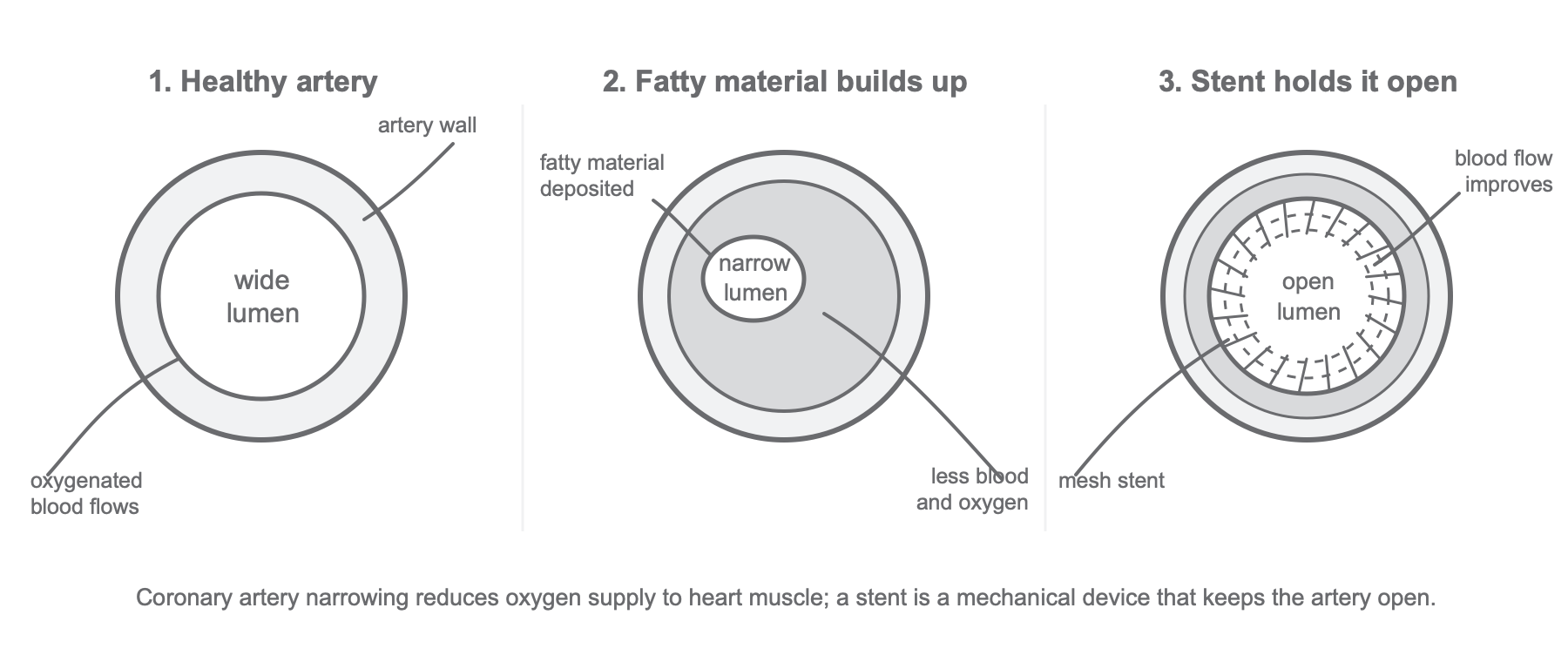
The coronary arteries are the blood vessels that supply the heart muscle with oxygenated blood. In coronary heart disease, layers of fatty material build up inside these arteries. This narrows the space inside the artery, so less blood can flow through it.
Coronary heart disease
A non-communicable disease in which fatty material builds up inside the coronary arteries, narrowing them and reducing blood flow to the heart muscle.
Heart muscle cells need oxygen for aerobic respiration. If the coronary arteries are narrowed, less oxygen is delivered to the heart muscle. The heart muscle may not be able to respire enough to contract normally, and severe lack of oxygen can damage the heart muscle.
In coronary heart disease, fatty material narrows the coronary arteries, reducing blood flow and oxygen supply to the heart muscle.
Stents and statins
Two named treatments for coronary heart disease are stents and statins. They help in different ways, so exam answers must not blur them together.
A stent is a small mesh tube placed inside a narrowed coronary artery. It is a mechanical device. The stent holds the artery open, so more blood can flow through to the heart muscle.
Statins are drugs used to reduce blood cholesterol levels. Lower cholesterol slows down the rate at which fatty material is deposited in the arteries. Statins do not physically widen an artery straight away; their main GCSE role is to reduce further build-up over time.
[DIAGRAM: asset_name: coronary-artery-narrowing-and-stent - diagram 1; asset_slug: 023_4_2_2_4_coronary_heart_disease_and_treatments_diagram1; file: diagram_assets/imagegen_regen_all/023_4_2_2_4_coronary_heart_disease_and_treatments_diagram1_imagegen.png; recommended_method: codex_image_gen; description: Monochrome three-panel schematic of a healthy coronary artery with an open lumen, a narrowed coronary artery with fatty material reducing the lumen and blood flow, and a stented coronary artery held open by a mesh tube, with readable labels and flow arrows.]
| Treatment | Type | How it helps | Possible disadvantages |
|---|---|---|---|
| Stent | Mechanical device | Keeps a narrowed coronary artery open, improving blood flow and oxygen supply | Surgery/procedure risk; blood clots may form near the stent |
| Statin | Drug | Reduces blood cholesterol, slowing the rate of fatty material deposit | Must usually be taken regularly for a long time; side effects can occur |
Faulty heart valves
Heart valves keep blood moving in the correct direction through the heart. A faulty valve can cause problems in two main ways: it may not open fully, or it may leak.
If a valve does not open fully, blood flow through the valve is reduced. The heart may have to work harder to push blood through the smaller opening. If a valve leaks, some blood flows backwards, so less blood moves forwards with each heartbeat.
Faulty heart valves can be replaced using biological valves or mechanical valves.
| Replacement valve | Main advantage | Main disadvantage |
|---|---|---|
| Biological valve | Often less risk of blood clotting than a mechanical valve | May wear out and need replacing later |
| Mechanical valve | Usually lasts a long time | Can increase the risk of blood clots, so anticoagulant drugs may be needed |
The best choice depends on the patient. A strong evaluation does not say one valve is always best; it links the benefit and risk to the situation.
Transplants and artificial hearts
Heart failure means the heart cannot pump enough blood around the body. In severe cases, a donor heart can be transplanted. If both the heart and lungs are badly affected, a heart and lungs transplant may be used.
Transplants can greatly improve survival and quality of life for carefully selected patients, but they are major operations. Donor organs are limited, the donated heart may be rejected by the immune system, and patients usually need drugs that suppress the immune system.
An artificial heart is a mechanical device that can support circulation when the heart is failing. In this specification point, artificial hearts are used occasionally to keep patients alive while waiting for a heart transplant, or to allow the heart to rest as an aid to recovery.
Heart failure
A condition in which the heart cannot pump blood around the body effectively enough.
Evaluating treatments
To evaluate a treatment, give benefits and risks, then make a judgement that fits the patient or situation. A vague answer such as "it is good but risky" is not enough. Name the treatment, state how it helps, and identify a specific disadvantage.
Worked evaluation:
A patient has narrowed coronary arteries but their heart muscle is still working. A stent may be useful because it directly keeps a narrowed coronary artery open, increasing blood flow and oxygen supply to the heart muscle. A disadvantage is that it involves a medical procedure and there is a risk of blood clots. A heart transplant would not normally be the first choice in this situation because it is major surgery, donor hearts are limited, and transplants are for severe heart failure.
Another patient has severe heart failure and medicines are no longer effective. A transplant may offer a longer life and better quality of life, but it depends on a suitable donor and carries risks such as rejection and the need for immune-suppressing drugs. An artificial heart may support the patient while waiting, but it is a temporary support rather than a simple cure.