4.1.1.1 - Eukaryotes, Prokaryotes and Cell Scale
Cells are the smallest living units, but they are not all organised in the same way. In this lesson, the main difference is where the genetic material is found: inside a nucleus in eukaryotic cells, but not inside a nucleus in prokaryotic bacterial cells. You will also practise the scale language AQA expects: prefixes, standard form and order of magnitude.
Two cell types
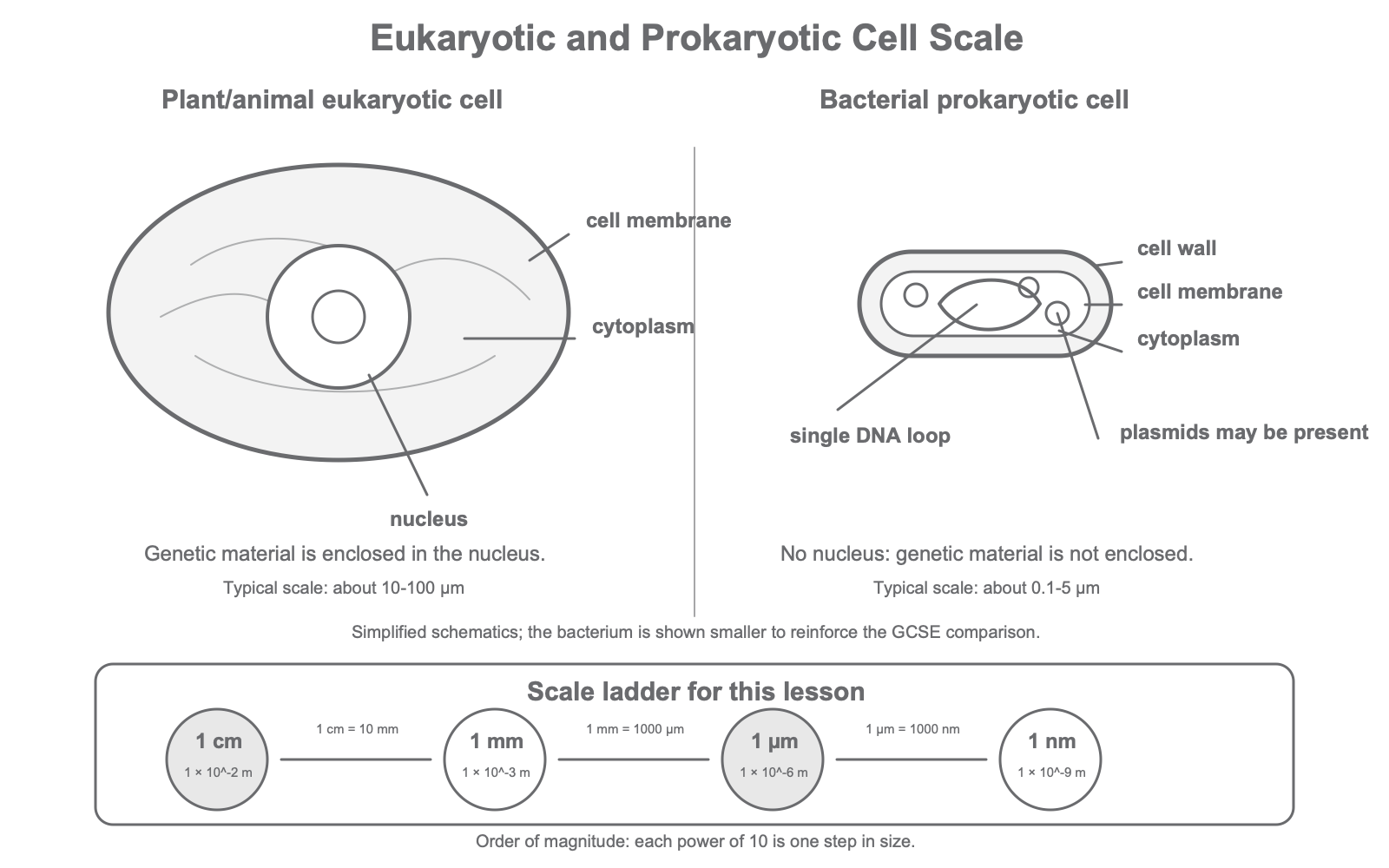
A eukaryotic cell has its genetic material enclosed inside a nucleus. Plant cells and animal cells are eukaryotic cells. At this point in the course, the shared features you need are simple: they have a cell membrane, cytoplasm and genetic material enclosed in a nucleus.
Eukaryotic cell
A cell with genetic material enclosed in a nucleus.
A prokaryotic cell does not have its genetic material enclosed in a nucleus. Bacterial cells are prokaryotic cells. They are much smaller than eukaryotic cells and have cytoplasm, a cell membrane surrounded by a cell wall, and genetic material as a single DNA loop. They may also contain one or more small rings of DNA called plasmids.
Prokaryotic cell
A cell whose genetic material is not enclosed in a nucleus.
[DIAGRAM: asset_name: cell-scale-comparison - diagram 1; asset_slug: 001_4_1_1_1_eukaryotes_prokaryotes_and_cell_scale_diagram1; file: diagram_assets/001_4_1_1_1_eukaryotes_prokaryotes_and_cell_scale_diagram1.png; recommended_method: deterministic_drawn; description: Monochrome side-by-side schematic comparing a plant/animal eukaryotic cell with nucleus, cytoplasm and cell membrane to a much smaller bacterial prokaryotic cell with cell wall, cell membrane, cytoplasm, DNA loop and plasmids, plus a scale ladder for cm, mm, micrometres and nanometres.]
Comparing structures
AQA often rewards precise comparison. The safest approach is to name the cell type, then name the structure or state clearly that it is absent.
| Feature | Eukaryotic plant and animal cells | Bacterial prokaryotic cells |
|---|---|---|
| Cell membrane | Present | Present |
| Cytoplasm | Present | Present |
| Nucleus | Present | Absent |
| Genetic material | Enclosed in the nucleus | Not enclosed in a nucleus |
| Cell wall | Not part of this shared plant-and-animal description | Surrounds the cell membrane |
| DNA loop | Not the AQA description here | Single DNA loop |
| Plasmids | Not the AQA description here | May be present |
| Relative size | Larger | Much smaller |
Notice the trap: a prokaryotic cell does have genetic material. It is wrong to say bacteria have "no DNA". The correct comparison is that bacterial DNA is not enclosed in a nucleus.
For this specification point, the sharp distinction is nucleus versus no nucleus, not DNA versus no DNA.
Prefixes and units
Cells are too small to describe comfortably in metres. Biology often uses micrometres, written as µm, and smaller structures may be described in nanometres, written as nm.
| Prefix | Symbol | Meaning in metres | Standard form |
|---|---|---|---|
| centi | c | one hundredth of a metre | 1 cm = 1 × 10^-2 m |
| milli | m | one thousandth of a metre | 1 mm = 1 × 10^-3 m |
| micro | µ | one millionth of a metre | 1 µm = 1 × 10^-6 m |
| nano | n | one billionth of a metre | 1 nm = 1 × 10^-9 m |
The most useful GCSE conversions here are:
1 cm = 10 mm
1 mm = 1000 µm
1 µm = 1000 nm
So moving from a bigger unit to a smaller unit makes the number bigger. For example, 0.04 mm = 40 µm because each millimetre contains 1000 micrometres.
Standard form
Standard form is a compact way to write very large or very small numbers. A number in standard form is written as:
Standard form
a must be at least 1 and less than 10. The power of 10 tells you how many places the decimal point has moved. For cell sizes, the power is often negative because the measurement is smaller than one metre.
Worked example:
A bacterial cell is 2 µm long. Write this length in metres and in standard form.
- Use the prefix:
1 µm = 1 × 10^-6 m - Substitute the number of micrometres:
2 µm = 2 × 10^-6 m - The answer is already in standard form because 2 is between 1 and 10.
Another worked example:
A eukaryotic cell is 50 µm wide. Write this in metres and standard form.
50 µm = 50 × 10^-6 m- Rewrite 50 as
5.0 × 10^1 5.0 × 10^1 × 10^-6 = 5.0 × 10^-5 m
Order of magnitude
An order of magnitude is a factor of 10. If one object is about 10 times larger than another, it is one order of magnitude larger. If it is about 100 times larger, it is two orders of magnitude larger because 100 = 10^2.
Order of magnitude
A size difference measured by powers of 10.
To compare cell sizes, put both measurements in the same unit first.
Worked example:
A bacterial cell is about 2 µm long. A eukaryotic cell is about 20 µm wide. How many times larger is the eukaryotic cell measurement?
20 µm ÷ 2 µm = 10
The eukaryotic cell measurement is about 10 times larger, so it is about one order of magnitude larger.
If the values were 2 µm and 200 µm, the calculation would be 200 ÷ 2 = 100, which is two orders of magnitude.
Exam precision
In exam answers, be careful with the exact words. Eukaryotic means the genetic material is enclosed in a nucleus. Prokaryotic means the genetic material is not enclosed in a nucleus. Bacterial cells are not empty or DNA-free; their DNA is just organised differently.
For scale questions, do not compare numbers until the units match. A value in millimetres and a value in micrometres cannot be compared fairly until one has been converted. Then look for factors of 10 when the question asks about order of magnitude.
A strong short answer often follows this pattern:
Bacterial cells are prokaryotic. Their genetic material is not enclosed in a nucleus; it is a single DNA loop and may include plasmids. They are much smaller than eukaryotic plant and animal cells.