4.1.1.2a - Animal and Plant Cell Structures
Cells are easier to understand when you treat each labelled part as a structure with a job. In this lesson, the key skill is not just naming the parts of animal and plant cells, but explaining how each sub-cellular structure is related to its function. Bacterial plasmids are included only where the specification uses them as a comparison point for cell structure.
Cells as working systems
A cell is a living system made from smaller working parts. At GCSE, these parts are usually called sub-cellular structures. Some of them are organelles, which means specialised structures inside a cell that carry out particular functions.
Sub-cellular structure
A part of a cell that has a particular role, such as the nucleus, cytoplasm, cell membrane, mitochondria, ribosomes, chloroplasts, permanent vacuole, cell wall or plasmid.
Plant and animal cells are eukaryotic cells, so their genetic material is enclosed in a nucleus. A typical GCSE cell diagram is a model: it shows the important parts clearly, but real cells vary in shape, size and the exact number of structures they contain.
When you see a cell image, ask two questions:
- What structures are present?
- What does each structure allow the cell to do?
Naming a structure is only the first step; exam answers often need the link between structure and function.
Animal cell structures
Most animal cells have a nucleus, cytoplasm, a cell membrane, mitochondria and ribosomes. These structures are not decorative labels: each one helps the cell carry out life processes.
| Structure | Function you should know | Creditworthy wording |
|---|---|---|
| Nucleus | Contains genetic material and controls cell activities | "The nucleus contains DNA/genetic material and controls the cell." |
| Cytoplasm | Jelly-like substance where many chemical reactions take place | "Many chemical reactions happen in the cytoplasm." |
| Cell membrane | Controls movement of substances into and out of the cell | "The cell membrane controls what enters and leaves the cell." |
| Mitochondria | Site of aerobic respiration | "Mitochondria are where aerobic respiration releases/transfers energy." |
| Ribosomes | Site of protein synthesis | "Ribosomes make proteins." |
Be careful with mitochondria. They do not create energy from nothing. Respiration transfers energy from glucose into a form the cell can use.
Plant cell structures
Plant cells usually contain the same main structures as animal cells: nucleus, cytoplasm, cell membrane, mitochondria and ribosomes. In addition, plant cells often have chloroplasts and a large permanent vacuole. Plant and algal cells also have a cellulose cell wall.
[DIAGRAM: asset_name: Animal and plant cell structure comparison - diagram 1; asset_slug: 002_4_1_1_2a_animal_and_plant_cell_structures_diagram1; file: diagram_assets/imagegen_regen_all/002_4_1_1_2a_animal_and_plant_cell_structures_diagram1_imagegen.png; recommended_method: codex_image_gen; description: Monochrome side-by-side GCSE model of an animal cell and plant cell, with labels for animal-cell structures and the extra plant-cell structures: cellulose cell wall, chloroplasts and permanent vacuole.]
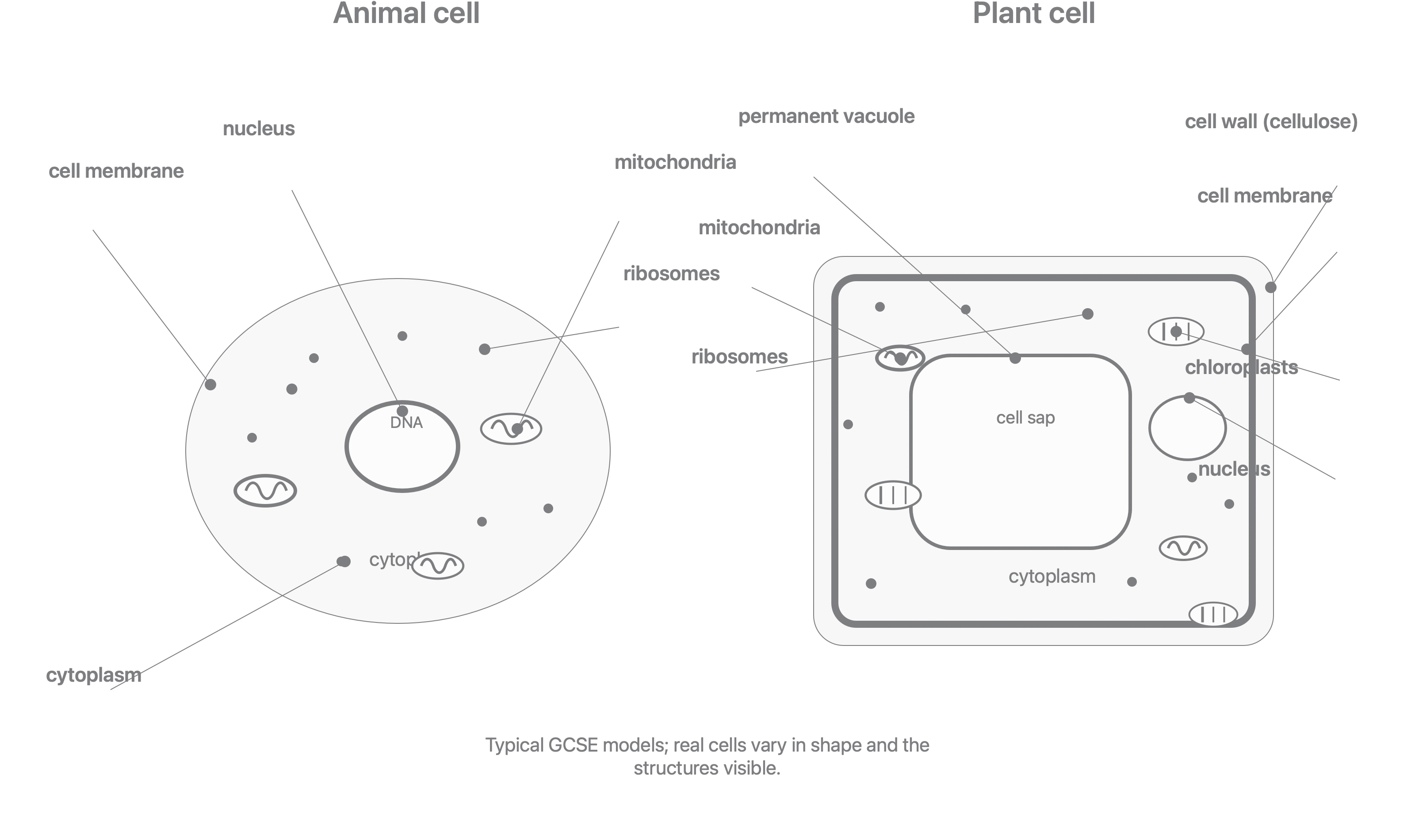
| Structure | Function you should know | Common mistake to avoid |
|---|---|---|
| Cell wall made of cellulose in plant and algal cells | Strengthens and supports the cell | Do not confuse the cell wall with the cell membrane; plant cells have both. |
| Chloroplasts in many plant cells | Contain chlorophyll, which absorbs light for photosynthesis | Do not say every plant cell has chloroplasts; cells away from light may not. |
| Permanent vacuole filled with cell sap in plant cells | Stores cell sap and helps support the cell by keeping it firm | Do not describe it as a temporary animal-cell vacuole. |
The word "often" matters. A leaf cell is likely to have chloroplasts because it receives light for photosynthesis. A root cell may not have chloroplasts because it is usually underground and not exposed to light.
Bacterial plasmids in comparison
Bacterial cells are different from plant and animal cells because they are prokaryotic cells. Their genetic material is not enclosed in a nucleus. For this lesson, the key bacterial structure is the plasmid.
Plasmid
A small ring of DNA found in many bacterial cells, separate from the main bacterial DNA.
A plasmid carries genetic information. Some plasmids carry genes that give bacteria extra features. The important GCSE comparison is that a plasmid is a DNA structure in a bacterial cell, whereas a nucleus is a larger structure in plant and animal cells that encloses genetic material.
Explaining structure and function
The strongest answers use a simple chain: name the structure, give its relevant feature, then link that feature to the job it performs.
For example:
- Chloroplasts contain chlorophyll, so they absorb light for photosynthesis.
- A cellulose cell wall is strong, so it strengthens and supports a plant or algal cell.
- A cell membrane controls movement of substances, so the cell can regulate what enters and leaves.
- Ribosomes are the site of protein synthesis, so they make proteins needed by the cell.
Do not just list structures if the command word is Explain. A list can earn recall marks, but an explanation needs a because/so link between the structure and the function.
When interpreting an unfamiliar cell image, avoid assuming every structure must be present. Use what you can see and what the question tells you. If chloroplasts are shown, link them to photosynthesis. If a cellulose cell wall is shown, link it to strengthening the cell.