4.1.3.1b - Surface Area to Volume Ratio and Exchange Surfaces
Every cell needs substances to move in and out across a surface. As organisms get larger, their volume increases faster than their outside surface area, so diffusion across the body surface alone becomes too slow. This lesson shows how to calculate surface area to volume ratio, then uses that idea to explain why multicellular organisms need specialised exchange surfaces and transport systems.
The size problem
Cells exchange materials across their cell membranes. Oxygen, carbon dioxide, dissolved food molecules, water, mineral ions and waste products all have to cross surfaces at the correct places.
Surface area is the total area available for exchange. Volume is the space inside the organism or structure, and it relates to how many cells need supplying or how much material must be moved.
Surface area to volume ratio
The surface area to volume ratio compares the area available for exchange with the volume that needs supplying.
A single-celled organism has a relatively large surface area compared with its small volume. Its cell membrane is close to all parts of the cytoplasm, so diffusion can usually supply enough substances and remove enough waste for the whole cell.
A large multicellular organism has a much smaller surface area compared with its volume. Many cells are deep inside the body, far from the outside surface. Diffusion across the outer surface alone would not move enough molecules quickly enough to meet the organism's needs.
Calculating ratios
AQA can ask you to calculate and compare surface area to volume ratios. For a simple shape, first calculate the surface area, then calculate the volume, then divide surface area by volume.
Surface area to volume ratio
For a cube with side length s:
surface area = 6s^2
volume = s^3
Worked example:
A cube has sides of 2 cm.
- Surface area:
6 × 2^2 = 6 × 4 = 24 cm^2 - Volume:
2^3 = 8 cm^3 - Surface area to volume ratio:
24:8 - Simplify by dividing both sides by 8:
3:1
[DIAGRAM: asset_name: cube-surface-area-volume - diagram 1; asset_slug: 013_4_1_3_1b_surface_area_to_volume_ratio_and_exchange_surfaces_diagram1; file: diagram_assets/013_4_1_3_1b_surface_area_to_volume_ratio_and_exchange_surfaces_diagram1.png; recommended_method: deterministic_drawn; description: Monochrome cube model comparing 1 cm, 2 cm and 3 cm cubes, with side length, surface area, volume and simplified surface area to volume ratio shown for each cube.]
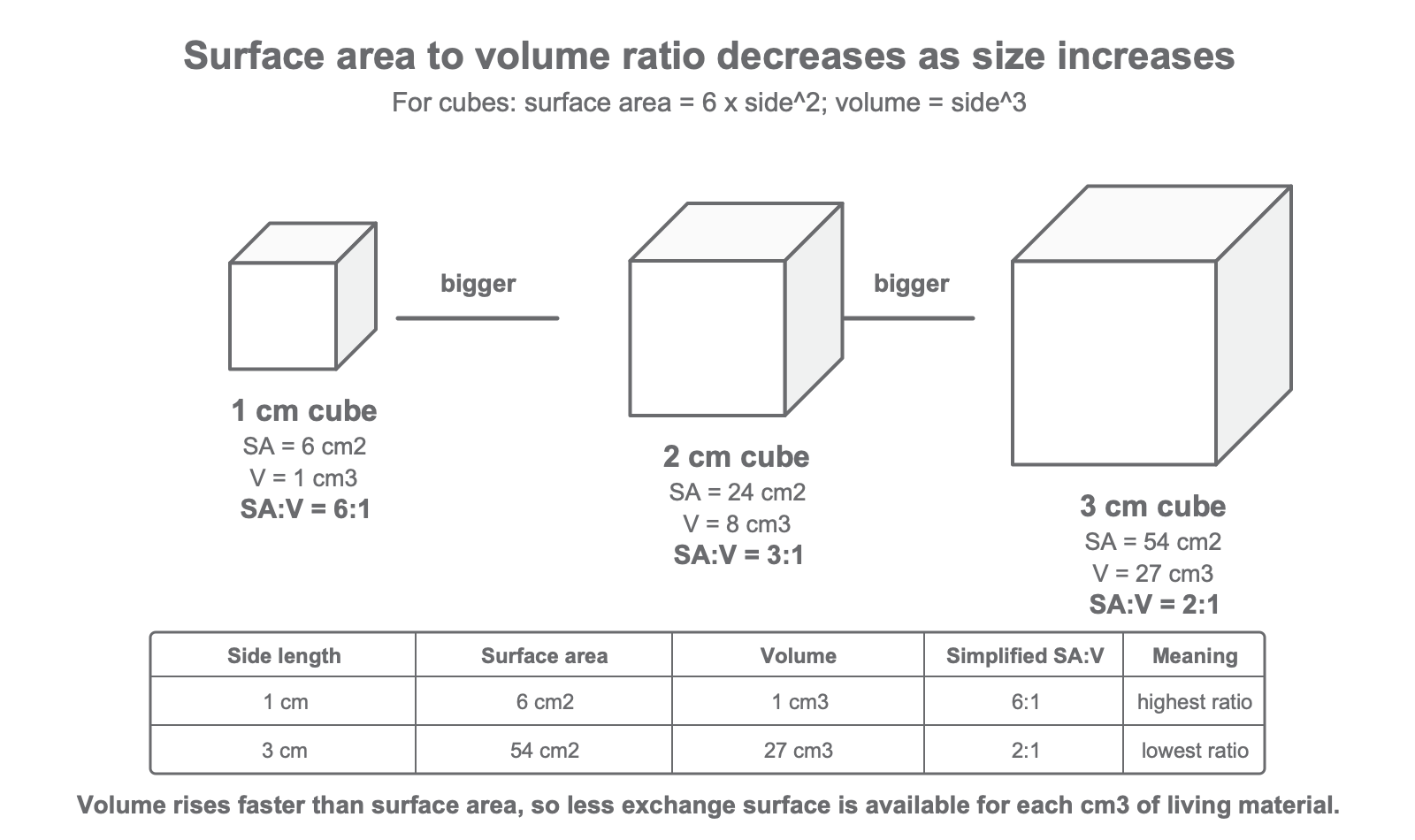
The key comparison is the trend. A 1 cm cube has a ratio of 6:1, a 2 cm cube has a ratio of 3:1, and a 3 cm cube has a ratio of 2:1. As the cube gets larger, the surface area to volume ratio decreases.
Why systems are needed
The surface area to volume ratio explains a major problem for multicellular organisms. Their volume represents many living cells that need oxygen, food molecules and water, and that produce carbon dioxide and other wastes. Their outer surface is not large enough, relative to that volume, for simple diffusion across the body surface to meet all those needs.
An exchange surface is a specialised surface where substances move between an organism and its environment, or between one part of the organism and another. A transport system carries substances between the exchange surface and cells elsewhere in the body.
Exchange surface
A specialised surface adapted for the movement of substances into or out of an organism.
In animals, the transport system is usually the blood. Blood brings useful substances to cells and carries waste products away. This keeps concentration gradients steep, so diffusion across exchange surfaces can continue at a high enough rate.
Plants also need transport pathways. Roots absorb water and mineral ions from the soil, while leaves exchange gases with the air. Transport tissues then move materials between roots, leaves and the rest of the plant.
That explanation is the core reasoning AQA is looking for: connect size to ratio, ratio to diffusion distance, and diffusion distance to the need for specialised systems.
Effective exchange surfaces
Different organisms have different exchange surfaces, but AQA expects the same core features.
A large surface area allows more particles to cross at the same time. A thin membrane gives a short diffusion path, so particles take less time to cross the surface. In animals, an efficient blood supply carries substances to and from the exchange surface, helping maintain a steep concentration gradient. For gaseous exchange in animals, ventilation moves fresh air or water over the surface, also maintaining the concentration gradient.
[DIAGRAM: asset_name: exchange-surface-features - diagram 2; asset_slug: 013_4_1_3_1b_surface_area_to_volume_ratio_and_exchange_surfaces_diagram2; file: diagram_assets/imagegen_regen_all/013_4_1_3_1b_surface_area_to_volume_ratio_and_exchange_surfaces_diagram2_imagegen.png; recommended_method: codex_image_gen; description: Monochrome feature map showing an effective exchange surface with four labelled adaptations: large surface area, thin membrane, efficient blood supply in animals, and ventilation for animal gas exchange, plus small example sketches of a villus, alveolus, fish gill, root hair and leaf stoma.]
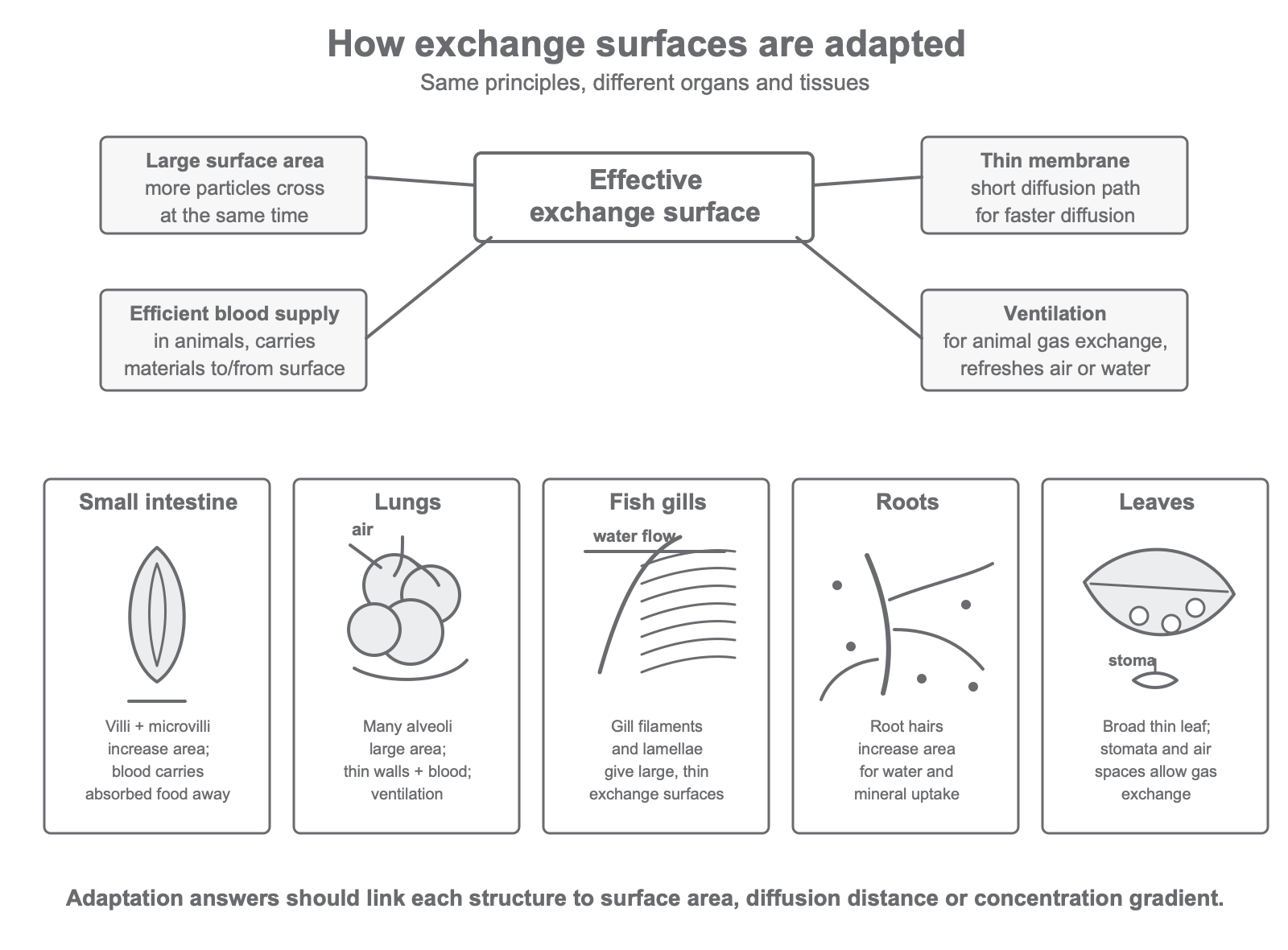
These features work together. For example, making a surface larger helps only if the molecules can also cross it easily and if the concentration gradient is maintained.
Efficient exchange surfaces maximise surface area, minimise diffusion distance and maintain steep concentration gradients.
When answering questions, name the feature and then state how it increases the rate of exchange.
Animal examples
The small intestine, lungs and fish gills are all animal exchange surfaces. They are not identical, because they exchange different substances in different environments, but the same principles appear again and again.
| Exchange surface | Main materials exchanged | Adaptations to explain |
|---|---|---|
| Small intestine | Digested soluble food molecules move into the blood | Villi and microvilli give a large surface area; the surface is thin; a rich blood supply carries absorbed molecules away |
| Lungs | Oxygen moves into the blood and carbon dioxide moves out | Many alveoli give a large surface area; alveolar walls are thin; capillaries give an efficient blood supply; ventilation refreshes the air |
| Fish gills | Oxygen moves from water into the blood and carbon dioxide moves out | Gill filaments and lamellae give a large surface area; surfaces are thin; blood flow carries gases away or towards the surface; water is moved over the gills |
For exam answers, link the adaptation to the effect. Do not just list "villi" or "alveoli". Say that they increase surface area, giving more area for diffusion or absorption.
Plant examples
Plants also need exchange surfaces. Roots are adapted for absorbing water and mineral ions from soil. Root hair cells have long extensions that increase surface area, so more material can be absorbed from the soil around the root.
Leaves are adapted for gas exchange. They are broad and thin, giving a large surface area and short diffusion distances. Stomata are pores that allow gases to move into and out of the leaf, and air spaces inside the leaf help gases reach photosynthesising cells.
Transport systems matter in plants too. Water and mineral ions absorbed by roots must move to leaves and other tissues, while sugars made in leaves must be moved to the rest of the plant. The detailed transport tissues are taught elsewhere; here, the important link is that exchange surfaces and transport pathways work together.
Common exam traps:
- Do not say a large organism has "less surface area" without comparing it with volume. The key phrase is
smaller surface area to volume ratio. - Do not say exchange surfaces "make diffusion happen". Diffusion happens because particles move down a concentration gradient; exchange surfaces make the rate high enough.
- Do not describe an adaptation without its effect. Link
large surface areato more particles crossing at once, andthin membraneto a short diffusion path.