4.1.2.3 - Stem Cells
Stem cells matter because they are not yet specialised. They can make more cells of the same type, and some of their cells can become specialised by differentiation. This lesson keeps the exam boundary clear: you need the functions, uses and evaluation points, not the detailed laboratory techniques.
What stem cells are
A stem cell is an undifferentiated cell. Undifferentiated means it has not yet become specialised for one particular function.
Stem cell
An undifferentiated cell of an organism that can give rise to many more cells of the same type, and from which certain other cells can arise by differentiation.
There are two ideas inside this definition. First, stem cells can produce more stem cells of the same type. Second, some of the cells they produce can differentiate into specialised cells. Differentiation is the process where a cell changes to become specialised for a particular function.
Do not write that stem cells are "empty" or "simple" cells. They are living cells with genetic material. The key point is that they are not yet fixed into one specialised job.
Animal stem cells
In human embryos, stem cells can be cloned and made to differentiate into most different types of human cell. This is useful because an early embryo is still at a stage where its cells have not all become locked into one specialised role.
In adult animals, stem cells are more limited. AQA names adult bone marrow as the key example. Stem cells from adult bone marrow can form many types of cell, including blood cells. That is why bone marrow is an animal example, not a plant example.
[DIAGRAM: asset_name: stem-cell-sources-and-fates - diagram 1; asset_slug: 011_4_1_2_3_stem_cells_diagram1; file: diagram_assets/imagegen_regen_all/011_4_1_2_3_stem_cells_diagram1_imagegen.png; recommended_method: codex_image_gen; description: Monochrome three-panel comparison of stem cell sources: human embryo stem cells differentiating into most human cell types, adult bone marrow stem cells forming many cell types including blood cells, and plant meristem stem cells forming any plant cell type throughout life. Includes a small warning that technique details are not required.]
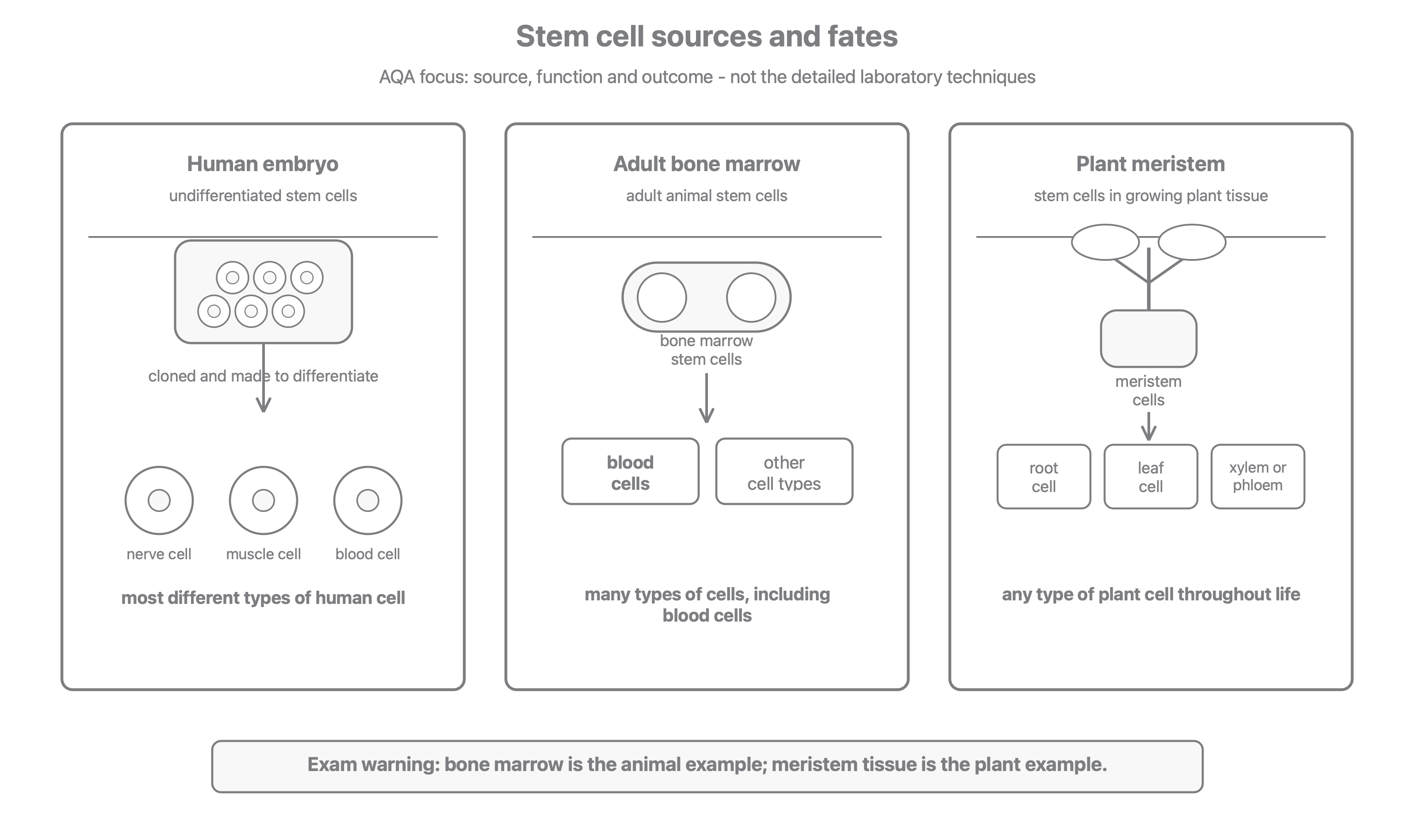
The exam often rewards careful comparison. Embryonic stem cells can become most different types of human cell. Adult bone marrow stem cells can form many types of cell, including blood cells, but they are not described as becoming almost any human cell type in this specification point.
Therapeutic cloning
Treatment with stem cells may be able to help conditions such as diabetes and paralysis. The idea is that stem cells could be used to produce specialised cells that replace or repair damaged cells.
In therapeutic cloning, an embryo is produced with the same genes as the patient. Stem cells from this embryo are not rejected by the patient's body, so they may be used for medical treatment.
[DIAGRAM: asset_name: therapeutic-cloning-principle - diagram 2; asset_slug: 011_4_1_2_3_stem_cells_diagram2; file: diagram_assets/imagegen_regen_all/011_4_1_2_3_stem_cells_diagram2_imagegen.png; recommended_method: codex_image_gen; description: Monochrome flowchart showing the principle of therapeutic cloning: patient genes, embryo with same genes as patient, stem cells differentiate into treatment cells, treatment cells returned to patient with lower rejection risk. No lab technique steps are shown.]
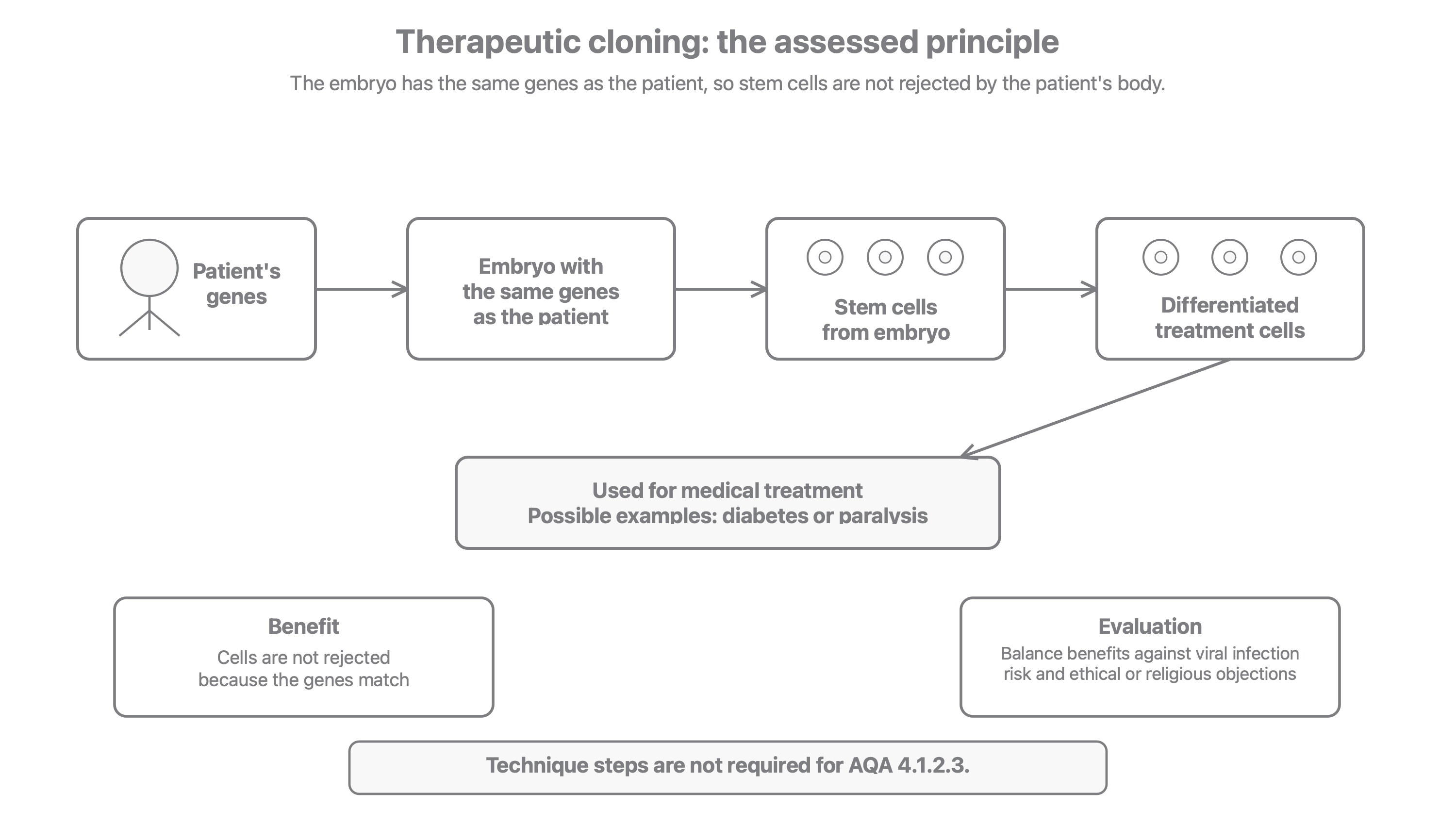
The important exam link is genetic similarity and rejection. If the cells have the same genes as the patient, the patient's immune system is less likely to recognise them as foreign. AQA does not require you to describe the detailed technique used to make the embryo.
Evaluating stem cell use
AQA expects you to evaluate practical risks and benefits, as well as social and ethical issues, of using stem cells in medical research and treatment. Evaluate means give a balanced judgement using more than one side of the argument.
| Possible benefit | Risk, concern or limitation |
|---|---|
| Stem cells may help treat conditions such as diabetes and paralysis. | Stem cell use has potential risks such as transfer of viral infection. |
| Therapeutic cloning can produce stem cells with the same genes as the patient. | Some people have ethical or religious objections to using human embryos. |
| Matching genes means the patient's body does not reject the cells. | Society still needs rules about consent, safety and acceptable use. |
An evaluation answer should not just list positives and negatives. It should connect them to a judgement. For example, a patient might benefit if stem cells replace damaged cells, but the treatment must be carefully controlled because viral infection and ethical objections are serious issues.
After practising an evaluation, check whether your answer has both biology and judgement. A list of opinions without stem-cell detail will not score well.
Plant meristems
Plants have stem cells in meristem tissue. Meristem tissue can differentiate into any type of plant cell throughout the life of the plant. This is different from adult bone marrow, which is the animal example.
Meristems are found in growing regions of plants, such as roots and shoots. The exact location is not the main focus here, but the tissue name matters: if AQA asks for the plant tissue containing stem cells, the answer is meristem tissue.
Stem cells from meristems can be used to produce clones of plants quickly and economically. A clone is genetically identical to the organism or cell it came from. Plant cloning can be useful because:
- rare species can be cloned to protect them from extinction
- crop plants with special features, such as disease resistance, can be cloned to produce large numbers of identical plants for farmers
You do not need to describe detailed plant tissue-culture techniques for this specification point. Keep the answer focused on meristems, clones and why identical plants can be useful.
Exam precision
This topic is small but mark schemes are precise. Learn the exact pairings:
| If the question says... | Strong answer |
|---|---|
| What is a stem cell? | An undifferentiated cell that can make more cells of the same type and give rise to specialised cells by differentiation. |
| Human embryo stem cells | Can be cloned and made to differentiate into most different types of human cell. |
| Adult animal stem cells | Adult bone marrow stem cells can form many types of cell, including blood cells. |
| Plant stem cells | Found in meristem tissue; can differentiate into any plant cell type throughout life. |
| Therapeutic cloning | Embryo has the same genes as the patient, so stem cells are not rejected. |
| Evaluation | Include benefits, practical risks, and social, ethical or religious issues. |
Three common traps are worth avoiding. Do not say that all adult animal stem cells can become any human cell type. Do not name bone marrow when the question asks for the plant tissue containing stem cells. Do not describe cloning techniques when the question only asks for benefits, risks or uses.
The highest-value words are undifferentiated, differentiation, bone marrow, meristem, same genes and not rejected.
Use those words in full sentences, and make sure each one is attached to the right source of stem cells.