PT6 - Solving problems in two dimensions
Turn measurements and directions into a clear two-dimensional model, then choose the triangles that reveal an unknown height, distance or bearing. You will combine familiar trigonometry and Pythagoras, use two lines of sight when a distance is inaccessible, and build a height model for a point travelling round a circle.
Combining a height with a sloping length
Will a cable reach the top of a mast from an anchor from its base? An observer from the base sees the top at elevation , with eyes above level ground. There is enough information, but it belongs to two different right-angled triangles.
You already know
In a right-angled triangle, use sine, cosine or tangent when an angle is involved, and Pythagoras when two sides are known. These ratios and Pythagoras are on the formulae sheet. Use the sine and cosine rules for triangles without a right angle.
A drawing translates the words into geometry. An angle of elevation is measured upwards from the observer's horizontal line, not from the ground beneath their feet. An angle of depression is measured downwards from a horizontal line. Parallel horizontals make a depression angle equal to the corresponding elevation angle at the other end of the same sightline.
[DIAGRAM: asset_name: Two triangles for a mast and its cable; asset_slug: two-d-height-cable; caption: The observation triangle finds height above eye level; the cable triangle uses the full mast height; description: A vertical mast with top T and base B stands on horizontal ground. Observer E is 24 metres to the left with eye height 1.6 metres. A dashed horizontal from E meets the mast at F and the elevation angle between EF and ET is 38 degrees. A ground anchor A is 15 metres to the right of B. The blue cable AT and full mast BT form a second right-angled triangle. Right-angle marks are at F and B.]
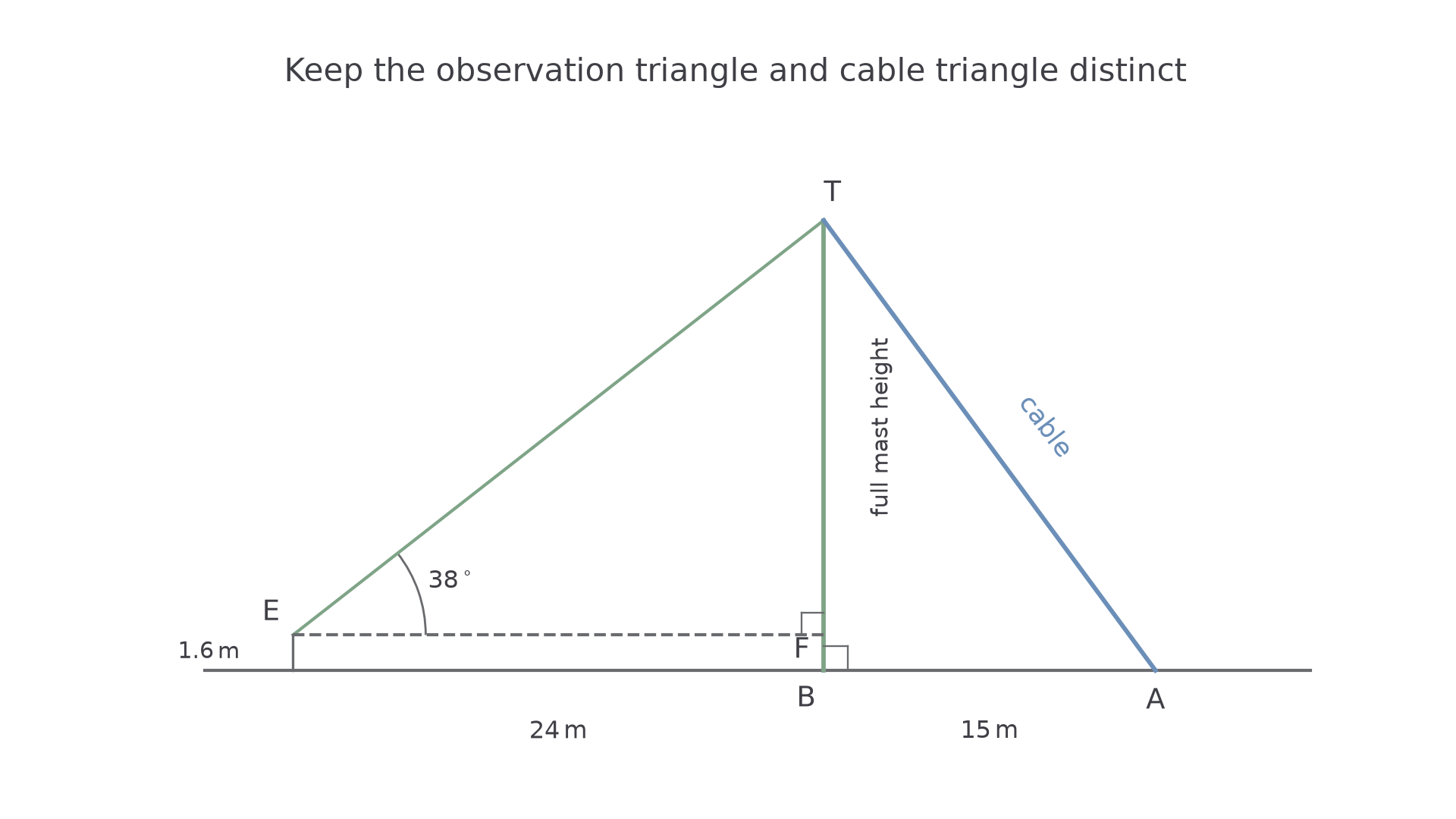
If the vertical difference is and horizontal separation is , tangent gives . Add the observer's height to obtain the full mast height. Pythagoras then gives the cable length from the full vertical and horizontal separations. The model treats the cable as straight and the ground as level.
Pythagoras for a sloping segment
Here and are perpendicular horizontal and vertical separations, and is the straight sloping distance. It is the hypotenuse, so take the positive root for a length.
On the formulae sheet.
Name the height you have just found before carrying it into the next triangle. That small habit prevents the eye-level height being mistaken for the full height.
Worked example 1: an observer on the ground
Question. Use the measurements in the opening question to find the mast height and required straight cable length, to 3 significant figures. Decide whether the cable is long enough.
Plan. Use tangent in the observation triangle, add eye height, then use Pythagoras in the cable triangle.
Why add before using Pythagoras? The cable starts at ground level; its vertical separation is the whole mast, not just the part above the observer's eyes.
Answer. The mast is high and the cable must span . A cable is too short, even before allowing for fixings.
Check. The required cable is longer than both and , as a hypotenuse must be.
The next example changes only the observer's height above the ground. Their horizontal distance and measured elevation remain the same, so the inferred mast is taller.
Worked example 2: an observer on a platform
Question. The observer's eyes are now above the mast's ground level, while horizontal separation is and elevation is . Find the inferred mast height and straight cable length to an anchor from the base. Give answers to 3 significant figures.
Plan. Keep the same observation triangle above eye level, but use the new eye height in the full-height calculation.
Why does the cable not increase by exactly ? The mast height increases by , but the cable is sloping. Pythagoras determines its change.
Answer. Mast height ; cable length .
Check. The new height is exactly greater before rounding, while the cable length rises by about .
A perspective sketch does not prove a right angle; the model's vertical mast and horizontal ground do. Mark those facts explicitly.
Watch out
Wrong: , ignoring eye height. That expression finds . Right: for the first observer.
Now try the complete chain with new measurements.
Finding a height from two lines of sight
Two observations can reveal both a height and an unknown distance when you cannot walk to the base.
Suppose two points and lie on the same horizontal line as a tower base , with between and . The angles of elevation of top are from and the larger angle from . Write , and . The farther horizontal distance is , not .
[DIAGRAM: asset_name: Two observations share one height; asset_slug: two-d-two-sightlines; caption: The two right-angled triangles share height h and have horizontal distances x and x plus d; description: P, Q and B lie in that order on a horizontal baseline, with a vertical tower BT at B. PQ is marked d and QB is marked x. Sightlines PT and QT form angles alpha and beta with the rightward horizontal, beta greater than alpha. The full height BT is h and a right-angle mark appears at B. The larger observation triangle contains the smaller.]
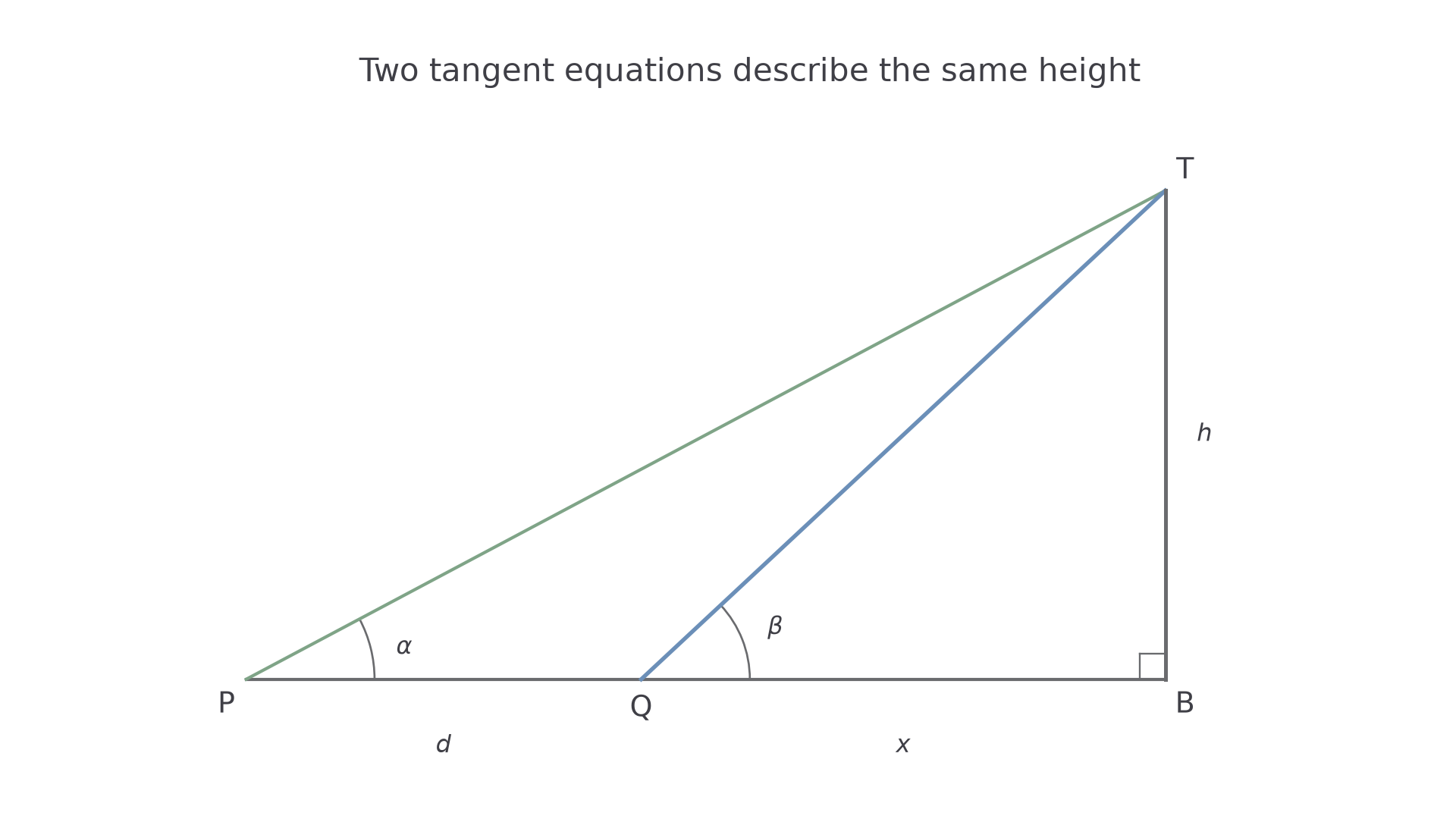
Write one tangent equation for each triangle, then equate the two expressions for the same . This derives the distance from the diagram; it does not need another memorised formula. The resulting two-observation relationship is not on the formulae sheet: derive it.
Worked example 3: an inaccessible base
Question. Points and are apart on level ground, in line with a vertical tower's base . Point is nearer the tower and lies between and . Elevations of the top are from and from , measured at ground level. Find and the tower height, to 3 significant figures.
Plan. Call , write the height using each tangent ratio, and solve the resulting linear equation.
Why use in the farther triangle? The given joins the observers; it does not reach the tower base.
Answer. and tower height .
Check. The farther-triangle calculation gives , the same unrounded height.
The next example changes only the nearer elevation to . A steeper near sightline changes both inferred unknowns.
Worked example 4: a steeper near sightline
Question. Keep the same layout, and the far elevation , but let the near elevation be . Find and tower height to 3 significant figures.
Plan. Equate the two new expressions for the shared height, then substitute back.
Why does the denominator stay positive? The nearer elevation is larger, so its tangent is larger for these acute angles. A negative distance would signal a wrong layout or sign.
Answer. and height .
Check. , confirming the far observation too.
If the observers stand on opposite sides of the tower, the distance between them is a sum of the two distances to the base. Draw that layout afresh instead of reusing . If their eyes are at the same non-zero height, both equations find the height above that common eye level; add the eye height afterwards.
Watch out
Wrong: in the first example. The is not adjacent to the elevation in a triangle reaching the tower. Right: use and the second observation to find .
Set up both triangles for a different pair of observations.
Turning bearings into triangle angles
Bearings describe directions from north; a triangle rule needs the interior angle between its own sides.
Bearing
A bearing is an angle measured clockwise from north, normally written with three digits to the nearest degree. For example, means east of north. A turn measured from east is not a bearing.
Draw parallel north lines at each location. Reversing a direction changes its bearing by , reduced to the range . This bearing relationship is not on the formulae sheet: learn it. If a journey goes from to , then to , the angle at is between and , so reverse the first bearing before comparing directions.
Continue this lesson.
You’re previewing NovaLearn without an account. Create a free account to read the rest.
Create free account