AL6 - Setting up equations in one unknown
An equation turns a condition in a problem into something you can solve. You will choose one unknown, build linear, quadratic and cubic equations, and handle equations containing algebraic fractions. The final step is always to decide which mathematical solutions answer the original question.
Turning a condition into a linear equation
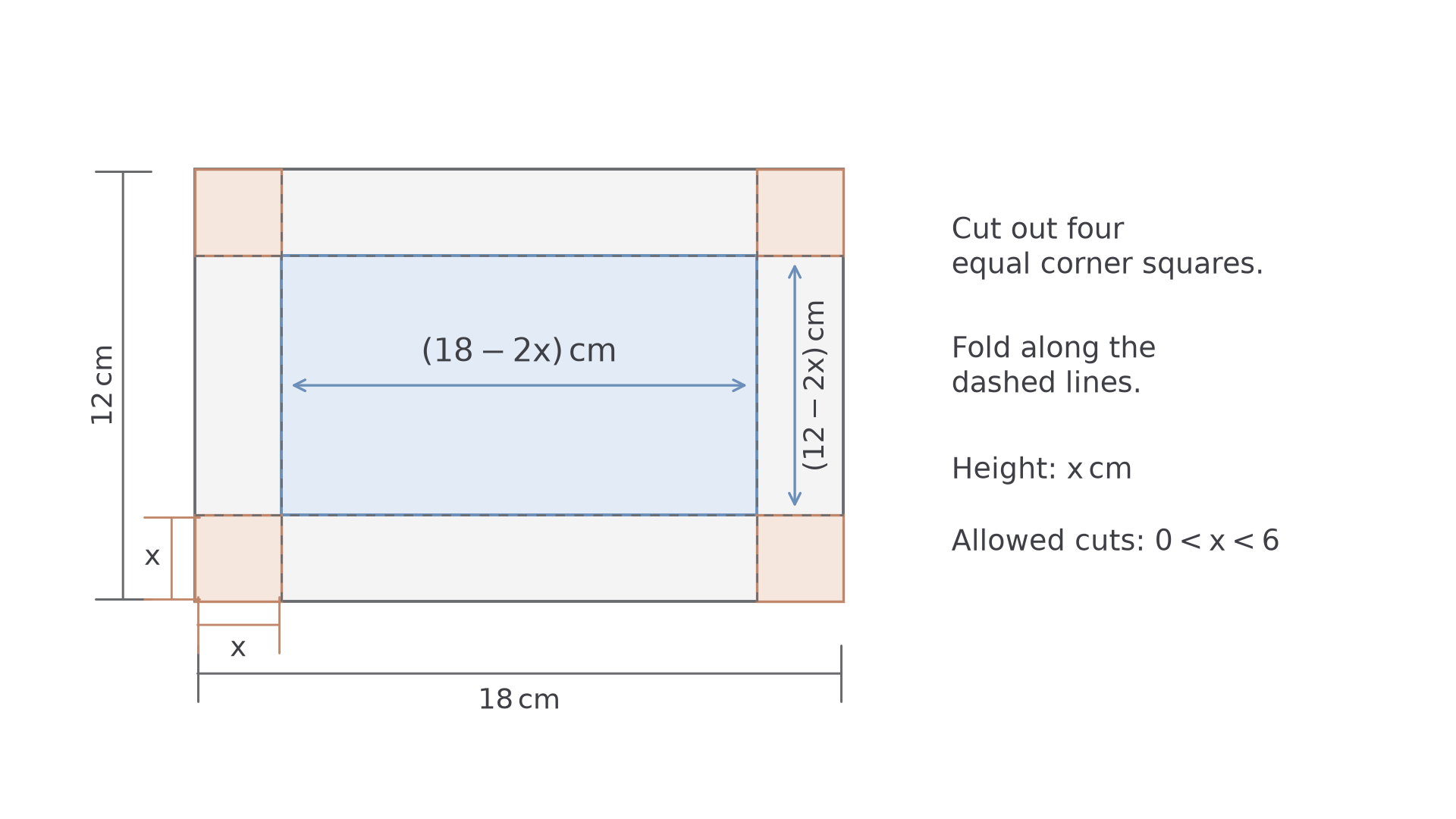
Cut equal squares from the corners of an by card, then fold up the sides to make an open box. Can two different cuts both give a volume of ? We will return to that puzzle after practising how a sentence becomes an equation.
You already know
An unknown is a quantity to find. An equation states that two expressions are equal; solving it means finding the inputs for which that equality holds. Expand brackets and collect terms, keeping the equation balanced by applying the same operation to both sides.
Begin by defining the unknown with its units. Write an expression for each quantity in the condition, then connect them with an equals sign. In a linear equation the unknown appears only to the first power after simplification. Its solution may be positive, negative or zero mathematically, but the context may permit only some of those values.
For a tank starting with litres and gaining litres each minute, the amount after minutes is litres. The starting amount appears once; the rate is multiplied by the elapsed time. This constant-rate model is not on the formulae sheet: form it from the stated quantities.
Worked example 1: reaching a fixed amount
Question. A tank initially contains litres. Water enters at litres per minute. Determine when the tank contains litres.
Plan. Let be the number of minutes and equate the amount in the tank to .
Why multiply by ? Four litres arrive in every minute, so minutes supply litres. The units are litres on both sides.
Answer. After minutes.
Check. litres; the time is positive as required.
Now change one feature: the target amount also changes with time. A second tank starts with litres and loses litre per minute.
Worked example 2: two changing amounts
Question. Tank A starts with litres and gains litres per minute. Tank B starts with litres and loses litre per minute. Determine when the amounts are equal.
Plan. Use the same elapsed time for both tanks and equate their amounts.
Why use only one unknown? Once the elapsed time is chosen, both amounts are determined. Their different starting amounts do not require different time variables.
Answer. After minutes.
Check. Tank A contains litres, and tank B contains litres. Neither tank is empty.
An equation with the unknown on both sides is still linear if both expressions contain only constants and first powers.
Watch out
Wrong: for a tank losing water. The positive sign describes a gain. Right: use . Decide what each term means before rearranging; correct algebra cannot rescue a model with the wrong sign.
Set up the same type of comparison with new rates.
Quadratic equations and admissible roots
Multiplying two lengths that both depend on the unknown often creates a quadratic equation.
For a rectangle of width and length , its area is , not . The rectangle's area rule follows from multiplying its side lengths; it is not separately printed on the formulae sheet: learn it. Because represents a length, only is permitted here.
Once the equation is in the form , choose a method that suits the coefficients:
| Form of the equation | Useful approach |
|---|---|
| Clear integer factors | Factorise, then set each factor equal to zero |
| A completed square is easy to form or already given | Isolate the square and take both square roots |
| No convenient factorisation | Use the quadratic formula |
The zero-product rule says that a product equals zero only if at least one factor is zero. It is not on the formulae sheet: learn it. Also remember that , for , gives both and . A negative gives no real solution.
Quadratic formula
For , with , there are real solutions when . Keep both signs before checking the context.
On the formulae sheet.
Do the algebra for all roots first; use the physical meaning to select the admissible ones afterwards.
Worked example 3: an area equation that factorises
Question. A rectangle has length greater than its width and area . Determine its dimensions.
Plan. Let the width be , form the area equation, solve it and keep the positive width.
Why reject ? It solves the algebraic equation but cannot represent a physical width. The permitted root is , so the length is .
Answer. Width , length .
Check. and , satisfying both conditions.
Now change only the area to . There are no integer factors, so use a method that keeps the roots exact.
Worked example 4: exact dimensions from the formula
Question. A rectangle has length greater than its width and area . Determine its exact dimensions.
Plan. Form the same area equation with the new area, then use the quadratic formula.
Why retain the root containing ? Since , , making this width positive. The other root is negative.
Answer. Width , length .
Check. Their product is , and their difference is .
For a purely mathematical equation, a negative root may be perfectly valid. Reject a root only for a stated restriction or a clear contextual reason, such as a negative length or an undefined original fraction.
Watch out
Wrong: from , cancelling and reporting only as the algebraic solution. The cancelled factor could itself be zero. Right: find both roots first, then explain why the context excludes one.
Use either completing the square or the quadratic formula to find the next exact dimensions.
Equations containing algebraic fractions
Clearing denominators turns a fraction equation into a polynomial equation, provided you first exclude inputs that make an original denominator zero.
For , exclude and . Multiplying by is then reversible, because that multiplier is non-zero on the permitted inputs. It removes all denominators at once. Alternatively, combine the left-hand fractions first. Both routes must lead to the same polynomial equation.
A fraction equal to zero
The denominator cannot be zero. A fraction is zero because its numerator is zero, not because its numerator and denominator are equal.
Not on the formulae sheet: learn it.
This is why you return to the original restrictions after solving. Clearing denominators can produce candidates that the original equation never allowed.
Worked example 5: clearing three denominators
Question. In this question you must show detailed reasoning. Solve .
Plan. Exclude and , multiply every term by , then solve and check the resulting quadratic.
Why does the second numerator become ? The original loses its denominator , leaving the multiplier's other factors, with its minus sign still attached.
Answer. or .
Check. At , . At , . Neither input is excluded.
Now change only the sign of the right-hand side. The same denominator work produces a quadratic with no real root, which is a possible outcome rather than an algebraic failure.
Worked example 6: a fraction equation with no real solution
Question. Solve for real .
Plan. Clear the denominators as before, then complete the square to decide whether real roots exist.
Why does this end the calculation? A real square cannot be negative, so no real input can satisfy the transformed equation.
Answer. No real solution.
Check. The quadratic formula gives , confirming that there are no real roots.
In a word problem, take one extra step before this algebra: express the fractions from the quantities. For example, travelling at takes hours. “The slower trip takes one hour longer” translates into slower time minus faster time equal to . The GCSE relationship time equals distance divided by speed is not on the formulae sheet: learn it.
Watch out
Wrong: , therefore . Equality of top and bottom would make the fraction . Right: set , giving , and check that . OCR reports this numerator-equals-denominator error in fraction equations.
Write the complete denominator-clearing line before expanding in the next detailed reasoning question.
Cubic equations from volumes
Multiplying three lengths that depend on one unknown can create a cubic equation, and the context decides which of its roots describe real objects.
The general rule, volume of a prism equals cross-sectional area times length, is on the formulae sheet. For a cuboid, applying it to a rectangular cross-section gives : multiply the three perpendicular dimensions. This cuboid form is an application of the given rule, rather than a separately printed formula. Write each dimension as an expression in the same unknown, and state the range that makes every length positive.
To solve the resulting cubic, use the factor theorem and division to obtain a linear factor times a quadratic. Solve both factors when possible. No general cubic-solving formula is needed or supplied on the formulae sheet.
Worked example 7: three increasing dimensions
Question. A cuboid has dimensions , and . Its volume is . Determine its dimensions.
Plan. Form the volume equation with , find an integer root, and factorise to check for any further real roots.
The quadratic factor is , which is positive for every real . It gives no additional real solution.
Why examine the quotient? Finding one root does not prove it is the only root. Here the positive completed square rules out every other real candidate.
Answer. , giving dimensions , and .
Check. , and the dimensions have the stated differences.
Now change the way the dimensions depend on : cutting and folding makes two dimensions decrease as the height increases. This is why the opening puzzle can have more than one physically valid answer.
[DIAGRAM: asset_name: Cutting a card to form a box; asset_slug: cut-card-box-model; caption: Cutting squares of side x leaves base dimensions 18 minus 2x and 12 minus 2x; description: A flat 18 cm by 12 cm rectangle has a square of side x marked in clay at every corner and a pale blue central base rectangle. Dashed fold lines separate the base from the four side panels. The central base is labelled 18 minus 2x horizontally and 12 minus 2x vertically. External dimension arrows label 18 cm and 12 cm. One corner carries two separate x dimension labels. Text states that folding makes the height x and requires 0 less than x less than 6.]
Worked example 8: two boxes with the same volume
Question. Squares of side are cut from each corner of an by card. The sides are folded up to make an open box of volume . Determine all possible values of .
Plan. Use height , base dimensions and , and restrict so all lengths are positive.
Why subtract from each card dimension? A square is cut from both ends of that dimension. Subtracting only would leave a base too large.
Answer. The algebraic roots are , and . Only and lie between and , so these are the two possible cuts.
Check. A cut gives volume . A cut gives . A cut would give negative base dimensions and cannot form this box.
The opening puzzle is answered: the taller box can have the same volume because its base is smaller. An algebraic model keeps both effects in the same equation and finds both possibilities.
Watch out
Wrong: for the cut-card box. Each base dimension loses a square at both ends. Right: , with . A root outside that range cannot describe the box, even if it satisfies the cubic.
The model and its restrictions work together: one translates the volume, and the other describes which algebraic inputs the construction permits.
Problem-solving
State the unknown and its restrictions before expanding. After solving, return to the original lengths, times or denominators; a root answers the equation, but it answers the problem only if those quantities are valid.
Use the same cut-card model with a smaller card. Find every permitted cut, rather than stopping at the first successful root.
Quick Recap
- Define one unknown, including its units, and translate the condition into an equation before rearranging.
- Solve quadratics by factorising, completing the square or using the quadratic formula; keep exact roots when asked.
- Exclude zero denominators before clearing fractions, then check every candidate in the original equation.
- A volume model can produce a cubic. Find a factor, divide, solve the remaining quadratic and apply the contextual restrictions.
The opening box has two valid cut sizes: and , both giving exactly .