AL10, AL11 - Recurrence relationships and modelling
Describe a sequence by telling each term how to make the next one. AL10 develops recurrence notation, including rules that use two earlier terms; AL11 turns repeated changes in balances and other quantities into mathematical models. You will see why the timing of a payment can matter as much as its size.
Making the next term
Two savings plans both add £100 a year and pay annual interest. One adds the money before interest; the other adds it afterwards. Starting with the same balance, will they give the same result? A recurrence relationship will make the order of events impossible to miss.
Begin with a simpler sequence: . Each term is more than the previous one. If means the term in position , we write , together with the starting value .
Recurrence relationship
A recurrence relationship defines a term using one or more earlier terms. It needs enough initial values to start the sequence. For example, , for positive integers , determines the sequence . The rule alone does not determine its starting value.
The subscript is a position label, not a multiplication. In , the advances one position; it does not add to the value. By contrast, really does add to the current value. Recurrence notation and the rules in this part are not on the formulae sheet: learn how to use them.
Worked example 1: adding a fixed amount
Question. Given and , determine .
Plan. Use the rule successively for , recording the subscript at every step.
Why three steps? is already the first term. Three updates take it to the fourth term.
Answer. .
Check. Starting at , three additions of give .
The second example changes only the update operation: multiply by instead of adding . The index still advances by just one at each step.
Worked example 2: multiplying by a fixed amount
Question. Given and , determine .
Plan. Double each new value to obtain the following term.
Why use the new value each time? The rule acts on the immediately previous term, so growth compounds rather than repeatedly doubling the original .
Answer. .
Check. Three doublings give .
A rule can also combine operations, such as , or use a negative multiplier. Read and apply the complete right-hand side at each update.
Watch out
Wrong: means , . The subscript does not replace the multiplier. Right: .
Now keep multiplication but change the sign of the multiplier. Track the alternating signs.
Rules using two earlier terms
Some sequences need two pieces of memory: the next term uses both of the previous two terms.
For , knowing only is not enough to calculate : you also need . Once both are supplied, make the third term from the first two, the fourth from the second and third, and so on. Keep a small table or write each substitution. This is safer than trying to remember two changing calculator values.
Initial values
Initial values are the specified terms that start a recurrence. A rule using the previous two terms generally needs two initial values. For example, and start ; alone leaves many possible sequences.
The displayed recurrence is a rule supplied by the problem; it is not on the formulae sheet. Its indices tell you exactly which values to use.
Worked example 3: adding the previous two terms
Question. A sequence satisfies , and . Determine .
Plan. Find , then shift the pair of inputs forward for each new term.
Why not use again for ? Increasing shifts every subscript. The input pair moves from to .
Answer. .
Check. The terms each satisfy the stated sum rule after the first two.
The next example changes one feature: the older of the two input terms is doubled. Its coefficient belongs to that older term throughout.
Worked example 4: a weighted two-term rule
Question. Given , and , determine .
Plan. At each step, double the older input and add the newer one.
Why write the subscripts? The related rule would give different terms: doubling the wrong input changes the sequence.
Answer. .
Check. With , the original rule gives .
A calculator is useful for arithmetic, but a single ANS value does not by itself hold both required earlier terms. Written substitutions make the recurrence visible.
Watch out
Wrong: from , write . This doubles the newer input. Right: use throughout, giving .
Writing the full intermediate terms also makes your method available for credit.
Exam tip
For a two-term recurrence, show the intervening terms even when only the fifth term is asked for. OCR's schemes can award separate marks for correctly determined intermediate terms, and the written indices help prevent using the wrong pair.
The next rule doubles the newer term instead; read its indices before calculating.
Modelling a repeated percentage change
A percentage change acts on the current amount, so its natural recurrence multiplies the previous term.
You already know
From GCSE, a increase uses multiplier , while a decrease uses . The multiplier represents the whole new amount, rather than just the amount gained or lost.
A increase retains , giving multiplier . A decrease retains , giving multiplier . Define what the subscript counts: if is the balance after complete years, is the starting balance, before any interest is added.
A fixed percentage update
Here is the signed percentage change per period: positive for an increase and negative for a decrease. The model assumes the same rate applies at every update.
Not on the formulae sheet: learn it.
Repeated multiplication gives the familiar compound-interest expression. The sheet supplies this direct formula, but you still need to translate a situation into its recurrence.
Compound interest
Here is the initial principal, is the percentage interest rate per compounding period and is the number of completed periods. No money is paid in or taken out.
On the formulae sheet.
The two expressions describe the same repeated process: one makes the next value, the other jumps directly to a chosen period.
Worked example 5: a growing balance
Question. £5000 is invested at annual compound interest. Write a recurrence for the balance , in pounds, after years and calculate .
Plan. Start at and multiply the current balance by each year.
Why not add £200 each year? Only the first year's interest is of £5000. Later interest is calculated on a larger balance.
Answer. , , and the balance after three years is £5624.32.
Check. The formulae-sheet expression gives .
The second example changes growth into a percentage decrease. The multiplier must now be less than .
Worked example 6: a reducing value
Question. A machine is initially worth £8000 and loses of its current value each year. Write a recurrence for its value after years and find .
Plan. Retain of the current value at each update.
Why , rather than ? is the amount lost. is the amount remaining.
Answer. , , and : £4913.
Check. , and the values decrease while remaining positive.
This model assumes a constant annual percentage loss. A real machine might have a resale floor or a different rate in its first year; a recurrence is only as useful as its assumptions.
Watch out
Wrong: a decrease gives . That keeps only . Right: , keeping .
Use that retained percentage in the next model, keeping intermediate values unrounded.
Combining a change with a payment
When a fixed amount is added as well as a percentage change, the order of those events determines the recurrence.
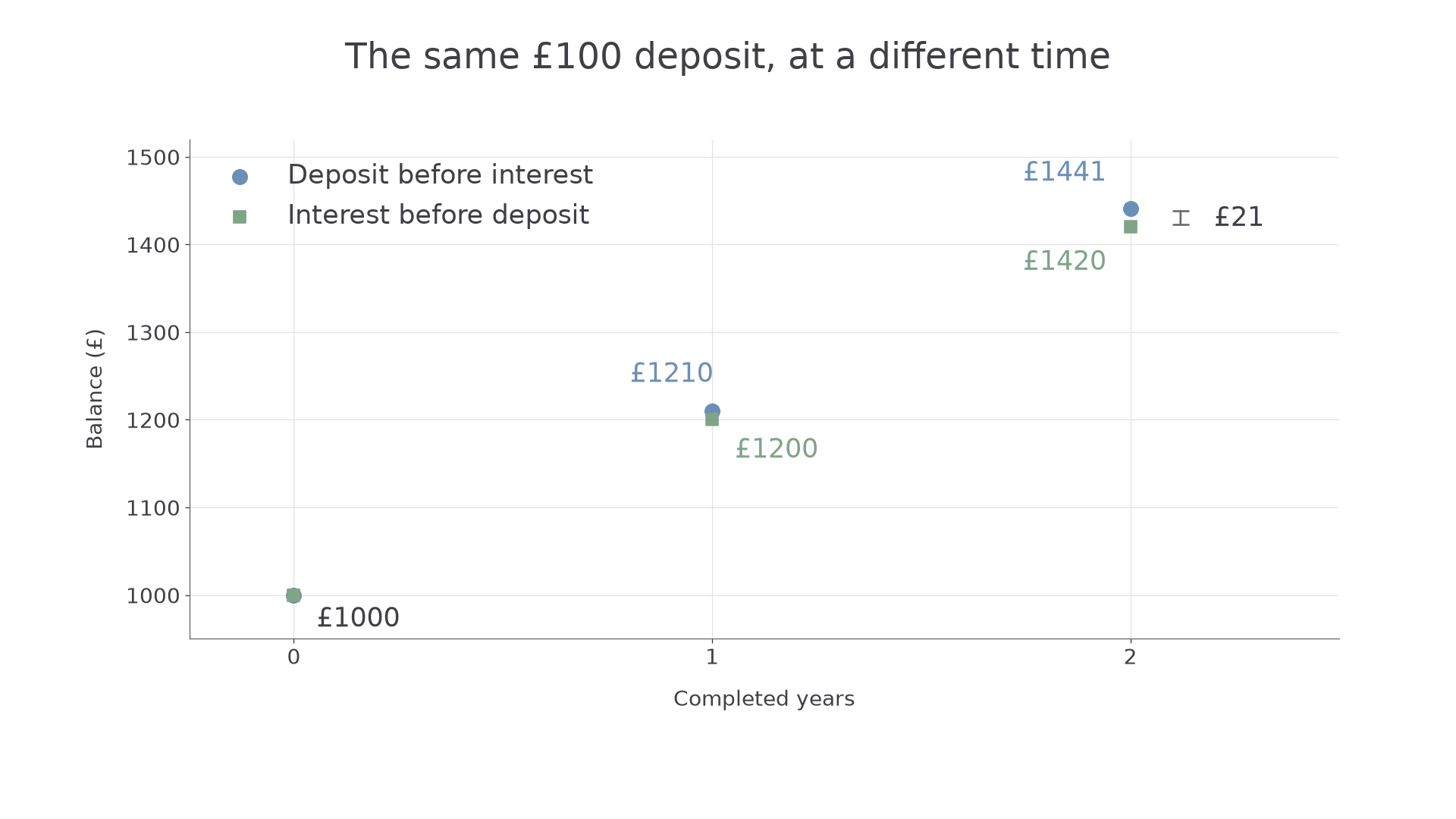
Suppose the balance at the start of a year is £1000. Adding £100 and then applying interest gives . Applying interest first and adding £100 afterwards gives . The extra £10 is the interest earned by the early £100 deposit.
This model assumes a fixed interest rate. Define the time at which each is measured before you write a rule.
Worked example 7: interest followed by a deposit
Question. A balance starts at £1000. At each year end, interest is added, then £100 is deposited. Let be the balance just after deposit number , with . Form a recurrence and find .
Plan. Multiply the previous balance by , then add .
Why is outside the multiplication? The new deposit arrives after that year's interest has been calculated, so it earns no interest in that update.
Answer. , , and : £1420.
Check. The second year starts with £1200, earns £120 interest and receives £100, giving £1420.
The final example changes only the timing: the same deposit is made before interest. Put the deposit inside the brackets.
Worked example 8: a deposit followed by interest
Question. Starting from £1000, £100 is deposited at the start of each year, then interest is added at year end. Let be the balance at the end of year , with . Form a recurrence and find .
Plan. Add to the previous year-end balance, then multiply the whole amount by .
Why the brackets? Both the old balance and the new £100 earn interest during the year.
Answer. , , and : £1441.
Check. The second year starts after the deposit with £1310; interest is £131, giving £1441.
The opening plans are therefore different: after two updates, the early-deposit plan has £21 more. Its first extra £10 has itself earned £1, and the second early deposit earns another £10. Small timing differences can compound too.
[DIAGRAM: asset_name: Deposit timing changes the balance; asset_slug: recurrence-deposit-timing; caption: Deposits made before interest earn interest one year earlier; description: Discrete year-end balances for years zero, one and two. Blue points for deposit before interest are 1000, 1210 and 1441 pounds. Sage points for interest before deposit are 1000, 1200 and 1420 pounds. The year-two difference is labelled 21 pounds; points are not joined by continuous growth curves.]
The same modelling idea handles a withdrawal, with a minus sign, or a quantity partly retained and then topped up. For example, if a tank retains of its water and then receives , its volume follows . Starting at , it stays at , because : a changing process can have an unchanged balance. These combined-update recurrences are not on the formulae sheet; form them from the stated sequence of events.
Watch out
Wrong: use for interest followed by a deposit. That pays interest on money that has not yet arrived. Right: follow the events in order, giving .
Use the same timing decision with a top-up followed by a loss: the incoming water is included in the amount to which the percentage applies.
Quick Recap
- A recurrence makes new terms from earlier terms; provide the initial values and keep the position subscripts distinct from the term values.
- A rule using two earlier terms needs both starting values; move the input pair forward at each step.
- Repeated percentage changes multiply the current amount; define whether the initial value is labelled with subscript or .
- In a combined update, follow the events in order. A constant-rate model assumes those rules remain valid.
The opening plans give £1420 and £1441 after two years. Depositing before interest earns interest on each new payment one year earlier.