PT6 - Solving problems in three dimensions
Find lengths and angles in solids by identifying the two-dimensional triangles inside them. You will use horizontal projections to measure a line's inclination, handle observers at different heights, and explain why the line straight up a sloping plane is steeper than a diagonal route across it.
Finding the right triangles inside a solid
A hillside rises over a horizontal distance of . If you walk diagonally across it instead of straight up, do you meet the same slope angle? Both routes reach the same height, but their inclinations differ. We will use the triangles inside the hill to explain why.
You already know
Pythagoras applies to a right-angled triangle, and the trigonometric ratios connect its angles and sides. These are on the formulae sheet. A perspective drawing can distort angles; use the stated geometry to identify a true right angle.
Start with a cuboid. Its base is a horizontal rectangle and lies vertically above . The base diagonal belongs to the rectangle. The space diagonal then belongs to triangle , which is right-angled at , because a vertical edge is perpendicular to the horizontal base.
[DIAGRAM: asset_name: Two right triangles inside a cuboid; asset_slug: three-d-cuboid-diagonal; caption: First use the base triangle ABC, then the vertical triangle ACG; description: An accurately projected cuboid has rectangular base ABCD with AB 8 metres, BC 5 metres and vertical CG 4 metres. The top vertices E, F, G and H are above A, B, C and D respectively. Base diagonal AC is sage and space diagonal AG is blue. A small marked point M lies on AB with AM 2 metres for the second example. Hidden base edges are dashed.]
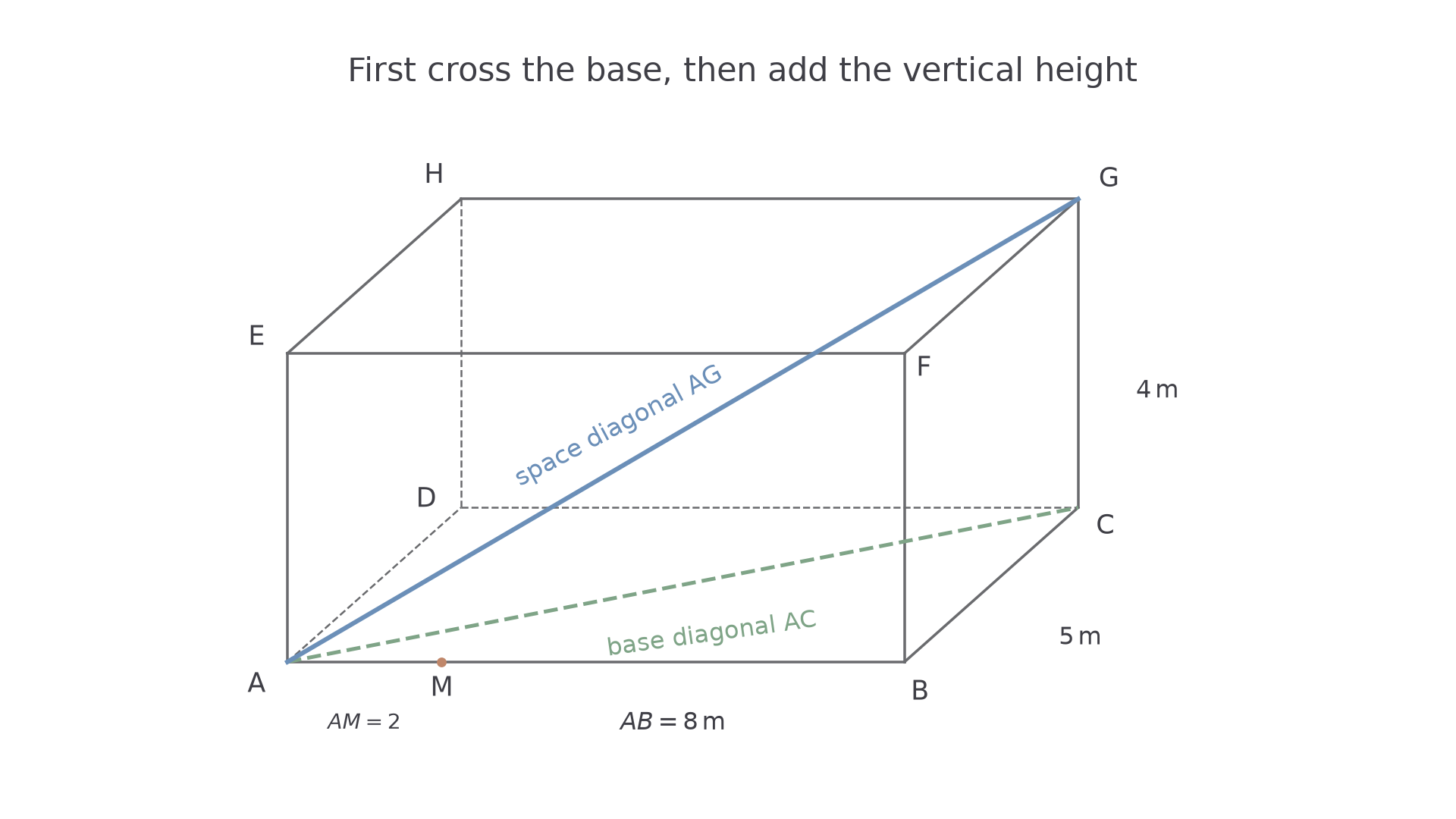
Redraw each selected triangle flat if the solid is hard to read. A face diagonal, such as , stays in one face; a space diagonal, such as , joins opposite vertices through the interior. A straight segment is not automatically a space diagonal merely because it slopes on the page.
Space diagonal of a cuboid
Here , and are the three mutually perpendicular edge lengths. First the base diagonal has square , then Pythagoras adds . Pythagoras is supplied, but this three-length result is derived from it.
Not on the formulae sheet: learn it.
For a point partway along an edge, build the base triangle from the remaining horizontal distances. The three full cuboid edges no longer describe that segment.
Worked example 1: the space diagonal
Question. A cuboid has horizontal base , with , and vertically above . Find and , giving exact answers and values to 3 significant figures.
Plan. Apply Pythagoras in the base triangle , then in vertical triangle .
Why use in the second triangle? It joins the ground point directly to the foot of , so and are the perpendicular horizontal and vertical parts of .
Answer. ; .
Check. , and the space diagonal is longer than the base diagonal.
The next example changes only the starting point from to a point on the edge. Find its horizontal projection before using the height.
Worked example 2: starting partway along an edge
Question. In the same cuboid, lies on with . Find and , exactly and to 3 significant figures.
Plan. Find the remaining edge length , then use Pythagoras in and .
Why use , not , with side ? The right-angled base triangle reaches through . Its side along is , not .
Answer. ; .
Check. Moving towards shortens the horizontal run to , so both lengths are smaller than those from .
The solid has not introduced a new form of trigonometry. Its main demand is choosing the correct ordinary triangles.
Watch out
Wrong: . This omits the cuboid's width and finds a diagonal of a different face. Right: include the base diagonal, giving .
Try a new point on a different cuboid's edge. Keep the remaining edge length distinct from the stated one.
Finding the angle between a line and a plane
A line's angle with a plane is measured against its projection onto that plane, so finding the correct horizontal run is essential.
Projection and line-plane angle
The perpendicular projection of a point onto a plane is the foot of its perpendicular to the plane. Projecting the endpoints of an oblique segment gives its projected segment. The angle between an oblique line and a plane is the acute angle between the line and this projection. A line parallel to or lying in the plane has angle ; a perpendicular line has angle .
In the cuboid, projects vertically onto , while and already lie in the base. So projects onto , and projects onto . The required angles are and , at the starting points in the plane. An angle against a vertical edge is the complementary angle, a different quantity.
[DIAGRAM: asset_name: Project a line onto the base before measuring its angle; asset_slug: three-d-line-plane; caption: The inclination of MG to the base is angle GMC, measured between MG and its horizontal projection MC; description: Left, the cuboid with base 8 by 5 metres and vertical height 4 metres has M on AB, 2 metres from A. MG is blue and its base projection MC is sage, with G vertically above C. Right, the same vertical triangle MCG is redrawn flat, right-angled at C, with MC root 61 metres, CG 4 metres and the acute angle theta at M. The angle between MG and vertical CG at G is not labelled as theta.]
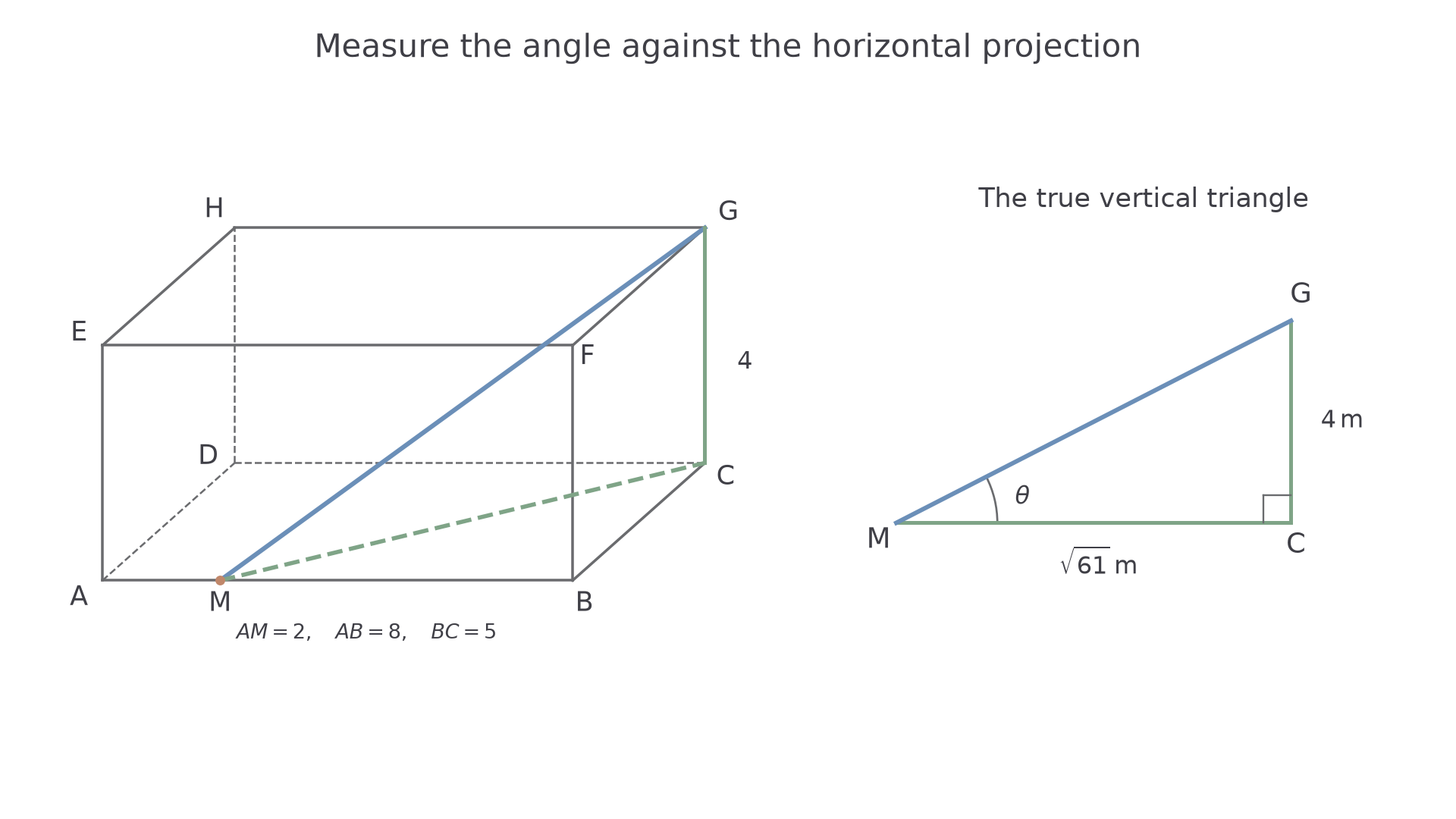
Once the correct vertical triangle is isolated, use the familiar tangent ratio.
Inclination from a right-angled triangle
Here is perpendicular height above the plane, is the length of the projection and is the angle between the segment and the plane. This is the supplied opposite-over-adjacent ratio applied to the selected triangle.
On the formulae sheet.
Do not use a cuboid edge as the adjacent side merely because it looks horizontal on the page. The projection must join the actual start to the perpendicular foot of the other endpoint.
Worked example 3: inclination of a space diagonal
Question. For the cuboid with , and vertical , find the angle between and the base, to 1 decimal place.
Plan. Project onto , find the base diagonal and use tangent in .
Why is the angle at ? Both the sloping line and its projection start there.
Answer. .
Check. Using sine instead gives , which gives the same angle. The angle to the vertical at is , not the required inclination.
The next example changes only the starting point to , as in Worked example 2. The height is unchanged, but the projection is shorter.
Worked example 4: inclination from an edge point
Question. In the same cuboid, . Find the angle between and the base, to 1 decimal place.
Plan. Use the projection , then measure in its vertical triangle.
Why is the new angle greater? The same vertical rise is achieved over a smaller horizontal distance, so the slope is steeper.
Answer. .
Check. gives the same result, and agrees with the shorter projection.
A labelled small triangle is often the clearest evidence that you chose the correct angle. Keep exact projection lengths in the calculator until the final angle is rounded.
Watch out
Wrong: when is the angle of to the base. That finds the angle to the vertical. Right: , because the rise is opposite the angle at .
Identify the projection for a new cuboid before doing any trigonometry.
Working with observers at different levels
In a three-dimensional observation problem, find the horizontal separation in a plan view and the vertical difference in a side view.
The horizontal distance is measured in the ground plane, even when the observer stands above that plane. Their line of sight and its horizontal projection then form a vertical right-angled triangle. The opposite side is the difference between target height and observer height, not automatically the target's full height.
Continue this lesson.
You’re previewing NovaLearn without an account. Create a free account to read the rest.
Create free account