CG3 - The equation of a circle
A circle equation is a distance statement in disguise. You will write one from a centre, a point or a diameter, uncover the centre by completing the square, and find where a line meets a circle. Keeping squared lengths exact makes the geometry much simpler than measuring a drawing.
Centre, radius and equation
Can one equation describe every point exactly units from , without accidentally including the points inside? Try : its horizontal and vertical separations from are and , so its distance is . The equation needs to make that same test for any point .
You already know
Squared distance between and is . A diameter's centre is its mid-point, and its radius is half its length.
Replace the particular point by . Requiring squared distance gives . Points inside give a smaller left-hand side; points outside give a larger one. Equality picks out the boundary alone.
Circle
A circle is the set of points in a plane at a fixed positive distance, the radius, from a fixed point, the centre. The filled disc includes the inside; the circle itself does not.
Pythagoras supplies the equation for any centre. A surprising detail is that the right-hand side needs only the squared radius, so you can write an exact circle equation without ever calculating the square root of the radius squared.
Equation of a circle
The centre is , and the radius is . A point lies on the circle exactly when its coordinates satisfy the equation.
Not on the formulae sheet: learn it.
The signs inside the brackets express differences from the centre. A centre below the horizontal axis therefore produces a plus sign in the second bracket.
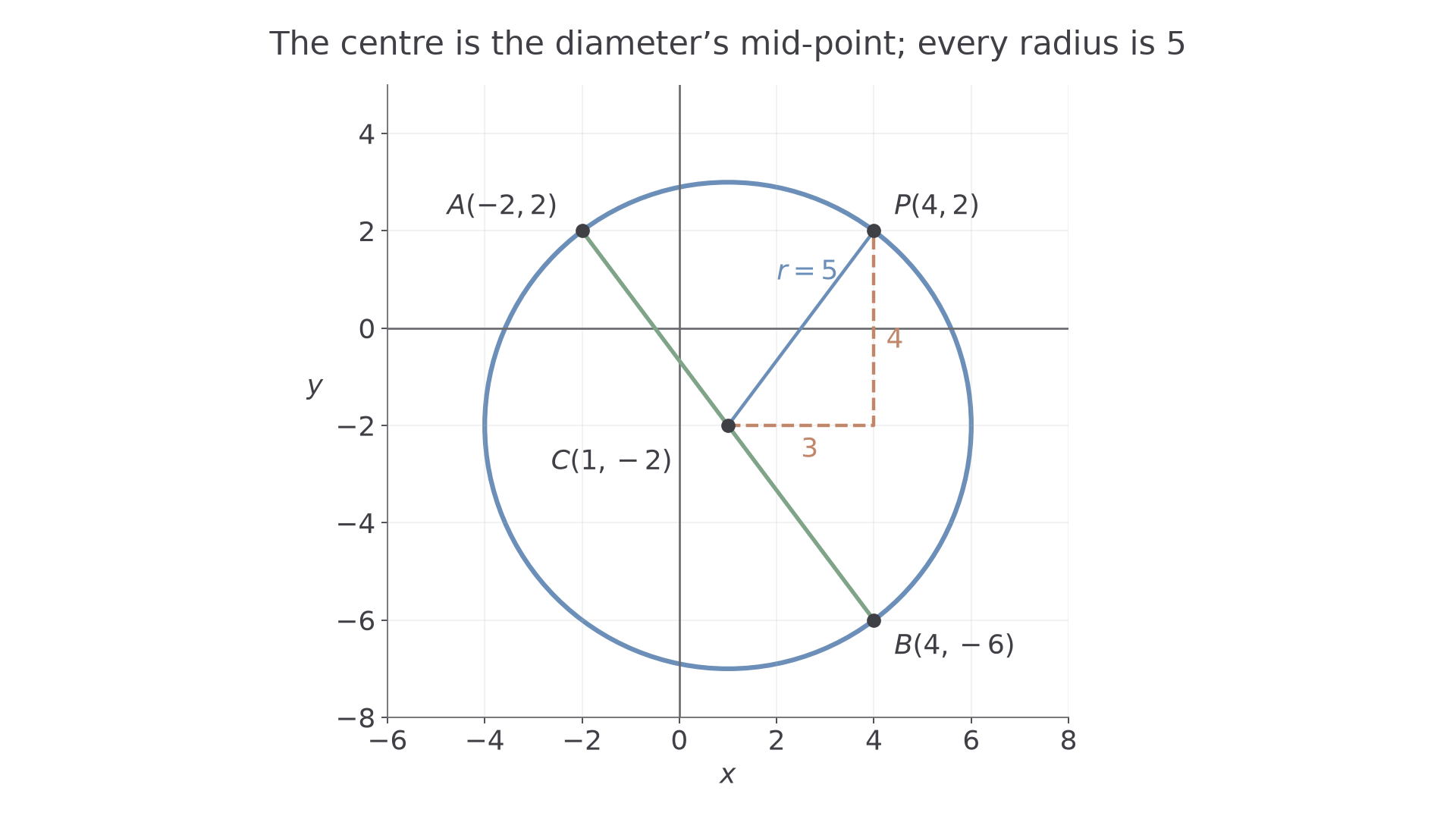
[DIAGRAM: asset_name: A circle from a radius or a diameter; asset_slug: cg19-circle-centre; caption: The same circle can be defined by its centre and a point or by the endpoints of a diameter; description: The circle has centre C at 1 comma minus 2 and radius 5. Diameter endpoints A at minus 2 comma 2 and B at 4 comma minus 6 lie on opposite sides of C. Another radius joins C to P at 4 comma 2, with perpendicular horizontal and vertical changes 3 and 4.]
Worked example 1: a centre and a point
Question. A circle has centre and passes through . Determine its equation.
Plan. Find the squared distance , then place the centre and squared radius in the circle equation.
Why stop at ? The equation needs , not an unnecessary calculation of .
Answer. .
Check. At , , so is on the circle. At the centre, the left-hand side is , so the centre is not on it.
The next example changes how the circle is given: the endpoints of a diameter replace the centre and one point. The diagram shows why the mid-point must come first.
Worked example 2: a diameter determines the circle
Question. and are the ends of a diameter. Determine the circle's equation.
Plan. Find the centre as the mid-point, then use one endpoint to find the squared radius.
Why not use for ? is the diameter, so its squared length is four times the squared radius.
Answer. .
Check. , giving , as required.
Reading a sign as a coordinate is an easy way to put the right circle in the wrong place.
Watch out
Wrong: has centre and radius . Right: its centre is and radius is . The brackets vanish at the centre, and the right-hand side is the radius squared.
Try a new diameter with new coordinates. You can still keep the equation tidy.
Uncovering the centre by completing the square
An expanded equation hides the centre in its linear terms; completing the square brings the geometry back into view.
You already know
Completing the square gives . Apply it separately to the terms and the terms. Keep both corrections.
For example, and . The corrections total , which must be included when the constant is moved to the other side. The completing-square result is not on the formulae sheet: learn it.
Continue this lesson.
You’re previewing NovaLearn without an account. Create a free account to read the rest.
Create free account