PT3, PT4 - Trigonometric identities
Use the tangent ratio and the identity linking squared sine and cosine to find exact values and simplify expressions. You will also prove trigonometric identities by writing a clear chain of valid algebra, with care over any zero denominators.
Two identities from the unit circle
Can you find the exact value of without finding either trigonometric value? The circle says yes: the answer is exactly , however awkward the individual coordinates look.
You already know
The unit-circle point at angle has coordinates . An identity is true for every permitted input; an equation may be true only for particular inputs. The symbol emphasises an identity.
The notation means . It does not mean , or . If the point's coordinates are , Pythagoras gives , even when either coordinate is negative: squaring removes the sign.
[DIAGRAM: asset_name: Pythagoras on the unit circle; asset_slug: identities-unit-circle; caption: Squared horizontal and vertical coordinates add to the squared radius, which is 1; description: A unit circle has a point P in quadrant II with coordinates cosine theta and sine theta. A radius of length 1 joins the origin to P. A dotted horizontal projection and a vertical segment form a right-angled triangle, with the horizontal coordinate negative and the vertical coordinate positive. A right-angle mark is at the foot of the vertical segment. A displayed relation shows cosine squared theta plus sine squared theta equals 1.]
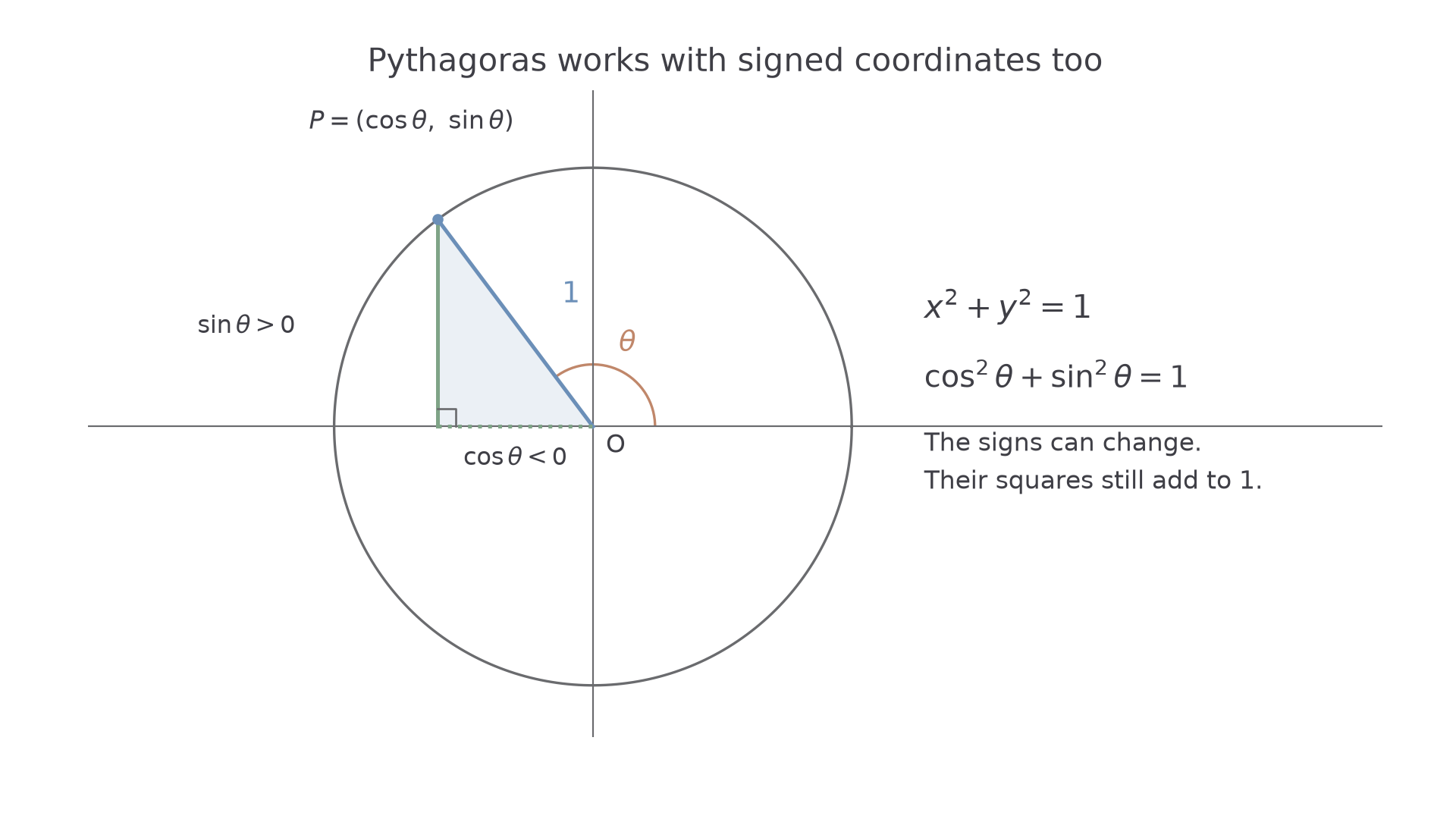
The squared sine and cosine identity
This holds for every angle . Equivalently, and .
Not on the formulae sheet: learn it.
Tangent is vertical coordinate divided by horizontal coordinate. Substituting the names of those coordinates gives the second identity. Unlike the first, it has a restriction because division by zero is undefined.
The tangent identity
This holds where , so for every integer .
Not on the formulae sheet: learn it.
At , the squared identity still reads , but tangent is undefined. “Every permitted input” is doing real work: an identity never makes an undefined expression valid. You may write ordinary equals signs between steps of a proof, then use in its conclusion to emphasise that it holds throughout the domain.
Key idea
The squared identity replaces one squared ratio by the other. The tangent identity converts tangent into a fraction involving only sine and cosine.
Keep a square on the whole ratio in the following diagnostic.
Finding exact ratios with the correct sign
Knowing one trigonometric ratio gives the square of the other through the squared identity; the quadrant decides which square root is correct.
For example, if , then . This gives two algebraic possibilities for cosine, and . The sine value alone does not distinguish quadrants III and IV. An angle interval supplies the missing information.
You already know
In quadrant III, sine and cosine are both negative and tangent is positive. In quadrant IV, sine is negative, cosine positive and tangent negative. The square root symbol itself denotes the non-negative root; the sign comes from the quadrant.
Use the identity before a calculator inverse-trigonometric key. This keeps an exact answer exact and avoids rounding an unnecessary angle.
Worked example 1: cosine in quadrant III
Question. Given that and , find the exact values of and .
Plan. Find cosine squared, choose the negative cosine in quadrant III, then divide sine by cosine.
Why choose the negative root? The given interval puts the unit-circle point left of the vertical axis, so its horizontal coordinate is negative.
Answer. and .
Check. , and the quotient of the two negative coordinates is positive.
The next example changes only the angle interval. The squared calculation stays exactly the same, but the signs change.
Worked example 2: cosine in quadrant IV
Question. Given that and , find the exact values of and .
Plan. Use the same cosine square, choose its positive root in quadrant IV, then find tangent.
Why does the interval matter after squaring? Squaring erases the coordinate's sign; the quadrant restores it.
Answer. and .
Check. The same squared values still add to , while tangent now has quadrant IV's negative sign.
The square on a negative ratio is an especially common place to lose a sign.
Watch out
Wrong: , giving cosine squared greater than . Right: the square is . Only after finding cosine squared do you use the quadrant to choose cosine's sign.
Now change the given ratio, keeping the quadrant IV sign reasoning.
Simplifying by factoring a squared identity
A denominator such as suggests writing a sine square as a difference of two squares, so a whole factor can cancel.
The algebra is familiar: . Here the object can be a trigonometric ratio. Treat or as one complete object, just as you treat in a polynomial fraction. The difference-of-squares factorisation is not on the formulae sheet: learn it.
Problem-solving
Look at the denominator before expanding anything. A factor pairs with ; a factor pairs with .
Cancellation is allowed only when the factor is non-zero. Keep the original denominator restriction even if the simplified expression has a value at the excluded angle.
Worked example 3: a sine square over a cosine factor
Question. Simplify , stating its restriction.
Plan. Replace the numerator using the squared identity, factor, then cancel the non-zero denominator factor.
Why factor rather than cancel individual terms? Only a common multiplicative factor cancels. The numerator does not contain a separate term that can be cancelled against a term inside the denominator's sum.
Answer. , for .
Check. At , the original fraction is , and . At , the original denominator is zero, so that angle remains excluded.
The next example exchanges the roles of sine and cosine. The factorisation is unchanged in shape.
Worked example 4: a cosine square over a sine factor
Question. Simplify , stating its restriction.
Plan. Rewrite cosine squared in terms of sine, factor the difference of squares and cancel.
Why use sine throughout? It creates exactly the same factor as the denominator.
Answer. , for .
Check. At , the original fraction is , agreeing with . The angle stays excluded.
The simplified expression can have a larger natural domain than the original fraction. Equivalence still applies only where the original exists.
Watch out
Wrong: , obtained by crossing out the two terms before cancelling cosine. Terms inside sums cannot be cancelled. Right: factor the complete numerator first, then cancel the whole factor .
Now change the sign in the denominator, and look for its matching factor.
Continue this lesson.
You’re previewing NovaLearn without an account. Create a free account to read the rest.
Create free account